

Most students in the UK will need a guarantor to rent accommodation, but not always. Whether you need one depends on your landlord, how you choose to pay your rent, and the type of accommodation you book. A guarantor is simply someone who agrees to cover your rent if you’re unable to pay it. Landlords ask for this because most students don’t yet have a steady income or credit history. The good news is that if you don’t have a guarantor, there are still several options available to help you secure a place.
What Is a Guarantor for Student Accommodation?
A guarantor is someone who acts as a financial backup for your landlord. They agree to step in and cover costs if you’re unable to meet the terms of your tenancy.
This means they are legally responsible for:
- Your rent if you miss payments
- Any damage to the property beyond your deposit

In most cases, a guarantor signs a formal agreement alongside your tenancy, making their responsibility legally binding. If you’re new to renting, it’s worth understanding how this fits into the wider process of securing a student home, from choosing the right property to signing your contract.
Do You Need a Guarantor for Student Accommodation?
Not always, but in most cases, yes.
Most private landlords and student accommodation providers will ask for a guarantor, especially if you’re renting for the first time. This is mainly because students typically don’t have a steady income or a strong credit history yet.

You’ll usually NEED a guarantor if:
- You’re renting privately (houses or flats)
- You want to pay your rent in monthly or termly instalments
- You don’t have a regular income or credit history
- You’re living in shared student housing with others
You may NOT need a guarantor if:
- You’re staying in university-managed halls
- You pay your rent upfront for the full year
- You book with certain purpose-built student accommodation providers
- You use a paid guarantor service
The exact requirement will vary depending on the provider, so it’s always worth checking the terms before booking. If you’re comparing different types of accommodation, it helps to understand the difference between private lets and PBSA in more detail. See our guides on private student accommodation vs PBSA and what is purpose-built student accommodation.
If you’re currently searching, you can also explore options like student accommodation in Leicester to see which properties may offer more flexible booking requirements.

Why Do Landlords Ask for a Guarantor?
Landlords ask for a guarantor to reduce their financial risk. Renting to students can be less predictable, as most don’t yet have a stable income or established credit history.
For many landlords, the rent from their property helps cover important costs like mortgages, bills, and maintenance. A guarantor gives them added security, knowing that if something goes wrong, there’s someone legally responsible to step in and make the payments.
In simple terms, it’s about peace of mind, ensuring the rent is paid on time, no matter the situation.
Who Can Be a Guarantor?
In most cases, a guarantor is a parent or legal guardian, but it doesn’t have to be. Some landlords will also accept other relatives or even close friends, as long as they meet the required criteria.

Typically, a guarantor must:
- Be over 18
- Be UK-based (in most cases)
- Have a stable income
- Pass a credit check
The key thing landlords look for is financial reliability, someone who can realistically cover the rent if needed.
It’s worth noting that requirements can vary depending on the accommodation provider. Some may accept international guarantors, while others strictly require someone based in the UK. Always check the specific criteria before applying, as each landlord or provider sets their own rules.
What Does a Guarantor Actually Have to Do?
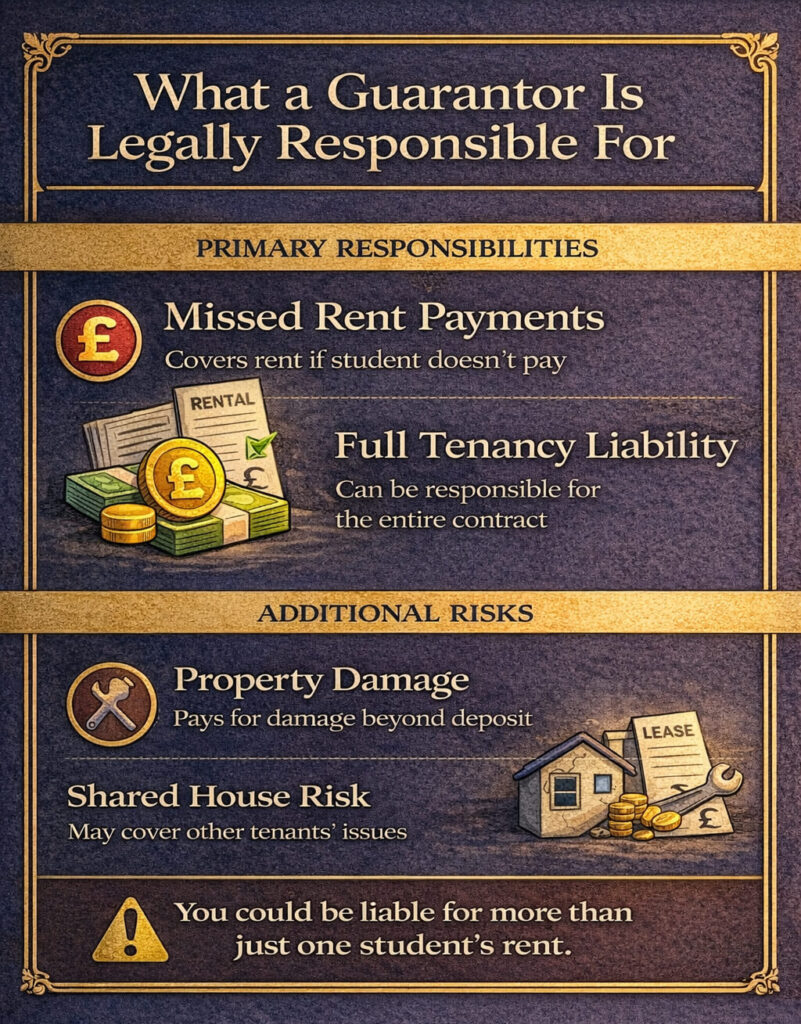
A guarantor’s role is straightforward, but it comes with serious responsibility.
If the tenant can’t meet their obligations, the guarantor is legally required to step in and cover the costs. This typically includes paying rent if any payments are missed, as well as covering damage to the property that isn’t covered by the deposit.
Because this is part of a formal agreement, it is legally binding. If payments aren’t made, landlords can pursue the guarantor directly for the money owed.
One important detail that often gets overlooked is how this works in shared housing. Many student properties use joint tenancy agreements, which means all tenants (and their guarantors) can be held responsible for the full rent, not just one person’s share. In practice, this means a guarantor could be asked to cover more than expected if another tenant defaults.
This is why it’s essential for both students and guarantors to read the tenancy agreement carefully before signing.
Risks of Being (or Using) a Guarantor
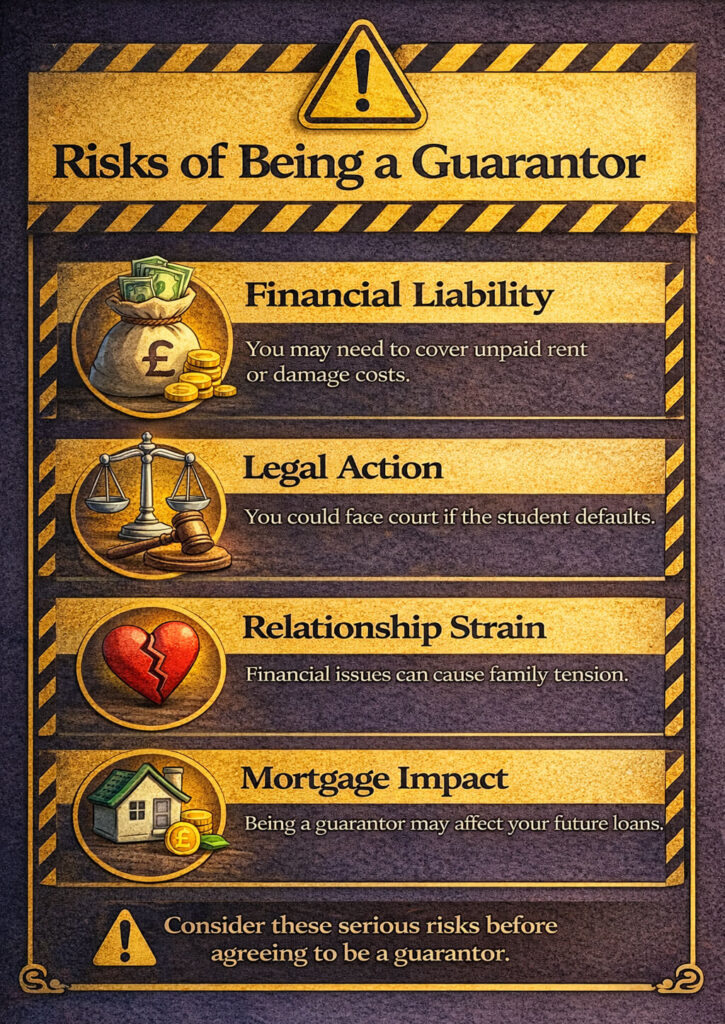
Being a guarantor, or relying on one, comes with real risks that shouldn’t be overlooked.
The biggest is financial liability. If rent isn’t paid or damage costs arise, the guarantor is responsible for covering those costs, which can quickly add up over the course of a tenancy.
There’s also the potential for legal action. Because the agreement is legally binding, landlords can pursue guarantors through formal channels, including the court, if payments aren’t made.
It can also put strain on personal relationships. Mixing finances with family or friends can become difficult if something goes wrong, especially in shared housing situations.
From a financial perspective, acting as a guarantor may also affect things like mortgage applications. Some lenders take these commitments into account when assessing affordability, as there’s a potential obligation to cover rent if the tenant defaults.
What Happens If You Don’t Have a Guarantor?
It can make renting more difficult, but not impossible.
Many landlords and letting agents will reject applications without a guarantor, particularly in private student housing where the financial risk is higher. This is especially common if you’re paying in instalments or don’t have a strong financial background.
That said, not having a guarantor doesn’t mean you’re stuck. There are still several ways to secure accommodation; it just means you may need to explore alternative options or be a bit more flexible with the type of property you choose.
Your Options If You Don’t Have a Guarantor
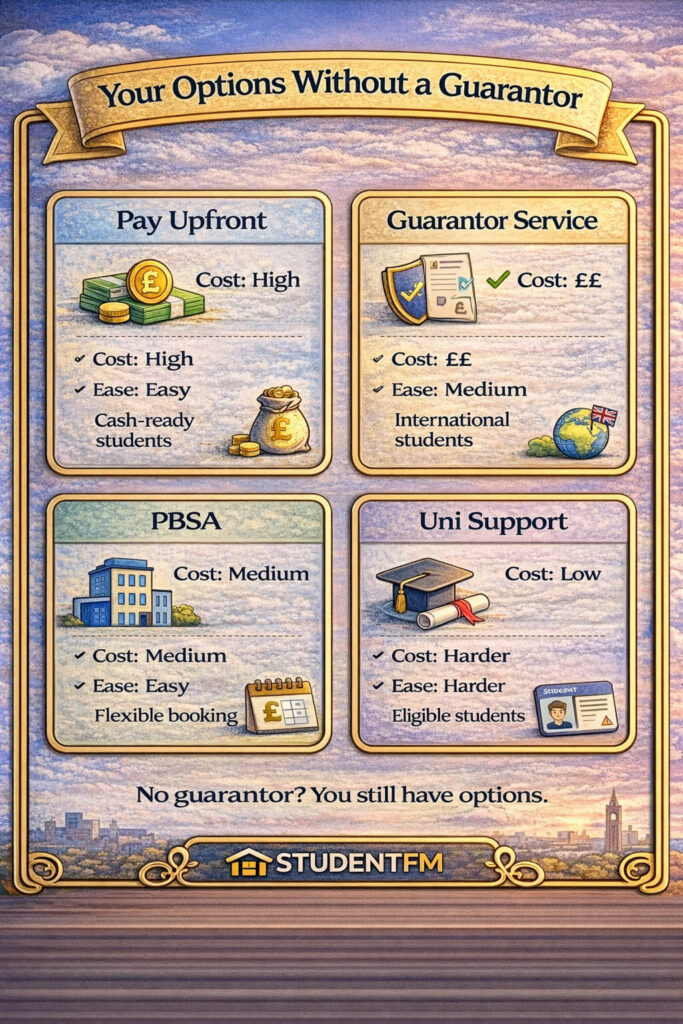
If you don’t have a guarantor, there are still several practical ways to secure student accommodation. Some are more flexible than others, but all are commonly used across the UK.
Option 1: Pay Rent Upfront
One of the most widely accepted alternatives is paying your rent in full at the start of your tenancy, usually 6 to 12 months upfront.
This removes the need for a guarantor entirely, as the landlord already has the full payment secured. The downside is the high upfront cost, so it’s important to plan your finances carefully. You can learn more about managing your budget in our guide to student budgeting in the UK.
Option 2: Use a Guarantor Service
Guarantor services are companies that act as your guarantor for a fee, typically around £300 – £500 per year.
These are especially popular with international students or those who don’t have access to a suitable UK-based guarantor. Once approved, they provide landlords with the same level of security as a personal guarantor.
Option 3: Choose No-Guarantor Accommodation
Some accommodation providers offer options specifically designed for students without a guarantor.
In these cases, you may find:
- Slightly higher rent
- Different payment structures
- Additional eligibility checks
StudentFM, for example, offers flexible options to help students secure accommodation without the traditional guarantor route. You can explore available student accommodation or browse live listings through the property search.
If you’re looking in a specific city, you can also view options for student accommodation in Leicester, Nottingham, or Sheffield.
Option 4: University Support or Schemes
Some universities offer support for students who can’t provide a guarantor, particularly international or estranged students.
This might include:
- Access to approved guarantor schemes
- Financial support or bursaries
- Alternative accommodation options
It’s always worth checking with your university’s accommodation or student services team to see what support is available.
Guarantors for International Students

For international students, finding a guarantor is often one of the biggest challenges when renting in the UK.
Most landlords and accommodation providers require a UK-based guarantor, which can be difficult if your family lives overseas. This is a standard requirement because landlords want someone they can legally pursue within the UK if needed.
If you don’t have a UK guarantor, there are still workable solutions:
- Use a guarantor service: a company acts as your UK guarantor for a fee
- Pay rent upfront: often 6 – 12 months to remove the need for a guarantor
- Choose flexible providers: some accommodation options are designed for international students
If you’re moving to the UK, it’s worth exploring all your options early. You can find more tailored advice in our guide for international students, including accommodation tips and support available to you.
Does Being a Guarantor Affect Credit or Mortgages?
Being a guarantor doesn’t always show up directly on your credit report, but it can still have a potential impact on your finances.
In most cases:
- Simply being a guarantor won’t automatically affect your credit score
- It may not appear as a formal debt unless payments are missed
However, there are important considerations:
- Mortgage lenders may factor it in when assessing affordability
- They can treat it as a potential financial commitment, especially if the rent is high
- If the tenant misses payments and you step in, this could impact your credit profile
In short, it’s not usually an issue, but it can affect borrowing capacity depending on the lender and your financial position.
The key takeaway: being a guarantor is a financial responsibility, not just a formality, so it’s worth considering carefully if you’re planning to apply for a mortgage or other credit soon.
Guarantor vs Paying Upfront: What’s Better?
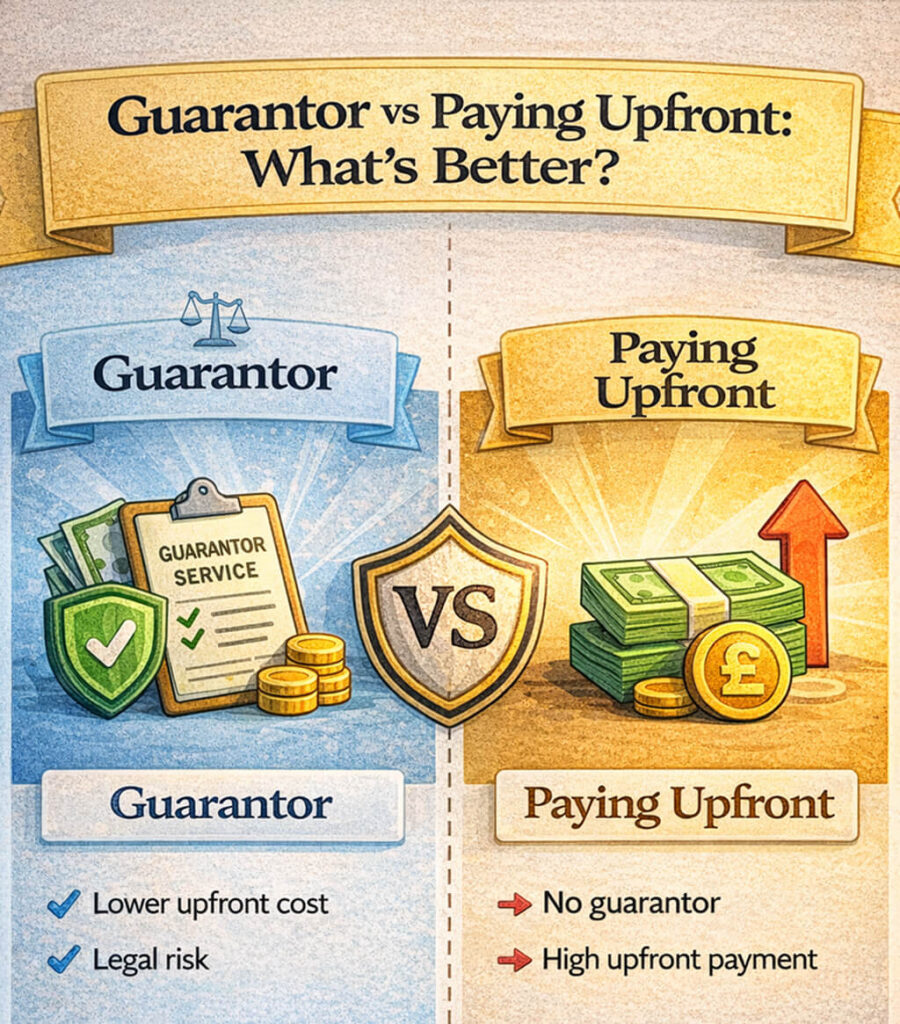
When deciding between using a guarantor or paying rent upfront, it really comes down to cash flow vs risk.
| Option | Pros | Cons |
| Guarantor | lower upfront cost | legal risk |
| Upfront | no guarantor needed | large payment |
How StudentFM Makes Renting Easier
At StudentFM, we understand that not every student has access to a guarantor, and that shouldn’t stop you from securing a great place to live.
That’s why we offer:
- No-guarantor options on selected properties
- Flexible payment solutions to suit different financial situations
- Support for international students, including guidance on alternative options
Whether you’re booking your first room or relocating from overseas, our goal is to make the process as straightforward as possible.
- You can explore available rooms across the UK on ourstudent accommodation page
- Or secure your place today via our book a room page
Finding the right accommodation should feel simple, and with the right support, it is.
FAQs
No, but most do. Many private landlords and letting agents require one, especially if you’re paying in instalments or renting off-campus. However, you may not need a guarantor if you pay rent upfront, use a guarantor service, or book certain PBSA or university-managed accommodation.
Yes, in some cases. A friend can act as a guarantor if they meet the requirements, typically a stable income, strong credit history, and often UK residency. That said, most students use a parent or close family member, as it’s a significant financial responsibility.
Yes, but it can be more difficult. Most UK landlords require a UK-based guarantor. If you don’t have one, you can use a guarantor service, pay rent upfront, or choose accommodation providers that offer no-guarantor options.
If a guarantor doesn’t pass referencing, the landlord may reject your application. In this situation, you’ll usually need to:
Provide an alternative guarantor
Pay rent upfront
Use a guarantor service
It depends on the landlord or provider. Some will allow changes before the tenancy starts, but once the agreement is signed, it’s much harder to switch. Always check the terms before signing to avoid issues later.