
If you’re starting university this year, understanding student budgeting in the UK is no longer optional; it’s essential. With rent rising across most cities and everyday expenses creeping up, accommodation will almost certainly be your biggest outgoing in 2026.

On average, students outside London now spend between £900 – £1,400 per month, while those in the capital can expect closer to £1,400 – £2,000, depending on lifestyle and accommodation type. The good news? Once you break your costs into clear categories, rent, bills, food, transport and social spending, managing your money becomes far more straightforward.
This guide covers everything you need to know about student living costs UK, including the real cost of student accommodation UK 2026, what a realistic monthly student budget UK looks like, and how to avoid the most common financial mistakes students make.
If you’re already looking for somewhere to live, you can explore available options here:
Student Accommodation Across Top UK Cities
Let’s start with the biggest expense of all: rent.

How Much Does Student Accommodation Cost in the UK in 2026?
Accommodation remains the largest part of student living costs UK in 2026. While prices vary by city, contract type and facilities, most students will fall into one of three accommodation categories.
Below is a realistic cost breakdown, including weekly, monthly and annual comparisons to help you plan your monthly student budget UK properly.
University Halls
- £120 – £220 per week
- Usually bills included
- Typically 40 – 51 week contracts
University halls are often the most popular first-year option. They’re run by the university, located close to campus and designed to help students settle into university life.
Cost breakdown example:
| Weekly | Monthly (x4.33) | 40 Weeks | 51 Weeks |
| £120 | ~£520 | £4,800 | £6,120 |
| £180 | ~£780 | £7,200 | £9,180 |
| £220 | ~£950 | £8,800 | £11,220 |
Halls are generally mid-range for pricing, but the all-inclusive nature (utilities, WiFi, security) makes budgeting simpler.
Purpose-Built Student Accommodation (PBSA)
- £140 – £280+ per week
- Modern studios & en-suites
- Premium facilities (gyms, cinema rooms, study spaces)
- Often fully all-inclusive
PBSA developments are privately operated and usually offer higher-spec accommodation — particularly popular in city centres.
If you’re unsure what counts as PBSA, see:
What Is Purpose Built Student Accommodation (PBSA)? A Complete Student Guide
Cost breakdown example:
| Weekly | Monthly | 51 Weeks |
| £150 | ~£650 | £7,650 |
| £220 | ~£950 | £11,220 |
| £280 | ~£1,210 | £14,280 |
Studios will sit at the higher end of this range, especially in major cities.
Shared Student Houses
- £90 – £160 per week (outside London)
- London: £150 – £250+ per week
- Bills sometimes separate
- Usually 48 – 52 week contracts
Shared houses are typically the cheapest option, especially in the second and third years.
Shared Student Accommodation: Pros, Cons & Costs (2026 Guide)
Cost breakdown example (outside London):
| Weekly | Monthly | 51 Weeks |
| £95 | ~£410 | £4,845 |
| £130 | ~£560 | £6,630 |
| £160 | ~£690 | £8,160 |
If bills aren’t included, expect to add £60–£120 per month for utilities, broadband and water.

London vs Non-London Comparison
London carries a noticeable premium.
Typical weekly rent (2026):
- London PBSA Studio: £280 – £400+
- London Shared House: £150 – £250
- Non-London Shared House: £90 – £160
In real terms, that’s often a £300 – £600 monthly difference, which significantly affects your overall student budgeting UK strategy.
Quick Annual Snapshot (Outside London Average)
- Shared house: £5,000 – £7,500 per year
- University halls: £6,000 – £9,000 per year
- PBSA: £7,500 – £12,000+ per year
Understanding these figures early makes it far easier to build a realistic 2026 student budget, which we’ll break down next.
What Does a Realistic Monthly Student Budget Look Like?
When planning your student budgeting UK strategy, it helps to see the numbers clearly laid out. Below is a realistic 2026 monthly estimate comparing students living outside London vs London.

Estimated Monthly Student Budget (2026)
| Category | Outside London | London |
| Rent | £450 – £750 | £750 – £1,200 |
| Food | £120 – £200 | £150 – £250 |
| Utilities (if not incl.) | £40 – £90 | £60 – £120 |
| Transport | £30 – £70 | £100+ |
| Social / Personal | £80 – £200 | £120 – £250 |
| Total | £900 – £1,400 | £1,400 – £2,000 |
These figures align with current student living costs UK research and reflect typical spending patterns across university cities in 2026.
A few key observations:
- Rent remains the largest variable in your cost of student accommodation UK 2026.
- Transport jumps significantly in London.
- Social spending is where budgets most often spiral.
Is £600 Per Month (Excluding Rent) Reasonable?
Short answer: Yes, in most cities outside London, £600 per month, excluding rent, is realistic and manageable.
Here’s why:
Outside London, a typical non-rent breakdown might look like:
- Food: £150
- Utilities: £70
- Transport: £50
- Social & personal: £150
- Miscellaneous / buffer: £100
That totals roughly £520 – £600 per month.
So if your accommodation includes bills and you’re sensible with social spending, £600 is actually a comfortable allowance outside London.
In London, however, £600 excluding rent can feel tighter due to higher transport and social costs. You’d need to budget more carefully, especially if bills aren’t included.
Are You Overthinking It?
If you’re spending well below £600 early in the month, you’re not being reckless; you’re budgeting consciously.
The real test isn’t what you spend in week one, it’s whether:
- You stay within your total monthly cap
- You leave some flexibility for unexpected costs
- You avoid dipping into savings regularly
If those are true, your monthly student budget UK is working.
Next, we’ll look at how to actually build and manage that budget step by step.
What Affects Your Student Living Costs?
Your student living costs UK aren’t fixed. Two students at the same university can have completely different monthly budgets depending on their choices.
Here are the biggest factors that influence your monthly student budget UK in 2026:
City
Location is the single biggest cost driver.

- London can be 40 – 60% more expensive than most UK cities.
- Cities like Leicester, Sheffield, Liverpool or Newcastle are significantly more affordable.
- Smaller towns often mean lower rent and transport costs.
For example, compare prices in student accommodation in Leicester to London, and you’ll immediately see the gap in weekly rent.
Accommodation Type
Where and how you live changes everything:
- University halls: predictable costs, often bills included.
- Purpose-built student accommodation (PBSA): higher rent, premium facilities.
- Shared houses: usually cheaper, but bills may be separate.
- Studios: more privacy, highest cost per person.


Choosing a shared house instead of a studio can easily save £200 – £400 per month.
Contract Length
Not all student contracts are equal.
- 40 – 44 week contracts (common in halls) reduce annual cost.
- 51 – 52 week contracts (common in house shares) mean you pay over summer.
- Some private providers charge premium rates for shorter stays.
Always calculate the total annual cost, not just weekly rent.
Bills Included vs Separate
Bills-inclusive rent simplifies budgeting.
If bills are separate, you’ll need to factor in:
- Gas & electricity
- Water
- Broadband
- TV licence
Outside London, this typically adds £40 – £90 per month per person. In London, it can be higher.
Lifestyle Habits
This is where budgets vary massively.
- Cooking at home vs frequent takeaways
- Nights out every week vs occasional socials
- Gym memberships, subscriptions, shopping
Two students paying the same rent can differ by £200+ per month, depending on lifestyle.
Travel Distance to Campus
Living further out usually means:
- Cheaper rent
- Higher transport costs
In London, especially, transport can exceed £100 per month. In smaller cities, walking or cycling often eliminates this cost entirely.
The Bottom Line
Your cost of student accommodation UK 2026 isn’t just about rent, it’s about the full ecosystem of choices around it.
Understanding these levers is the first step in controlling your student budgeting UK strategy rather than letting costs control you.
Next, we’ll look at how to build a simple, practical student budget that actually works month to month.

How Much Maintenance Loan Covers in 2026
If you’re building a realistic student budgeting UK plan, it’s important to understand what the Maintenance Loan actually covers, and what it doesn’t.
The figures below apply to Student Finance England (SFE) for 2026/27.
Minimum Maintenance Loan (2026/27)
All eligible students receive a basic, non–income–assessed amount:
- Living with parents: £4,013 per year
- Living away from home (outside London): £5,048 per year
- Living away from home (London): £7,039 per year
This is the minimum if the household income is above the threshold for additional support.
Maximum Maintenance Loan (2026/27)
Students from lower-income households (under £25,000 household income) may receive:
- Living with parents: £9,118 per year
- Living away from home (outside London): £10,830 per year
(London rates are higher but vary depending on circumstances.)
What Does That Mean Per Month?
Let’s break this down simply.
Example: Living Away From Home (Outside London)
- Maximum loan: £10,830 per year
- Over a 9-month academic year = approx £1,203 per month
However…
From earlier in this guide, realistic living costs outside London are:
- £900 – £1,400 per month (including rent)
So even at the maximum rate, many students are:
- Just about breaking even
- Or running short, depending on accommodation choice
Now look at students receiving the minimum (£5,048/year):
- That’s approx £561 per month
Which often doesn’t cover rent alone in many cities.
The Gap Between Loan & Real Costs
This is where the pressure builds.
In many cases:
- Rent consumes 50 – 70% of the loan
- Food, transport and bills quickly exceed what remains
- Social and academic costs add further strain
The result?
Most students experience a funding gap between their Maintenance Loan and their actual monthly student budget UK.


Why Many Students Work Part-Time
Because of that gap:
- Over half of UK students now work part-time during term
- Typical earnings: £10 – £12 per hour
- Students can work up to 20 hours per week (international visa rules apply)
Part-time income often covers:
- Food
- Transport
- Social spending
- Unexpected costs
For many, it’s not about luxury spending, it’s about stability.
The Reality in 2026
The Maintenance Loan is designed to contribute towards student living costs UK, not fully cover them in every situation.
Your overall affordability depends on:
- City
- Rent level
- Whether bills are included
- Household income assessment
- Lifestyle spending
That’s why understanding the full picture of the cost of student accommodation UK 2026, not just the loan figure, is essential when planning your budget.
Next, we’ll look at practical ways to stretch your budget further without compromising your student experience.
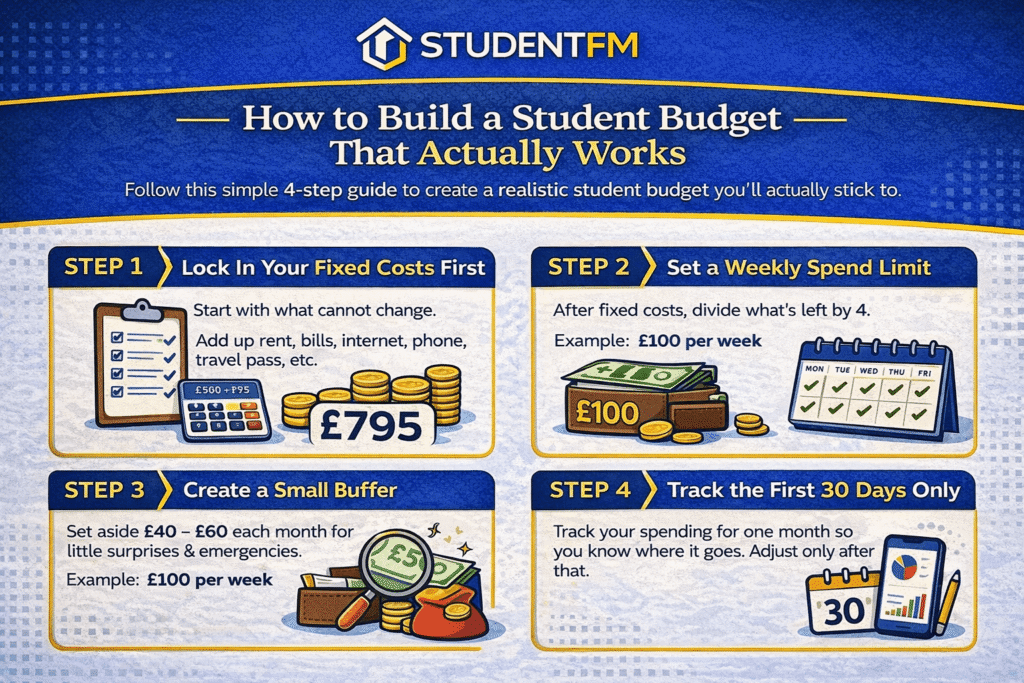
How to Build a Student Budget That Actually Works
Most budgeting advice is either too vague or too extreme.
You don’t need spreadsheets from hell.
You need something realistic you’ll actually follow.
Here’s a simple 4-step structure that works for a proper student budgeting UK plan.
Step 1 – Lock In Your Fixed Costs First
Start with what cannot change.
This includes:
- Rent
- Bills (if not included)
- Internet
- Phone contract
- Travel pass (if you need one)
Add these together first.
Example (outside London):
- Rent: £650
- Bills: £80
- Phone: £15
- Travel: £50
Fixed total = £795
Only once this number is clear can you work out what you actually have left.
This is where accommodation choice makes a huge difference to your overall student living costs UK.
Step 2 – Set a Weekly Spend Limit (Not Monthly)
Monthly budgets feel abstract. Weekly feels real.
Take what’s left after fixed costs and divide by 4.
Example:
- Income: £1,200
- Fixed costs: £795
- Remaining: £405
£405 ÷ 4 = £100 per week
That £100 covers:
- Food
- Coffee
- Nights out
- Takeaways
- Random spending
If you treat it as a weekly cap, you’ll naturally pace yourself.
This single switch stops 90% of overspending.
Step 3 – Create a Small Buffer (£40 – £60 per Month)
This is what most students forget.
Add a line in your budget called:
- “Unexpected”
Set aside £40 – £60 per month.
This covers:
- Society membership
- Replacement headphones
- Prescription costs
- Surprise birthday dinner
- Laundry card top-ups
Without a buffer, small surprises become financial stress.
With a buffer, they’re just part of the plan.
Step 4 – Track the First 30 Days Only
You don’t need to track your spending forever.
Just track it properly for 30 days.
That’s enough time to see:
- Where your money actually goes
- What you underestimate (usually food, takeaways and social spending)
- What you overestimate (often transport or “random extras”)
Most students are surprised by how quickly small purchases add up, £4 here, £9 there, £18 on a “quick” takeaway.
After one month, you’ll have a realistic baseline for your monthly student budget UK. From there, budgeting becomes adjustment, not guesswork.
If you want help tracking:
- Most bank apps now auto-categorise spending
- Budgeting tools like Monzo, Revolut or Emma can give simple breakdowns
- Or just keep a running total in your Notes app
You don’t need spreadsheets or complicated systems.
Clarity beats complexity every time.


The Goal Isn’t Restriction, It’s Control
A good budget:
- Doesn’t stop you from socialising
- Doesn’t make you anxious
- Doesn’t feel like punishment
It simply makes your cost of student accommodation UK 2026 and living expenses predictable.
When your money feels predictable, university feels manageable.
Next, we’ll answer the most common questions students ask about budgeting and accommodation in 2026.

Ways to Reduce Your Student Accommodation Costs
If you’re serious about smart student budgeting UK, reducing your rent is the single biggest win. Accommodation takes up 40 – 60% of most students’ budgets, so even small changes here make a big difference.
Here’s how to lower your cost of student accommodation UK 2026:
1. Book Early
The best-priced rooms go first, especially in popular cities.
Students who start searching between January and March usually get:
- Better weekly rates
- More room type options
- Stronger negotiating position
Leaving it until summer often means paying premium prices for what’s left.
Why You Should Look for Student Accommodation Early
2. Choose Shared Over Studio
Studios are convenient, but they’re also the most expensive option.
Choosing:
- An ensuite room in a shared flat
- Or a shared student house
can save £30 – £80 per week compared to a private studio.
Over a 44-week contract, that’s a potential £1,300 -£3,500 saving.
Compare options:
Ensuite vs Studio: What’s the Best Option for Students?
3. Look Slightly Outside the City Centre
Living 10 – 20 minutes further out can significantly reduce rent.
City centre properties charge a premium for:
- Location
- Nightlife access
- “New build” appeal
Meanwhile, well-connected neighbourhoods often offer:
- Lower rent
- Larger rooms
- Better value overall
Use a location example like:
Student Accommodation in Leicester – Modern Flats, Studios & En‑Suites
to compare central vs outer areas.
4. Consider Bills-Inclusive Properties
Bills-inclusive rent can:
- Protect you from winter energy spikes
- Make budgeting simpler
- Prevent awkward flatmate bill arguments
Sometimes the premium is small (£5 – £15 per week) compared to managing fluctuating utilities yourself.
5. Split Broadband Properly
If bills aren’t included:
- Don’t overpay for ultra-fast packages you don’t need
- Choose one account holder and split evenly
- Use simple bank transfers or shared expense apps
Broadband should rarely exceed £8 – £12 per person per month in a shared house.
6. Avoid Paying for Summer if You’re Going Home
Many private student house contracts run 51 – 52 weeks.
If you’re planning to go home for the summer:
- Look for shorter academic contracts (40 – 44 weeks)
- Or sublet legally where allowed
Paying 8 – 10 weeks of unused rent can cost £700 – £1,200 unnecessarily.
Final Thought
The biggest budgeting mistake students make isn’t coffee or nights out.
It’s overcommitting on rent.
If you control your accommodation cost first, the rest of your student living costs UK become far easier to manage.

Budgeting for First Year vs Second & Third Year
Your monthly student budget UK will look very different depending on which year you’re in.
Many students underestimate how much the structure of accommodation changes after first year.
Here’s what to expect.
First Year: Halls = Higher Weekly Cost, Lower Stress
University halls (or PBSA) often look more expensive per week.
But they’re usually:
- Bills included
- 40 – 44 week contracts
- No utility setup required
- Lower upfront admin hassle
You typically pay:
- Rent (termly or monthly)
- Small deposit or booking fee
- Food + personal spend
There’s less financial admin, which makes halls easier for students adjusting to university life.
That simplicity has value.
Second & Third Year: Lower Rent, More Responsibility
Moving into a shared house can reduce weekly rent, but it introduces new costs and commitments.
Expect:
- 12-month (51 – 52 week) contracts
- Full tenancy deposit (often 1 month’s rent)
- Holding deposit
- Bills setup (gas, electric, water, broadband)
- Possible council tax liability if not all tenants are students
While weekly rent may drop, your annual cost can increase because you’re paying over the summer too.
Upfront Costs to Plan For
Second-year housing often requires more cash upfront than first-year halls.
Budget for:
- Deposit (typically £400 – £700 outside London)
- First month’s rent in advance
- Possible guarantor fees
- Utility setup payments
- Furniture or household basics
This can mean needing £800 – £1,500 available before you even move in.
Planning early avoids panic borrowing.
Practical checklist here:
Moving Into Student Accommodation: The Complete Checklist
The Key Difference
- First year = simpler, more structured.
- Second/third year = cheaper weekly, more complex financially.
When thinking about student budgeting UK long-term, don’t just compare weekly rent, compare:
- Contract length
- Bills
- Deposit size
- Summer payments
That’s where the real cost difference sits.
Frequently Asked Questions
Excluding rent, most students need £400 – £700 per month to cover food, transport, social spending and personal costs.
Including rent, the average total monthly student budget UK in 2026 is:
£900 – £1,200 outside London
£1,300 – £1,800 in London
Your exact figure depends on the city, accommodation type and lifestyle.
Yes, for most students outside London, £600 per month, excluding rent, is realistic and manageable.
This typically covers:
£150 – £250 food
£50 – £100 transport
£100 – £200 social
£50 – £100 misc/personal
In London, £600 is tighter but still possible with disciplined spending.
Not quite twice, but it is significantly more expensive.
On average:
Rent in London is 30 – 60% higher
Transport costs are higher
Social spending tends to rise
Overall, total monthly costs in London are usually £300 – £500 more than in most UK cities.
It depends on the type:
University halls: Usually all-inclusive
Purpose-built student accommodation (PBSA): Almost always all-inclusive
Shared houses: Often separate unless advertised as bills-inclusive
Always check your contract before signing.
You can lower the cost of student accommodation UK 2026 by:
Booking early (more choice + lower prices)
Choosing shared housing instead of a studio
Living slightly outside the city centre
Comparing contract lengths (avoid unnecessary summer rent)
Splitting broadband and utilities properly
Small decisions here can save £1,000+ per year.
Ready to Find Student Accommodation Within Your Budget?
Smart student budgeting UK starts with choosing the right place to live.
Whether you’re looking for halls, shared houses or purpose-built student accommodation, comparing options early helps you stay in control of your monthly student budget UK, and avoid unnecessary costs later.
Start your search:
Plan smart. Book early. Stay within budget.