
Manchester is one of the UK’s most popular student cities, offering a strong mix of leading universities, lively neighbourhoods, cultural attractions, nightlife and employment opportunities. It can also provide better value than several larger UK cities, particularly for students who choose their accommodation carefully and make good use of Manchester’s walkable university areas and public transport network.
However, there is no single cost of living figure that applies to every student in Manchester. Your monthly spending will depend heavily on where you live, the type of accommodation you choose, whether household bills are included in your rent and how often you spend money on transport, takeaways, entertainment and shopping.
Accommodation is normally the largest part of a student budget. A room in a shared house may have a lower advertised rent than university halls or purpose-built student accommodation, but gas, electricity, water, broadband and transport could be charged separately. A room with bills included may appear more expensive at first, yet provide greater certainty and make it easier to plan your spending throughout the academic year.

Students also need to budget for more than rent. Typical living costs can include:
- Groceries and household essentials
- Gas, electricity, water and broadband
- Bus, tram or rail travel
- Mobile phone costs
- Laundry and personal care
- Course materials and printing
- Social activities and eating out
- Deposits, advance rent and moving-in essentials
- Emergency and unexpected expenses
This guide is designed for first-year students, returning undergraduates, postgraduates and international students who want a realistic picture of how much it may cost to live in Manchester in 2026. It will compare different accommodation options, neighbourhoods and lifestyles, while also explaining the first-month and hidden expenses that are often missing from basic student budget calculations.
The figures throughout this guide should be treated as realistic planning estimates rather than fixed prices. Actual costs will vary according to your tenancy, contract length, household size, university location and personal lifestyle. Where accommodation prices are discussed, the guide will also make clear whether figures are weekly or monthly, per person or per household, and whether bills are included.
Students who are still comparing where to live can explore student accommodation in Manchester or read our guide to finding your best option for student accommodation in Manchester.
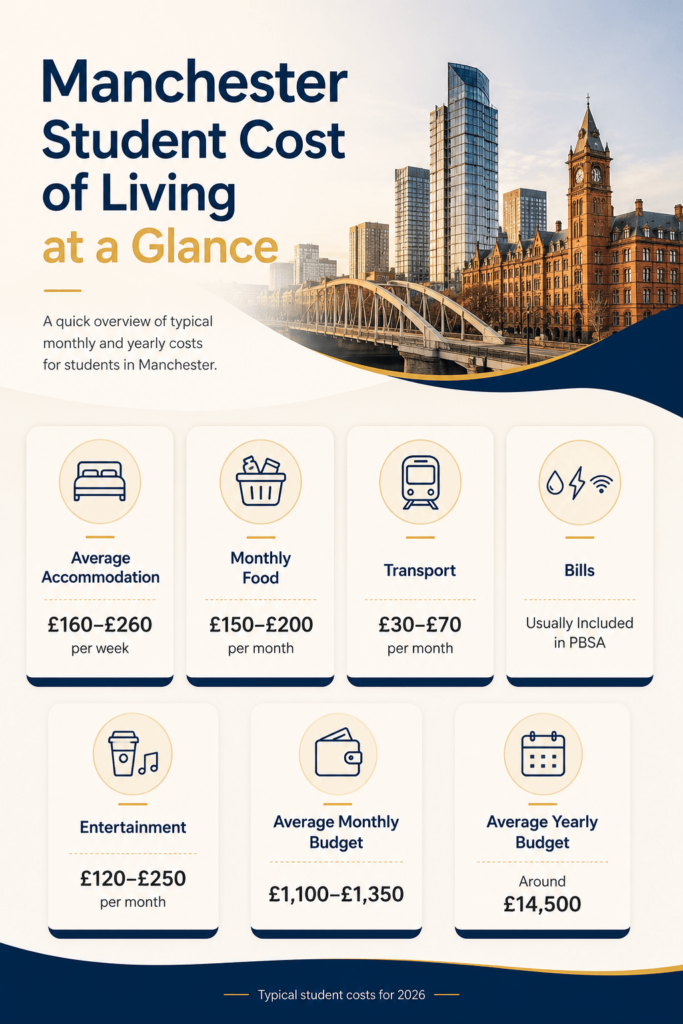
How Much Does It Cost to Live in Manchester as a Student?
Most students in Manchester should plan to spend around £900 to £1,350 per month, although students choosing premium accommodation or a more expensive lifestyle may spend £1,450 to £1,900 or more.
The amount you need will depend mainly on:
- The type and location of your accommodation
- Whether utility bills are included in your rent
- How often you use public transport
- Whether you cook or regularly buy takeaways
- How much you spend on nightlife, shopping and entertainment
- Your accommodation contract length
Rent will usually be your largest expense. Students living in a shared house or lower-cost room may be able to keep their budget close to £900 per month. Students choosing an en-suite room, studio or central accommodation will generally need more.
The following examples provide a useful starting point.
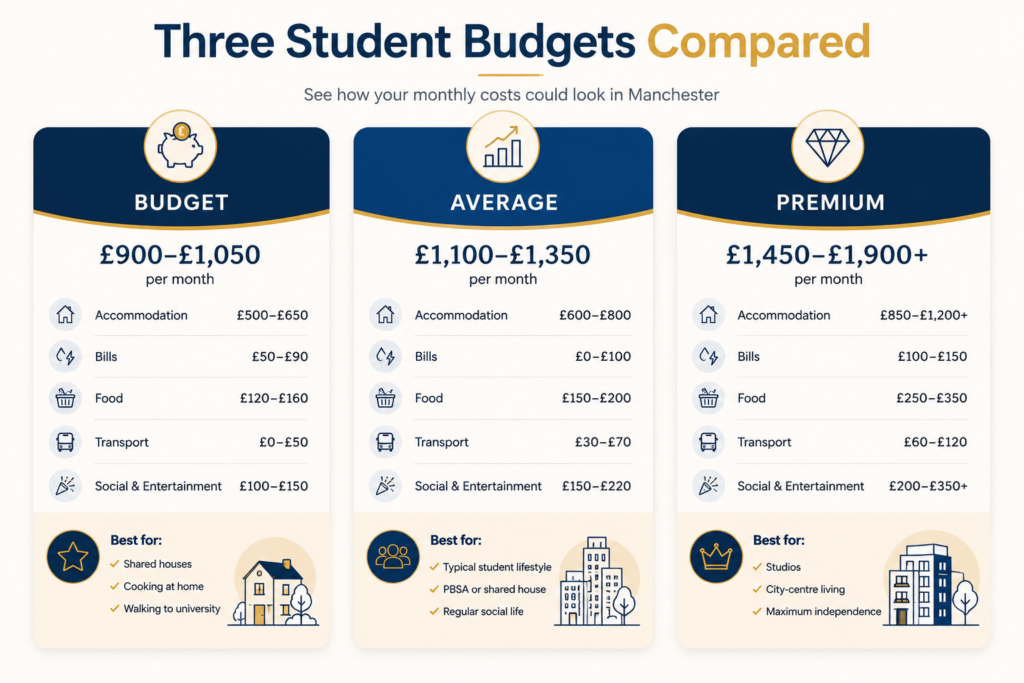
Budget Student: £900 – £1,050 per Month
A budget-conscious student may be able to live in Manchester for approximately £900 to £1,050 per month.
This budget is most realistic for someone who:
- Lives in an affordable shared house or lower-cost student room
- Shares utility bills with several housemates
- Cooks most meals at home
- Shops mainly at budget supermarkets
- Walks or cycles to university where possible
- Limits takeaways, taxis and paid entertainment
- Uses student discounts and free university facilities
A possible monthly budget could look like this:
| Expense | Estimated monthly cost |
| Accommodation | £500 – £650 |
| Bills | £50 – £90 |
| Groceries | £120 – £160 |
| Transport | £0 – £50 |
| Mobile phone | £10 – £20 |
| Social and personal spending | £100 – £150 |
| Course and miscellaneous costs | £30 – £50 |
| Estimated total | £900 – £1,050 |
Living within this range may require careful planning, particularly if rent is near the top of the estimate. There may also be less room for unexpected costs, trips home or frequent nights out.
Students considering lower-cost accommodation should compare the total cost, rather than looking only at the advertised weekly rent. A cheaper room with separate energy, water, broadband and transport costs may not always provide better overall value.
Typical Student: £1,100 – £1,350 per Month
A more typical Manchester student budget is approximately £1,100 to £1,350 per month.
This range may suit someone who:
- Lives in a shared house, university halls or an en-suite room
- Has some or all household bills included
- Cooks regularly but occasionally eats out or orders takeaway
- Uses buses or other public transport when needed
- Has a moderate social budget
- Pays for a few subscriptions, activities or society memberships
- Keeps a small allowance for unexpected expenses
A typical monthly budget may include:
| Expense | Estimated monthly cost |
| Accommodation | £600 – £800 |
| Bills | £0 – £100 |
| Groceries | £150 – £200 |
| Transport | £30 – £70 |
| Mobile phone | £10 – £25 |
| Social and personal spending | £150 – £220 |
| Course and miscellaneous costs | £40 – £70 |
| Estimated total | £1,100 – £1,350 |
This range gives students more flexibility than the lowest budget. It may allow for occasional meals out, regular social activities and a modest emergency buffer without requiring every purchase to be tightly controlled.
Students should still check whether their rent includes utilities, broadband, contents insurance and access to communal facilities. Understanding what is included in student accommodation makes it much easier to compare the true cost of different rooms.
Premium Lifestyle: £1,450 – £1,900+ per Month
Students choosing premium accommodation or spending more frequently on convenience and entertainment may need approximately £1,450 to £1,900 or more per month.
This budget may apply to someone who:
- Rents a private studio or premium city-centre room
- Prioritises privacy and additional facilities
- Eats out or orders takeaway regularly
- Uses taxis, buses, trams or trains frequently
- Pays for a gym, memberships and several subscriptions
- Spends more on shopping, nightlife, concerts or weekend travel
- Maintains a larger personal and emergency allowance
An example premium monthly budget could look like this:
| Expense | Estimated monthly cost |
| Accommodation | £850 – £1,200+ |
| Bills | £0 – £150 |
| Groceries and eating out | £250 – £350 |
| Transport | £60 – £120 |
| Mobile phone and subscriptions | £30 – £70 |
| Social and personal spending | £200 – £350+ |
| Course and miscellaneous costs | £50 – £100 |
| Estimated total | £1,450 – £1,900+ |
A higher budget does not necessarily mean careless spending. Some students pay more because they prefer a studio, need a particular location or want accommodation with additional facilities and all-inclusive bills.
Students comparing room types can read our guide to en-suite versus studio student accommodation or explore current student accommodation in Manchester.
These examples are intended as realistic planning ranges rather than guaranteed totals. Your actual spending will depend on your rent, contract length, household arrangements and lifestyle. It is also sensible to keep first-month expenses and emergency savings separate from your normal monthly budget.
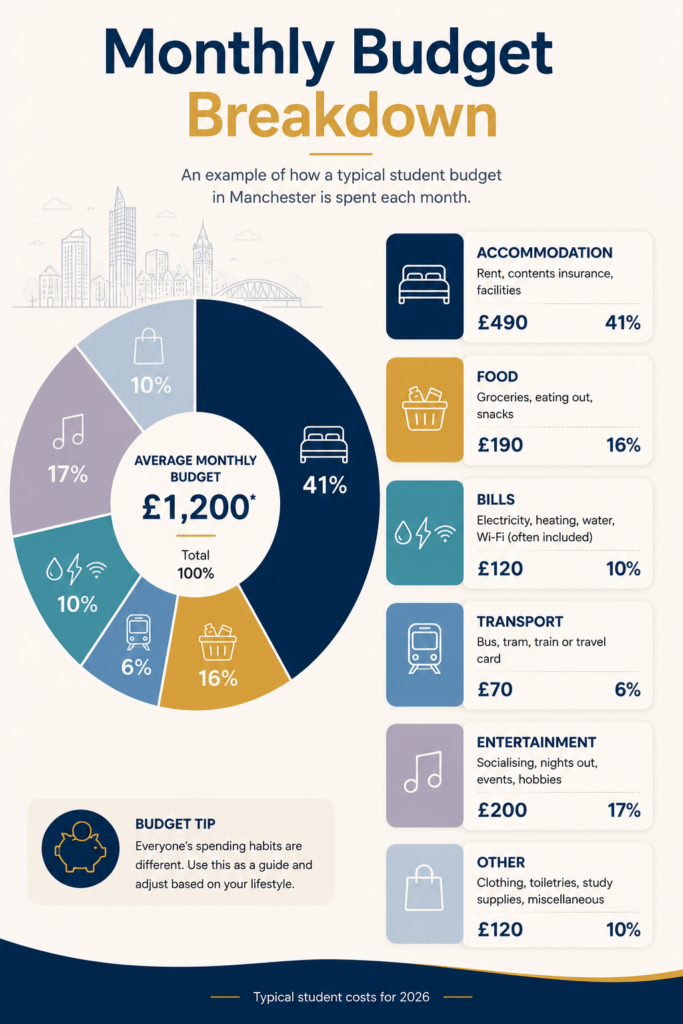
Monthly Student Budget Breakdown
Planning a monthly budget is one of the easiest ways to avoid running out of money before the end of term. While every student’s spending habits are different, most living costs fall into the same core categories. Understanding how much to allocate to each area will help you compare accommodation options, manage your maintenance loan more effectively and prepare for unexpected expenses throughout the academic year.
The table below shows realistic monthly spending estimates for a typical student living in Manchester during 2026.
| Monthly Expense | Typical Monthly Cost |
| Accommodation | £600 – £800 |
| Bills (if not included) | £0 – £100 |
| Food & Groceries | £150 – £200 |
| Transport | £30 – £70 |
| Mobile Phone | £10 – £25 |
| Course Materials & Printing | £20 – £50 |
| Entertainment & Socialising | £120 – £220 |
| Gym & Fitness | £0 – £40 |
| Shopping & Personal Care | £50 – £120 |
| Emergency & Unexpected Spending | £30 – £75 |
| Estimated Monthly Total | £1,100 – £1,350 |
Accommodation
Accommodation is usually your biggest monthly expense and can account for more than half of your total budget. The amount you pay depends on the type of room you choose, where it is located and whether your rent includes household bills.
Bills
Students renting private shared houses may need to budget separately for gas, electricity, water, broadband and sometimes contents insurance. Many purpose-built student accommodation (PBSA) buildings include these costs within the weekly rent, making monthly budgeting much simpler.
Food
Most students spend between £150 and £200 per month on groceries when cooking at home regularly. Eating out frequently or ordering multiple takeaways each week can increase this figure significantly.
Transport
Manchester has excellent public transport through buses, trams and trains, although many students living close to campus can walk or cycle to university, reducing travel costs considerably.
Mobile Phone
SIM-only contracts mean many students spend relatively little on their phone bill, with most paying between £10 and £25 per month.
Course Costs
Printing, stationery, specialist equipment, software subscriptions and course materials can vary depending on your degree. Some months may have very few academic costs, while others require purchasing textbooks or project materials.
Entertainment
This category covers nights out, cinema trips, meals with friends, coffee, streaming subscriptions and other leisure activities. It is often the easiest area to adjust when trying to save money.
Gym
Many universities offer discounted student gym memberships, while some accommodation providers include access to an on-site gym at no additional cost. Your monthly fitness budget may therefore range from nothing to around £40.
Shopping
Clothing, toiletries, haircuts and other personal purchases are often overlooked when planning a budget. Setting aside a small monthly allowance can help avoid unexpected overspending.
Emergency Spending
Unexpected expenses are almost inevitable during the academic year, whether it’s replacing a broken laptop charger, paying for medical prescriptions, travelling home unexpectedly or covering other one-off costs. Keeping a small emergency fund each month provides valuable financial flexibility.
Overall, a realistic monthly budget for most students in Manchester falls between £1,100 and £1,350, although careful budgeting can reduce this, while premium accommodation and lifestyle choices may increase it.
For more practical budgeting advice, including saving strategies, maintenance loans and managing your money throughout the academic year, read our guide to Student Budgeting UK: Complete Cost Guide.
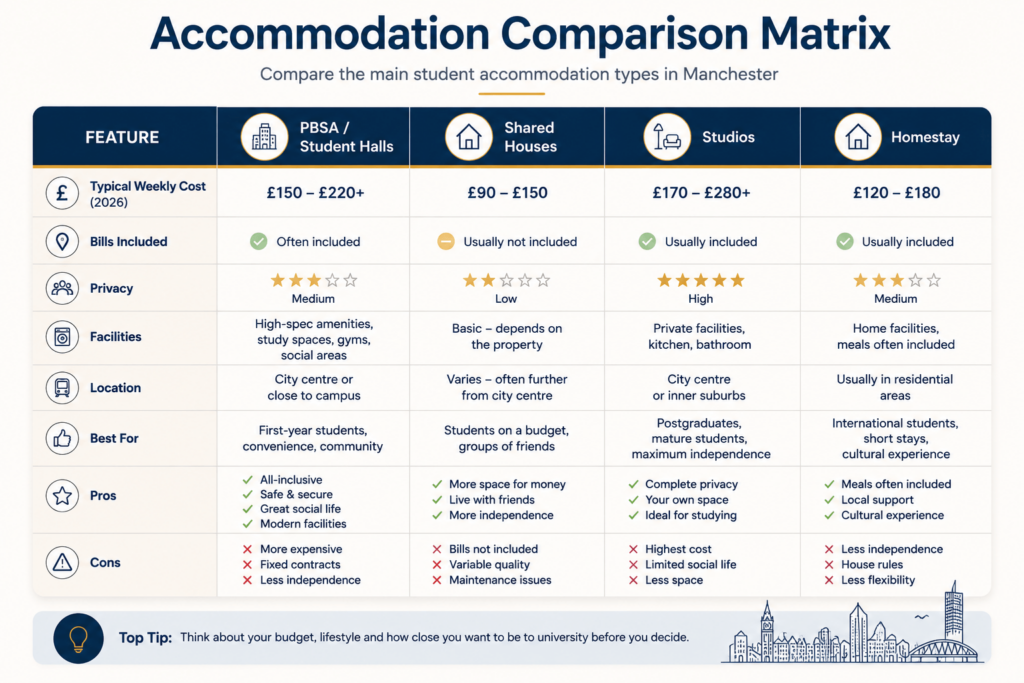
Student Accommodation Costs in Manchester
Accommodation will usually be the largest expense in a student’s budget, often accounting for more than half of their monthly living costs. The type of accommodation you choose will have a significant impact on not only how much you pay each week, but also whether your rent includes bills, how much privacy you have and the overall student experience.
Manchester offers a wide range of accommodation options to suit different budgets and lifestyles. These include traditional university halls, purpose-built student accommodation (PBSA), shared student houses, private studios and one-bedroom apartments. Each option has its own advantages, and the cheapest advertised weekly rent is not always the lowest overall cost once utility bills, internet and transport are taken into account.
Below are typical weekly accommodation costs for students living in Manchester during 2026.
| Accommodation Type | Typical Weekly Rent |
| University Halls | £140 – £220 |
| Purpose-Built Student Accommodation (PBSA) | £160 – £260 |
| Shared Student House | £110 – £180 |
| Private Studio | £220 – £350+ |
| One-Bed Apartment | £275 – £450+ |
These figures represent realistic averages across Manchester and will vary depending on location, room size, facilities, contract length and whether utility bills are included.

University Halls
University halls are often the first choice for first-year students. They provide a ready-made student community, organised social events and are usually located within easy reach of campus.
Many university halls include utility bills within the rent, making budgeting much easier. They are particularly well suited to students moving away from home for the first time who want a sociable environment and the reassurance of university-managed accommodation.

Purpose-Built Student Accommodation (PBSA)
Purpose-built student accommodation has become one of the most popular choices in Manchester. Modern PBSA developments typically include en-suite rooms, studios, study spaces, communal lounges, high-speed Wi-Fi, on-site gyms, laundry facilities and secure access.
Although the weekly rent is often higher than a shared house, many PBSA buildings include gas, electricity, water, broadband and contents insurance within the price. This can make budgeting much more predictable throughout the academic year and reduce the risk of unexpected bills.
PBSA is particularly suitable for students who want modern facilities, additional security, maintenance support and an all-inclusive living experience.

Shared Student Houses
Shared houses remain one of the most affordable accommodation options, particularly for second and third-year students who already have a friendship group.
Rent is generally lower than purpose-built accommodation, but tenants often need to organise and pay household bills separately. This means the advertised weekly rent does not always reflect the true monthly cost of living.
Shared houses are often best suited to students who are comfortable sharing responsibilities such as utilities, cleaning and household management.

Private Studios
Private studios provide complete independence, combining a bedroom, kitchen and living space within a single self-contained apartment.
Studios are usually one of the more expensive student accommodation options but offer significantly greater privacy. Many students choose a studio during their postgraduate studies or final year when they require a quieter environment for studying.
One-Bed Apartments
One-bedroom apartments offer the greatest level of independence but also tend to be the most expensive option available.
Unlike most student accommodation, private apartments may require tenants to arrange utility accounts, broadband and council tax exemptions themselves. They are generally most suitable for mature students, postgraduate students or couples who prefer living independently.
Accommodation Comparison
| Accommodation Type | Average Weekly Cost | Bills Included? | Privacy | Social Life | Best For |
| University Halls | £140 – £220 | Usually | ⭐⭐⭐ | ⭐⭐⭐⭐⭐ | First-year students |
| Purpose-Built Student Accommodation (PBSA) | Purpose-Built Student Accommodation (PBSA) | Usually | ⭐⭐⭐⭐ | ⭐⭐⭐⭐ | Students wanting modern facilities and simple budgeting |
| Shared Student House | £110 – £180 | Sometimes | ⭐⭐⭐ | ⭐⭐⭐⭐ | Second and third-year students looking to reduce costs |
| Private Studio | £220 – £350+ | Usually | ⭐⭐⭐⭐⭐ | ⭐⭐ | Students wanting maximum privacy and independence |
| One-Bed Apartment | £275 – £450+ | Rarely | ⭐⭐⭐⭐⭐ | ⭐ | Mature students, postgraduates and couples |
When comparing accommodation, it’s important to look beyond the weekly rent alone. A room costing £165 per week with all bills included may represent better overall value than a £135 room that requires separate payments for electricity, gas, water, broadband and transport.
Students should also consider location, walking distance to campus, contract length, on-site facilities, security, maintenance support and communal spaces before making a decision. Choosing the right accommodation can have a significant impact on both your monthly budget and your overall university experience.
If you’re still deciding which option is right for you, browse our available student accommodation in Manchester, compare the differences between private student accommodation and PBSA, or learn more about shared student accommodation.
You may also find these guides useful:
- En-suite vs Studio Student Accommodation
- What’s Included in Student Accommodation UK?
- What is Purpose Built Student Accommodation?
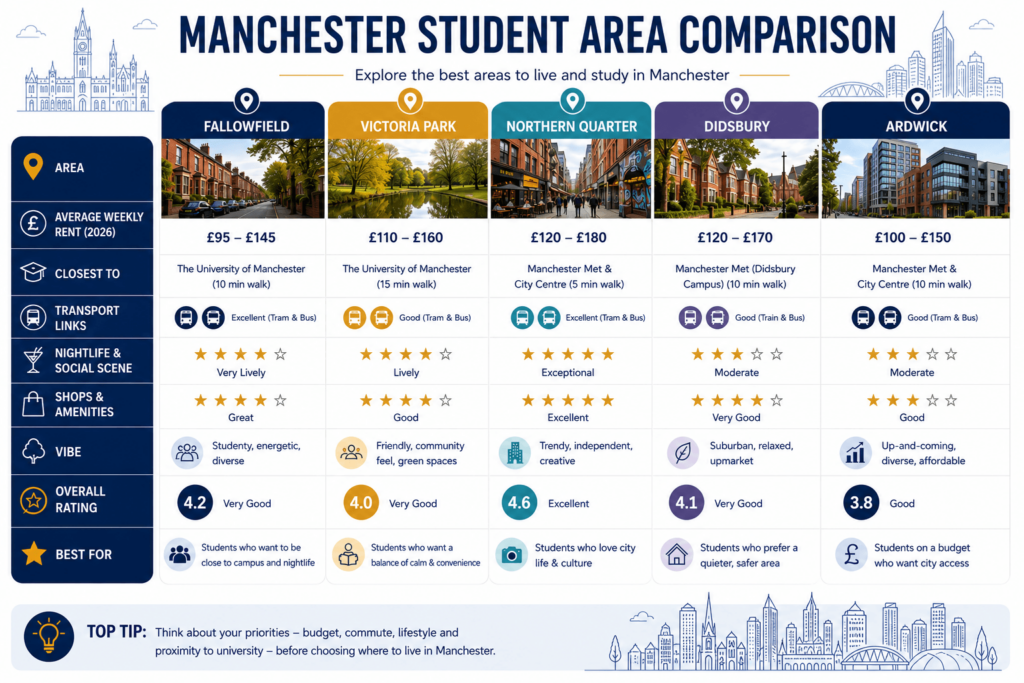
Which Areas of Manchester are Cheapest for Students?
Choosing the right area to live in can have just as much impact on your budget as choosing the right type of accommodation. While weekly rent is important, students should also consider travel costs, walking distance to campus, local amenities, supermarkets, safety and the overall student community.
Many of Manchester’s most popular student neighbourhoods are located close to the University of Manchester and Manchester Metropolitan University, allowing students to save money by walking or cycling instead of relying on public transport.
Below are some of the most popular student areas in Manchester and what you can typically expect to pay.
| Area | Typical Weekly Rent | Approx. Walk to University | Best For |
| Fallowfield | £130 – £190 | 20 – 35 minutes | Social student life and shared houses |
| Rusholme | £120 – £180 | 15 – 25 minutes | Affordable accommodation and restaurants |
| Withington | £125 – £185 | 25 – 40 minutes | Quieter student living |
| Victoria Park | £150 – £230 | 10 – 20 minutes | Purpose-built accommodation and university access |
| City Centre | £180 – £320+ | 10 – 25 minutes | Modern apartments and city lifestyle |
| Salford | £140 – £220 | 20 – 35 minutes | Good value close to the city |
| Good value close to the city | £170 – £260 | 0 – 15 minutes | Students wanting to live close to campus |
Fallowfield
Fallowfield has long been regarded as one of Manchester’s best-known student neighbourhoods. It offers a huge selection of shared student houses, independent cafés, pubs, supermarkets and takeaways, creating a lively atmosphere throughout the academic year.

Pros
- Large student community
- Wide choice of affordable shared houses
- Plenty of shops, bars and restaurants
- Good bus connections into the city centre
Cons
- Can be noisy during term time
- Popular properties are booked early
- Slightly longer walk to campus
Rusholme
Located between Fallowfield and the university campus, Rusholme is particularly popular with students looking to balance affordability with convenience. It is famous for its Curry Mile and offers a wide range of budget-friendly food options.

Pros
- Lower average rents
- Excellent food choices
- Easy walk or cycle to university
- Good transport links
Cons
- Busy main roads
- Limited availability during peak booking season
Withington
Withington offers a slightly quieter atmosphere while remaining popular with students. The area has plenty of cafés, supermarkets and local shops, making it a good choice for students who want a more relaxed environment.
Pros
- Generally good value for money
- Friendly neighbourhood feel
- Good local amenities
Cons
- Longer commute for some campuses
- Smaller student population than Fallowfield
Victoria Park
Victoria Park sits close to both major universities and contains a mix of university residences, purpose-built student accommodation and private housing.
Pros
- Close to university campuses
- Many modern accommodation options
- Walking distance to lectures
- Attractive residential streets
Cons
- Higher rents than some surrounding areas
- Premium accommodation fills quickly
City Centre
Living in Manchester city centre offers excellent access to shopping, restaurants, nightlife and transport. Many modern student apartment buildings are located here, although they usually come with higher weekly rents.

Pros
- Everything within walking distance
- Modern accommodation
- Excellent transport connections
- Vibrant city lifestyle
Cons
- Highest accommodation costs
- More expensive cafés, restaurants and entertainment
- Greater demand for premium accommodation
Salford
Salford has become increasingly popular with students thanks to continued regeneration and relatively competitive rental prices. It provides good access to Manchester city centre while often offering better value than central Manchester itself.
Pros
- Competitive rental prices
- Modern developments
- Good transport links
- Close to both universities and MediaCity
Cons
- Some areas are less student-focused
- Walking distances vary depending on location
Oxford Road
Oxford Road runs through the heart of Manchester’s university district and is home to many university buildings, libraries and student facilities. Living nearby offers one of the shortest commutes available.

Pros
- Extremely close to lectures
- Easy access to university facilities
- Excellent public transport
- Strong student community
Cons
- Higher demand for accommodation
- Premium prices for rooms close to campus
- Busy throughout the academic year
Which Area Offers the Best Value?
Students looking for the lowest accommodation costs often choose Rusholme, Withington or Fallowfield, particularly if they are happy living in a shared house.
Those who want to minimise commuting time may prefer Victoria Park or Oxford Road, while students seeking modern accommodation and city-centre living may find the additional cost worthwhile.
The best area ultimately depends on your priorities. Paying slightly more to live within walking distance of university can sometimes reduce transport costs enough to offset the higher rent, while accommodation with bills included can make budgeting much easier throughout the year.
If you’re comparing neighbourhoods, our upcoming guide to Best Student Areas in Manchester will explore each location in greater detail. You can also read How to Choose the Perfect Accommodation in Manchester for practical advice on finding the right property for your budget and lifestyle.
Bills Explained
When comparing student accommodation in Manchester, it’s important to understand exactly what is included in your rent. Two rooms may appear to have very different weekly prices, but once utility bills are added, the total monthly cost can be surprisingly similar.
Students living in purpose-built student accommodation (PBSA) often benefit from an all-inclusive rent, while those renting a private shared house usually need to budget separately for household bills.
Utilities (Gas and Electricity)
Gas and electricity are two of the largest household bills for students living in private accommodation. Heating costs can increase significantly during the winter months, particularly in older properties with poor insulation.
In a shared house, these costs are normally divided equally between all tenants, so the amount each person pays will depend on both energy prices and how much the household uses.
Most PBSA providers include gas and electricity within the rent, meaning students don’t need to worry about setting up accounts or unexpected energy bills.
Internet and Broadband
Reliable broadband is essential for university work, streaming and keeping in touch with family and friends.
Students living in shared houses often need to arrange a broadband package themselves and split the monthly cost with housemates.
In contrast, most modern PBSA developments include high-speed Wi-Fi throughout the building at no additional cost.
Water
Water charges are another household expense that students renting privately may need to pay.
Like other utilities, the cost is usually shared between everyone living in the property. Many students overlook this expense when comparing advertised rents.
Most purpose-built student accommodation includes water charges within the weekly rent.
Contents Insurance
Contents insurance protects your personal belongings against theft, fire or accidental damage.
Many PBSA providers include basic contents insurance as part of the accommodation package, while students living in shared houses may need to arrange their own policy if they want cover for laptops, phones, bicycles and other valuables.
Always check exactly what level of cover is included before assuming you’re fully protected.
TV Licence
If you watch or record live television broadcasts or use BBC iPlayer, you may legally require a TV Licence.
Many students using only subscription streaming services such as Netflix or Disney+ without watching live television may not need one, although it’s important to check the current licensing rules before deciding.
The cost can usually be shared between housemates if a single licence covers the property.
Council Tax
The good news is that most full-time students do not pay Council Tax.
Properties occupied entirely by full-time students are generally exempt, although students may need to provide exemption certificates from their university.
If someone living in the property is not a full-time student, different rules may apply, so it’s worth checking before signing a tenancy agreement.
Why Many PBSA Students Pay Nothing Extra
One of the biggest advantages of purpose-built student accommodation is the simplicity of budgeting.
In many PBSA buildings, your weekly rent already includes:
- Gas and electricity
- Water
- High-speed broadband
- Contents insurance
- Building maintenance
- On-site facilities such as study areas, communal lounges and sometimes gyms
Because these costs are bundled into one payment, students know exactly how much accommodation will cost each month without worrying about fluctuating utility prices or organising multiple household accounts.
How Shared House Bills Work
Students renting a shared house usually pay a lower advertised rent, but there are often additional monthly costs to consider.
These may include:
- Gas
- Electricity
- Water
- Broadband
- Contents insurance
- TV Licence (where required)
Bills are normally divided equally between everyone in the property, although usage can vary throughout the year. Winter heating costs, for example, may increase household spending considerably.
When comparing accommodation, it’s important to calculate the total monthly cost, rather than simply choosing the room with the lowest weekly rent. An all-inclusive room may ultimately provide better value, greater convenience and fewer financial surprises.
To learn more about what’s included in different accommodation types, read our guides to What’s Included in Student Accommodation UK, All Inclusive Student Accommodation and our Moving Into Student Accommodation Checklist.

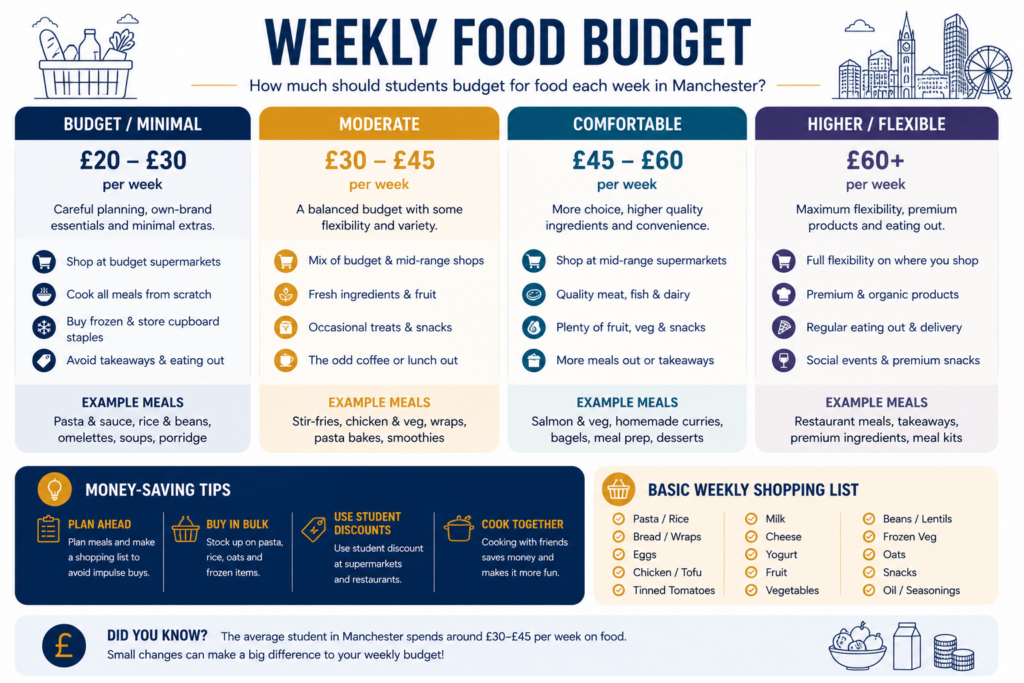
Food Costs
Food is one of the easiest areas of your student budget to control. While accommodation costs are largely fixed once you’ve signed your tenancy agreement, your weekly food spending depends almost entirely on your shopping habits, how often you cook and how frequently you eat out.
Most students in Manchester spend between £35 and £50 per week on groceries when preparing the majority of their meals at home. Students who regularly buy takeaway food, visit coffee shops or eat out several times a week can easily spend double that amount.
Typical Weekly Food Budget
| Expense | Typical Weekly Cost |
| Groceries | £35- £50 |
| Coffee & Drinks | £5 – £20 |
| Takeaways | £10 – £40 |
| Eating Out | £15 – £50 |
| Meal Deals & Snacks | £10 – £20 |
| Typical Weekly Total | £65 – £180 |
Your actual spending will depend on your lifestyle. Some students are happy cooking every evening, while others prefer the convenience of ready meals, cafés and food delivery apps.
Cooking for Yourself
Cooking at home is almost always the most cost-effective option. Preparing simple meals in batches can significantly reduce your weekly spending while also saving time during busy periods of the semester.
Buying supermarket own-brand products, frozen vegetables, rice, pasta and other cupboard staples can keep grocery costs relatively low without compromising on nutrition.
Students who meal prep often find they waste less food and avoid the temptation of expensive last-minute takeaways after lectures.
Takeaways
Manchester offers an enormous choice of takeaway options, from independent restaurants to popular delivery apps.
Although ordering food occasionally can be a nice treat, regular takeaways can quickly become one of the biggest drains on a student budget. Spending just £20 twice a week adds more than £2,000 to your annual living costs.
Many students choose to reserve takeaways for weekends or special occasions while cooking during the week.
Coffee
Buying coffee every morning may seem inexpensive, but the cost adds up surprisingly quickly.
A coffee costing £4 each weekday can total more than £80 per month during term time. Students who invest in a reusable travel mug or make coffee at home can save hundreds of pounds over the course of an academic year.
Of course, cafés remain popular places to meet friends or study, so many students choose to include a modest coffee allowance within their monthly budget.
Eating Out
Manchester has an excellent range of restaurants, street food markets and student-friendly dining options.
Fortunately, many venues offer student discounts, weekday promotions and early evening offers, allowing students to enjoy eating out without overspending. Limiting restaurant visits to once or twice a week can make this category much easier to manage.
Meal Deals and Snacks
Meal deals are convenient between lectures and can be a reasonable value compared with buying individual items separately. However, purchasing them every day soon becomes expensive compared with bringing lunch from home.
Preparing sandwiches, pasta salads or leftovers the night before is often one of the simplest ways to reduce weekly food spending while still eating well.
With a little planning, most students can enjoy a varied diet without exceeding their budget. Small changes, such as cooking more meals at home, reducing food waste and taking advantage of supermarket offers , can save hundreds of pounds over an academic year.
For more ideas, read our guides to Healthy Meal Planning: Easy Recipes for Busy Students and How to Meal Plan for Newbies.
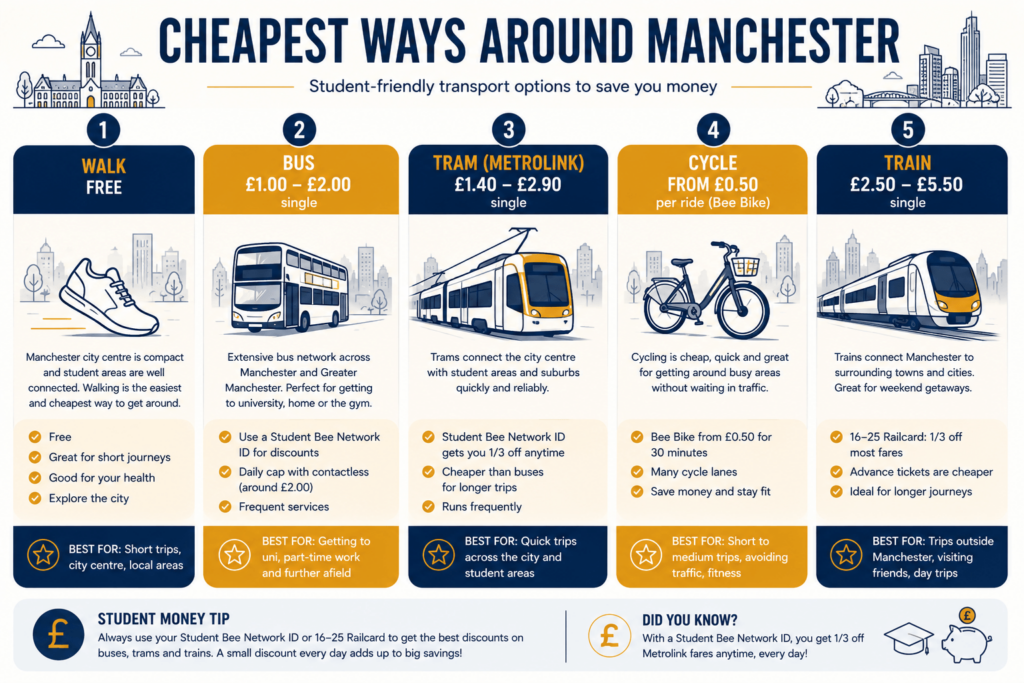
Transport Costs
One of Manchester’s biggest advantages as a student city is that many students spend very little on transport. Both the University of Manchester and Manchester Metropolitan University are located close to popular student neighbourhoods, meaning thousands of students simply walk or cycle to lectures every day.
For those travelling further afield, Manchester has an extensive public transport network including buses, trams and trains, making it easy to travel around the city without owning a car.
Walking
Walking is the most common way for students to get around Manchester.
Areas such as Victoria Park, Oxford Road and parts of the City Centre are all within comfortable walking distance of the main university campuses. Students living in these neighbourhoods often save hundreds of pounds each year by avoiding daily transport costs altogether.

Walking also provides flexibility, removes the need to wait for public transport and can easily fit into a healthy daily routine.
Cycling
Manchester has become increasingly cycle-friendly, with dedicated cycle lanes and improved infrastructure across many parts of the city.
Cycling can significantly reduce commuting times for students living slightly further from campus, particularly those based in Fallowfield, Withington or Salford. Once you’ve purchased a bicycle, ongoing travel costs are minimal compared with using public transport every day.
Many student accommodation buildings also provide secure cycle storage.
Bee Network
The Bee Network is Greater Manchester’s integrated public transport system, bringing together buses, trams, cycling and walking routes under one network.
Students can use the Bee Network to plan journeys, purchase tickets and travel efficiently across Greater Manchester. As more services become integrated, travelling between university, accommodation and part-time work continues to become easier.
Bus
Buses are one of the most affordable ways to travel around Manchester and are particularly useful for students living outside walking distance of campus.
Frequent services operate between popular student areas including Fallowfield, Rusholme, Withington, Salford and the city centre. Many routes run throughout the day and into the evening, making buses a practical option for lectures, work and social activities.
Typical weekly travel costs remain relatively low, especially when using student tickets or season passes.

Tram
Manchester’s Metrolink tram network connects the city centre with many surrounding areas, including MediaCity, Salford Quays, East Manchester and several suburban districts.
Although not every student needs the tram for their daily commute, it provides a fast and reliable option for travelling across Greater Manchester.
Students living near tram stops often find it a convenient alternative to buses during busy periods.
Train
Manchester’s railway stations provide excellent connections across the North West and beyond.
Many students use trains when travelling home during weekends and holidays or commuting from towns outside the city. Booking tickets in advance and using rail discount cards can help reduce travel costs significantly.
Student Discounts
Students can often benefit from discounted travel through student bus passes, railcards and local transport promotions.
Depending on how frequently you travel, purchasing a weekly, monthly or annual pass may work out considerably cheaper than buying individual tickets. It’s always worth checking whether your university or students’ union offers additional travel discounts.
When You Don’t Need Transport
One of the easiest ways to reduce your monthly living costs is to choose accommodation within walking distance of your university.
Many students living around Oxford Road, Victoria Park or nearby areas rarely need to pay for daily transport at all. Even students living in Fallowfield or Rusholme often choose to walk or cycle instead of taking the bus.
When comparing accommodation options, remember that a room costing slightly more each week but allowing you to walk everywhere may actually work out cheaper overall than a lower-priced property requiring daily transport expenses.
For most students in Manchester, transport is one of the smaller living costs, and with careful accommodation choices, it can often be kept to an absolute minimum.
Entertainment & Student Life Budget
University isn’t just about lectures and coursework. Exploring Manchester, meeting new people and making the most of student life are all important parts of the experience. Setting aside a realistic entertainment budget allows you to enjoy everything the city has to offer without putting unnecessary pressure on your finances.
Most students spend between £120 and £250 per month on social activities, although this can vary significantly depending on lifestyle and personal interests.
| Entertainment Expense | Typical Monthly Cost |
| Nights Out | £40 – £100 |
| Coffee & Cafés | £20 – £50 |
| Cinema & Events | £10 – £30 |
| Sport & Fitness | £0 – £40 |
| Student Societies | £10 – £30 |
| Shopping | £40 – £100 |
| Streaming Services | £5 – £25 |
| Typical Monthly Total | £120 – £250 |
Nightlife
Manchester is renowned for its vibrant nightlife, with everything from student bars and live music venues to nightclubs and comedy clubs.
The amount you spend depends entirely on how often you go out. Some students enjoy a weekly night out, while others save it for special occasions. Student discounts, society events and early-week promotions can help reduce costs considerably.
Setting a spending limit before going out is often one of the easiest ways to keep your monthly budget on track.
Coffee
Coffee shops have become popular places for studying, meeting friends and taking a break between lectures.
Buying coffee every day can quickly become an expensive habit, but many cafés offer student discounts or loyalty schemes. Mixing café visits with making coffee at home is a simple way to enjoy both convenience and savings.
Cinema and Entertainment
Manchester has a wide range of cinemas, theatres, museums, sporting events and live entertainment throughout the year.
Students can often take advantage of discounted tickets, student pricing and weekday promotions, making entertainment much more affordable than many people expect.
Sport and Gym
Keeping active is an important part of university life, whether that’s using the university gym, joining sports clubs, attending fitness classes or simply running and cycling around the city.

Many universities offer heavily discounted gym memberships, while some purpose-built student accommodation includes on-site fitness facilities at no additional cost.
Student Societies
Joining student societies is one of the best ways to meet new people and develop new interests.
Membership fees are generally low, and many societies organise regular social events, sports, volunteering opportunities and trips throughout the year. Even with a modest budget, societies often provide excellent value for money.
Shopping
Shopping includes clothing, toiletries, gifts and other personal purchases that don’t fall within your essential living costs.
Rather than buying items as needed, many students find it helpful to set a monthly shopping allowance to avoid impulse spending and keep their overall budget balanced.
Streaming Services
Streaming subscriptions for films, television and music are relatively small monthly expenses individually, but they can quickly add up when combined.
Reviewing your subscriptions every few months and taking advantage of student discounts can help keep these recurring costs under control.
Budgeting for Student Life
One of the biggest advantages of living in Manchester is that there are plenty of affordable ways to enjoy the city. Free museums, public parks, university events, student nights and discounted attractions mean you don’t need to spend large amounts of money to have a great university experience.
The key is balance. Prioritising your essential living costs first, then allocating a realistic monthly entertainment budget, allows you to enjoy student life without constantly worrying about your finances.
For more inspiration, take a look at our guides to Bottomless Brunch StudentFM Guide, 10 Things Every Student Does… and 10 Ways Busy Students Stay Active.
Hidden Costs Students Forget About
When planning a student budget, it’s easy to focus on the obvious expenses such as rent, food and transport. However, it’s often the smaller, less frequent costs that catch students by surprise.
While these expenses may not occur every month, they can quickly add up over the course of an academic year. Factoring them into your budget from the beginning will help you avoid unnecessary financial stress later on.

Laundry
If your accommodation doesn’t include a washing machine, you’ll usually need to use on-site laundry facilities.
Depending on how often you wash your clothes, laundry can cost £10 – £25 per month. Students often underestimate this expense because it’s spread across the year rather than paid in one large amount.
Course Materials
Although many learning resources are now available online, some courses still require students to purchase textbooks, specialist software, art supplies, lab equipment or printing credits.
These costs vary considerably depending on your degree, so it’s worth checking your course requirements before starting university.
Society Memberships
Joining university societies is one of the best ways to meet people and develop new interests, but some clubs require annual membership fees or contributions towards trips, competitions and equipment.
While many societies are inexpensive, joining several at once can increase your spending more than expected.
Graduation Costs
Graduation may seem a long way off when you first arrive at university, but the costs can add up.
Graduation gowns, professional photography, celebration meals and travel for family members are all expenses that students often overlook until their final year.
Replacing a Laptop
Your laptop is one of the most important tools you’ll own during university.
Accidents happen, and repairs or replacements can be expensive. Having an emergency fund or contents insurance can make unexpected technology costs much easier to manage.
Healthcare
While NHS healthcare is available to eligible students, there may still be additional costs such as prescriptions, dental treatment, eye tests or replacing glasses and contact lenses.
Including a small allowance within your annual budget can help cover these occasional expenses.
Haircuts and Personal Care
Haircuts, toiletries and other personal care costs are easy to overlook because they’re purchased irregularly.
Rather than treating them as unexpected expenses, it’s sensible to include them within your monthly budget alongside groceries and shopping.
Birthday Presents
Throughout the academic year, you’ll likely celebrate birthdays for friends and family.
Even modest gifts and meals out can add up over time, particularly if several birthdays fall within the same month.
Christmas Travel
Many students travel home during Christmas, Easter and the summer holidays.
Train tickets and long-distance coach travel become significantly more expensive during peak periods, especially if booked at short notice. Planning ahead and booking early can reduce these costs considerably.
Monthly Subscriptions
Streaming services, music subscriptions, cloud storage, gaming memberships and software subscriptions often seem inexpensive individually.
However, several recurring payments combined can easily exceed £30 – £50 per month. Reviewing your subscriptions regularly helps ensure you’re only paying for services you actually use.
Tenancy Deposits
Most private student accommodation requires an upfront tenancy deposit before moving in.
Although this money is usually returned at the end of your tenancy (provided the property is left in good condition and your tenancy agreement has been followed), you’ll still need enough savings to cover this initial payment before moving in.
Expect the Unexpected
No budget is perfect, and unexpected expenses are part of student life. Whether it’s replacing a broken phone charger, buying extra course materials, attending a last-minute society event or travelling home unexpectedly, having a small emergency fund can make a huge difference.
A good rule of thumb is to set aside £30 – £75 each month for unexpected spending. If you don’t need it, the money will gradually build into a useful savings buffer. If something unexpected does happen, you’ll be prepared without needing to rely on credit or sacrifice your essential living expenses.

First Month Costs
Your first month at university is almost always the most expensive. Alongside your regular living costs, you’ll need to pay for a variety of one-off purchases that help you settle into student life.
Many students focus only on their weekly rent and forget about the upfront costs of moving, furnishing their room and buying everyday essentials. Planning ahead can prevent unnecessary financial pressure during your first few weeks at university.
The table below shows some of the most common first-month expenses students in Manchester should budget for.
| First Month Expense | First Month Expense |
| Tenancy Deposit | £200 – £500+ |
| Advance Rent Payment | £500 – £900+ |
| Bedding & Bedroom Essentials | £50 – £150 |
| Kitchen Equipment | £40 – £120 |
| First Food Shop | £50 – £100 |
| Travel to University | £20 – £150+ |
| Books & Course Materials | £20 – £150 |
| Passport Photos / ID | £5 – £20 |
| Freshers’ Week | £50 – £200 |
| Phone Contract / SIM | £10 – £30 |
| Emergency Money | £100 – £300 |
| Estimated Total | £1,050 – £2,620+ |
Tenancy Deposit
Many private student properties require a tenancy deposit before you move in. This acts as security against damage or unpaid rent and is usually returned at the end of your tenancy, provided the property is left in good condition.
Some purpose-built student accommodation providers may ask for a smaller booking fee or advance payment instead, so it’s important to check what is required before signing your contract.
Advance Rent
Many accommodation providers require your first rent payment before your move-in date.
Depending on your tenancy agreement, this may cover several weeks or an entire term, making it one of the largest upfront expenses you’ll face.
Bedding and Bedroom Essentials
Unless your accommodation is fully equipped, you’ll usually need to purchase items such as:
- Duvet and pillows
- Bedding and sheets
- Mattress protector
- Towels
- Clothes hangers
- Laundry basket
- Small storage items
Buying these before arriving or taking advantage of student starter packs can often save money.
Kitchen Equipment
If you’re moving into self-catered accommodation, you’ll also need some basic kitchen essentials.
Typical purchases include:
- Plates and bowls
- Cutlery
- Mugs and glasses
- Saucepans
- Frying pan
- Chopping board
- Food storage containers
- Cooking utensils
Many students share larger kitchen items with housemates to reduce costs.
First Food Shop
Your first supermarket visit is usually much larger than your normal weekly shop.
Stocking up on cupboard essentials, cleaning products, toiletries and basic cooking ingredients can easily cost £50 – £100, even before buying fresh food.
Travel to University
Moving into accommodation often involves additional travel expenses.
These might include train tickets, fuel, parking, taxis or luggage transport, particularly if you’re travelling from another part of the UK.
Books and Course Materials
Some courses require textbooks, specialist equipment or software from the very beginning of term.
Before purchasing new books, it’s worth checking whether your university library provides digital copies or whether second-hand editions are available.
Passport Photos and Student ID
Although many universities now use digital identification, you may still need passport-style photographs or other forms of identification for university registration, accommodation or student travel cards.
Fortunately, this is usually one of the smaller moving costs.
Freshers’ Week
Freshers’ Week is an exciting introduction to university life, with welcome events, society fairs and social activities taking place across the city.
While it’s easy to spend a lot during your first week, setting yourself a budget allows you to enjoy the experience without overspending before lectures even begin.
Phone Contract
If your current phone contract is ending, moving to university can be a good opportunity to switch to a cheaper SIM-only deal.
Many students find they spend less on mobile data than expected because university campuses and most accommodation provide free Wi-Fi.
Emergency Money
It’s always sensible to arrive at university with a financial safety net.
Unexpected costs are common during your first month, whether that’s replacing forgotten essentials, paying for additional course materials or dealing with unexpected travel.
Having £100 – £300 set aside can provide valuable peace of mind while you settle into your new routine.
Plan Ahead and Reduce Stress
The first month at university is often the biggest financial hurdle, but careful planning makes it much easier to manage. Creating a checklist before you move, spreading purchases over several weeks, and budgeting for one-off expenses will help you settle into university life without unnecessary financial surprises.
Remember, many of these costs only happen once. Once you’re settled into your accommodation, your monthly spending becomes much more predictable, making it easier to stick to a realistic student budget for the rest of the academic year.
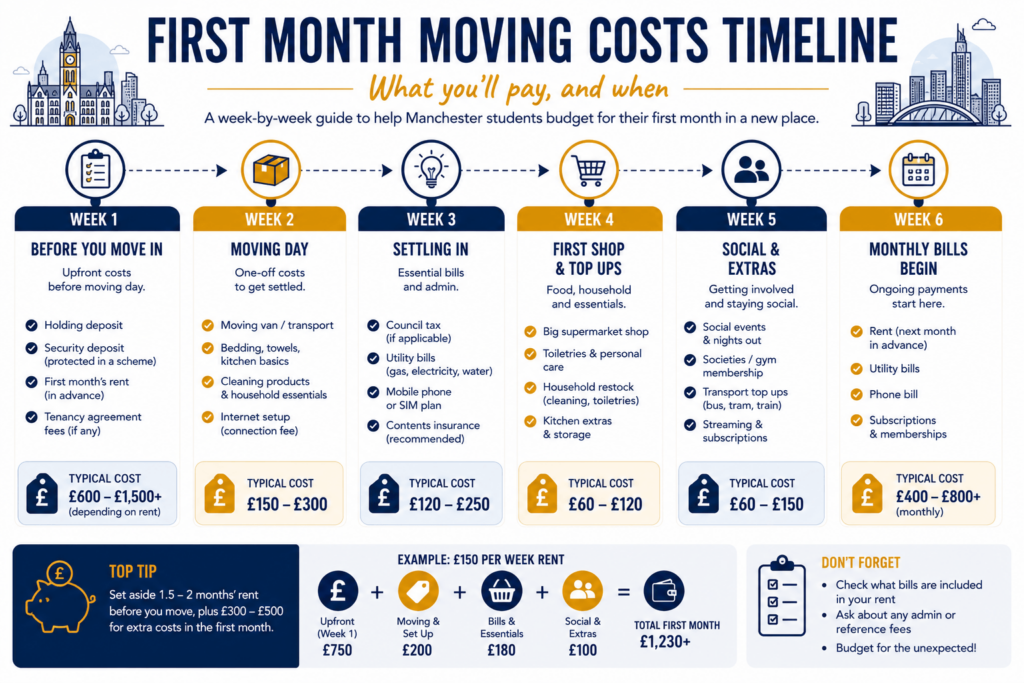
Before moving day arrives, it’s worth creating a checklist of everything you’ll need to organise, buy and budget for. Planning ahead can save both money and unnecessary stress during one of the busiest periods of starting university.
Our Moving Into Student Accommodation Checklist covers everything you’ll need before collecting your keys, while our guide to Guarantor Student Accommodation explains how guarantors work, when you’ll need one and the options available if you don’t have a suitable guarantor.
Cost of Living by Student Type
Not every student has the same living costs. Your accommodation choice, year of study, lifestyle and even where you’re travelling from can all have a significant impact on your monthly budget.
A first-year student living in university halls is likely to spend their money very differently from a postgraduate renting a private studio or an international student relocating from overseas.

Here’s what you can typically expect at each stage of university life.
| Student Type | Typical Monthly Budget | Most Common Accommodation |
| First Year | £1,050 – £1,300 | University halls or PBSA |
| Second Year | £950 – £1,250 | Shared student house |
| Final Year | £950 – £1,300 | Smaller shared house or PBSA |
| Postgraduate | £1,300 – £1,800+ | Studio or one-bedroom apartment |
| International Student | £1,400 – £2,000+ | PBSA or private studio |
First-Year Students
For many students, first year is the most expensive period at university.
Living in university halls or purpose-built student accommodation usually means higher accommodation costs, but the rent often includes utility bills, broadband and other services, making budgeting much simpler.
First-year students also face several one-off expenses during their first few weeks, including:
- Bedding and kitchen equipment
- Freshers’ Week activities
- Initial food shopping
- Travel to university
- Course materials
Despite these additional costs, many students appreciate the convenience and social opportunities that halls provide.
Second-Year Students
By second year, many friendship groups choose to move into a shared student house.
Sharing accommodation often reduces weekly rent, although students usually become responsible for organising household bills themselves. While budgeting becomes slightly more complicated, many students find they can significantly reduce their monthly living costs compared with their first year.
Second year is often when students become much more confident managing their finances and planning their monthly spending.
Final-Year Students
Final-year students often continue living in shared accommodation but may choose smaller houses or quieter neighbourhoods to focus on dissertations, placements and exams.
Many students also become more selective about spending, balancing part-time work with university commitments while preparing for graduation or future employment.
Although accommodation costs are often similar to second year, students may spend more on course materials, graduation expenses and career-related activities.
Postgraduate Students
Postgraduate students typically have different priorities from undergraduate students.
Many choose studios or one-bedroom apartments that offer greater privacy and quieter study environments. These accommodation options usually come with higher rental costs, although many postgraduates feel the additional expense is worthwhile.
Postgraduate students may also have different work patterns, professional placements or research commitments that influence where they choose to live.
International Students
International students often face the highest overall living costs, particularly during their first year in the UK.
In addition to normal student expenses, international students may also need to budget for:
- Visa application fees
- Immigration-related costs
- Flights to and from the UK
- Travel within their home country
- Health insurance or immigration health charges where applicable
- Currency exchange fees
- Additional luggage and shipping costs
- Temporary accommodation before moving into permanent housing
Many international students choose purpose-built student accommodation because it offers all-inclusive rent, making it easier to manage finances while adapting to life in a new country.
Every Student’s Budget Is Different
There is no single “correct” student budget. Some students prioritise living independently in a private studio, while others prefer to reduce costs by sharing accommodation with friends.
The key is choosing accommodation and a lifestyle that matches both your financial situation and your university experience. Planning ahead, understanding your expected monthly expenses and leaving room for unexpected costs will make managing your finances much easier throughout your studies.
If you’re moving to the UK from overseas, our guides to International Students and StudentFM Provide Cheap Accommodation for International Students provide practical advice on finding affordable accommodation, understanding the rental process and settling into university life.
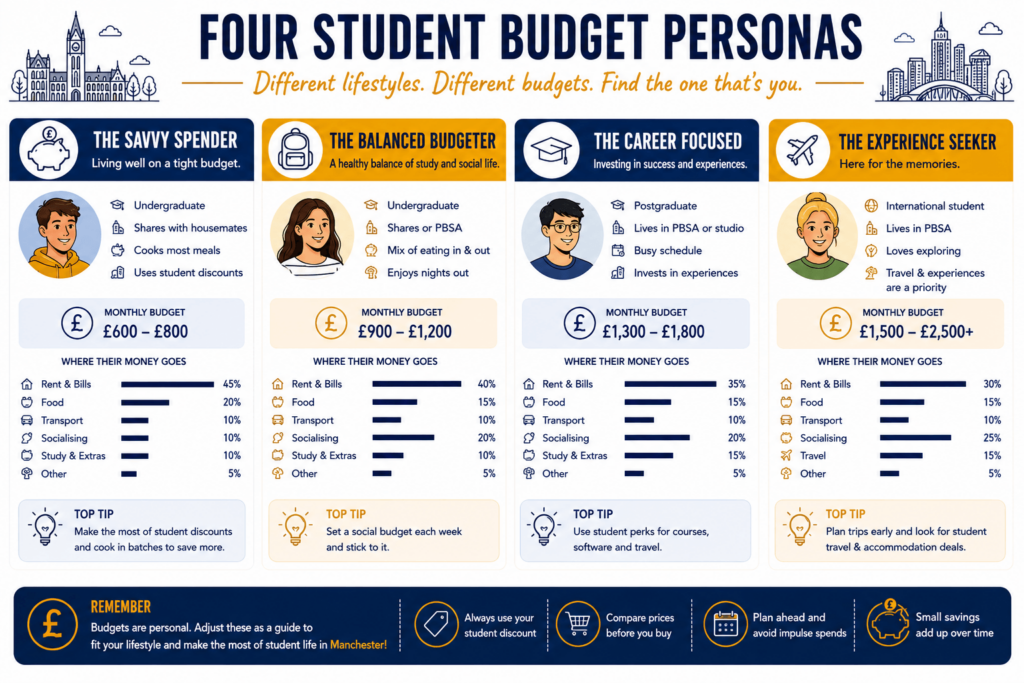
How Manchester Compares with Other Student Cities
Manchester is consistently ranked as one of the UK’s most popular student cities thanks to its world-class universities, vibrant nightlife, excellent transport links and wide variety of accommodation options. While it isn’t the cheapest place to study, it offers a strong balance between affordability, career opportunities and student experience.
Compared with cities such as London, Manchester remains relatively affordable. However, when compared with other major student cities including Preston, Leicester and Sheffield, accommodation costs are generally a little higher, particularly for purpose-built student accommodation and city centre apartments.
The table below provides a general comparison of living costs across some of the UK’s most popular university cities.
| Student City | Average Weekly Rent | Typical Monthly Budget | Transport Costs | Nightlife |
| Manchester | £160 – £260 | £1,100 – £1,350 | Low – Medium | ⭐⭐⭐⭐⭐ |
| Leeds | £140 – £230 | £1,000 – £1,300 | Low | ⭐⭐⭐⭐⭐ |
| Leicester | £120 – £210 | £950 – £1,200 | Low | ⭐⭐⭐⭐ |
| Preston | £95 – £180 | £850 – £1,100 | Very Low | ⭐⭐⭐ |
| Nottingham | £130 – £220 | £1,000 – £1,250 | Low | ⭐⭐⭐⭐ |
| Sheffield | £120 – £210 | £950 – £1,200 | Low | ⭐⭐⭐⭐ |
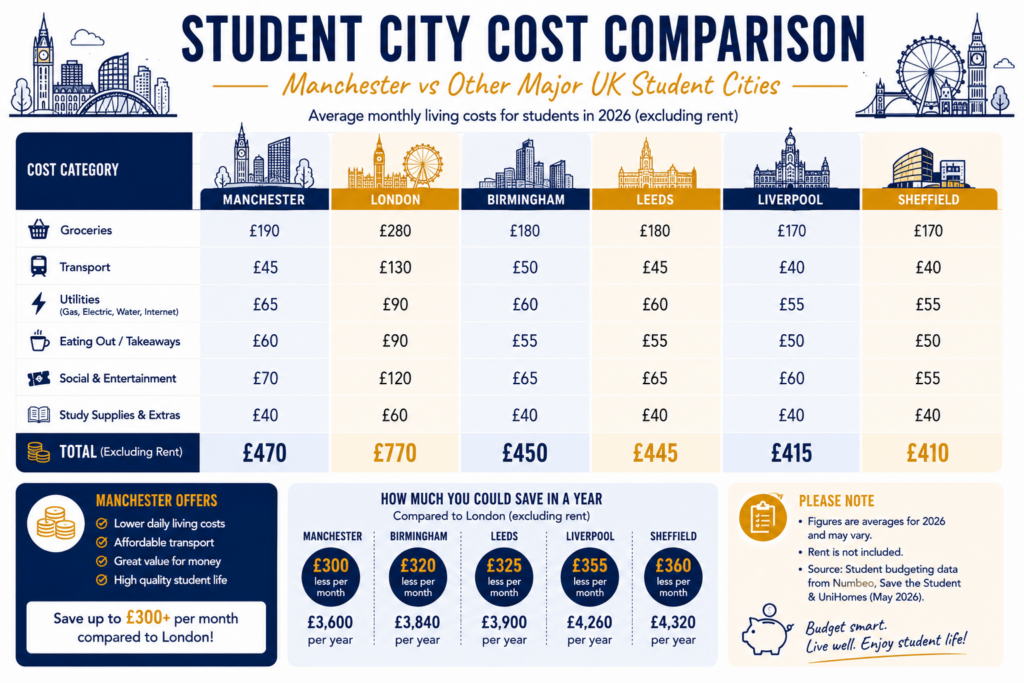
20 Ways to Save Money Living in Manchester
Living in Manchester doesn’t have to be expensive. With a little planning and a few smart habits, you can significantly reduce your monthly spending without missing out on the university experience.
Many students save hundreds, sometimes even thousands, of pounds each academic year simply by making small changes to how they shop, travel and manage their accommodation.
Here are 20 practical ways to stretch your student budget further.
1. Cook Meals Together
Sharing the cost of ingredients with housemates is often much cheaper than cooking individually. Batch cooking also reduces food waste and saves time during busy weeks.
2. Always Use Student Discounts
Many shops, restaurants, cafés, cinemas and online retailers offer student discounts. Carry your student ID and make use of student discount platforms whenever possible.
3. Walk Whenever You Can
Manchester is a highly walkable city, especially around the university campuses. Walking instead of taking the bus can save hundreds of pounds over an academic year.
4. Book Accommodation Early
The best-value student accommodation is often reserved months before the academic year begins. Booking early usually provides a wider choice of rooms and better prices.
5. Split Streaming Subscriptions
If permitted by the subscription provider, sharing streaming services with family or existing household members can reduce monthly entertainment costs.
6. Buy Second-Hand
Furniture, kitchen equipment, textbooks and even bicycles are often available second-hand through university groups, local marketplaces and charity shops.
7. Use Too Good To Go
Many cafés, bakeries and restaurants sell surplus food at heavily discounted prices through the Too Good To Go app, helping you save money while reducing food waste.
8. Meal Prep
Preparing lunches and dinners in advance makes it much easier to avoid expensive convenience food and last-minute takeaways.
9. Get a Student Railcard
If you regularly travel home or explore other cities, a student railcard can reduce train fares throughout the year and often pays for itself after only a few journeys.
10. Visit Free Museums and Galleries
Manchester has a fantastic selection of museums, galleries and cultural attractions that are free to enter, providing great days out without affecting your budget.
11. Check University Hardship Funds
Most universities offer hardship funds or financial support schemes for students experiencing unexpected financial difficulties. It’s worth knowing what’s available before you need it.
12. Use the University Library
Instead of purchasing every textbook, check whether your university library has physical or digital copies available. Many libraries also provide low-cost printing services.
13. Buy Everyday Essentials in Bulk
Sharing larger supermarket purchases such as pasta, rice, cleaning products and toiletries with housemates can reduce your overall shopping bill.
14. Attend Free Campus Events
Universities regularly organise free events including sports sessions, careers fairs, film nights, live music, guest lectures and society activities.
15. Choose a Student Bank Account
Many banks offer student accounts with interest-free overdrafts and additional perks. Comparing available accounts before starting university could save money throughout your studies.
16. Take Advantage of Bee Network Discounts
If you regularly use buses or trams, look at student travel passes and discounted tickets available through Greater Manchester’s Bee Network to reduce commuting costs.
17. Use the Campus Gym
University gyms are often significantly cheaper than private fitness centres, while some student accommodation even includes gym access within the rent.
18. Carry a Refillable Water Bottle
Buying bottled drinks every day quickly adds up. Refilling a reusable bottle on campus is better for both your wallet and the environment.
19. Plan Your Food Shopping
Writing a shopping list before visiting the supermarket helps reduce impulse purchases and makes it easier to stick to your weekly food budget.
20. Choose Bills-Included Accommodation
While accommodation with all bills included may appear more expensive at first, it often provides better overall value. Having one fixed monthly payment makes budgeting much easier and protects you from unexpected increases in utility costs.
Small Changes Add Up
Saving money at university isn’t about cutting out everything you enjoy, it’s about making informed choices. Walking instead of taking the bus, cooking a few extra meals at home or booking accommodation earlier can all make a noticeable difference over the course of an academic year.
The earlier you start building good financial habits, the easier it becomes to manage your budget while still making the most of student life in Manchester.
For more advice, read our guides to Why You Should Look for Student Accommodation Early and the Student Budgeting UK Cost Guide.

Annual Student Budget Example
Although most students manage their finances on a weekly or monthly basis, looking at your budget over an entire academic year gives a much clearer picture of how much university is likely to cost.
The example below shows a realistic annual budget for a typical undergraduate student living in Manchester in purpose-built student accommodation or a mid-range shared house.
| Annual Expense | Estimated Cost |
| Accommodation | £7,800 |
| Food & Groceries | £2,100 |
| Transport | £600 |
| Entertainment & Social Life | £2,000 |
| Books & Course Materials | £350 |
| Travel Home & Holidays | £600 |
| Miscellaneous & Personal Spending | £1,050 |
| Estimated Annual Total | £14,500 |
These figures represent a comfortable but sensible student lifestyle. Students living in cheaper shared accommodation and cooking most of their meals at home may spend considerably less, while those choosing premium studios or enjoying a more active social life could spend significantly more.
Accommodation
Accommodation remains the largest annual expense by a considerable margin, typically accounting for more than half of a student’s overall living costs.
Choosing accommodation with bills included can also make annual budgeting much more predictable by removing unexpected utility costs throughout the year.
Food
Food costs include weekly supermarket shopping, occasional meals out, takeaways and everyday essentials.
Students who regularly meal prep and cook at home often save hundreds of pounds each year compared with relying on convenience food.
Transport
Transport costs vary depending on where you live.
Students living within walking distance of campus may spend very little throughout the year, while those travelling regularly by bus, tram or train should factor these expenses into their annual budget.
Entertainment
This category includes nights out, cafés, cinema visits, streaming subscriptions, sports, societies and other leisure activities.
Entertainment spending is one of the most flexible parts of a student budget and can easily be adjusted depending on your financial situation.
Books and Course Materials
Academic costs vary between courses.
Some degrees require very few additional purchases, while others involve specialist software, equipment, laboratory materials or printed resources throughout the academic year.
Travel
Many students travel home several times each year during Christmas, Easter and the summer break.
Booking train tickets early and taking advantage of student discounts can make a noticeable difference to annual travel costs.
Miscellaneous Spending
This covers all the expenses that don’t fit neatly into other categories, including:
- Haircuts
- Toiletries
- Clothing
- Laundry
- Birthday presents
- Household items
- Replacing broken equipment
- Unexpected emergencies
Including a miscellaneous allowance helps create a more realistic annual budget.
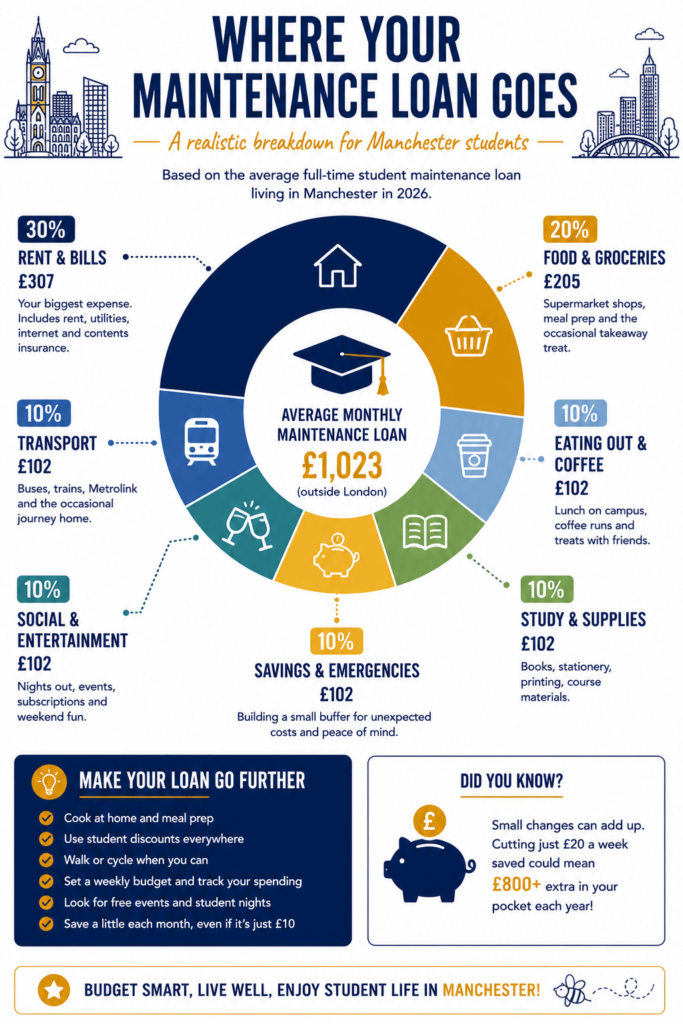
How Does This Compare with a Maintenance Loan?
For many UK students, the maintenance loan forms the foundation of their living-cost budget. However, whether it covers all of your annual expenses depends on several factors, including:
- Household income
- Where you study
- Whether you live at home or away from home
- Your accommodation costs
- Your personal spending habits
A student spending around £14,500 per year may find that their maintenance loan covers a substantial proportion of their living costs, but many students still rely on part-time work, family support, scholarships or personal savings to bridge the gap.
Understanding your expected annual spending before starting university makes it much easier to plan ahead, avoid unnecessary debt and make informed decisions about accommodation, transport and day-to-day budgeting. Even small savings each month can amount to several hundred pounds over the course of an academic year, helping you enjoy university life with greater financial confidence.
Frequently Asked Questions
Manchester is generally considered a mid-priced student city. It is more affordable than London but slightly more expensive than cities such as Preston and Leicester. Most students spend between £1,100 and £1,350 per month, depending on their accommodation, lifestyle and spending habits.
Many students can cover a large proportion of their living costs using their maintenance loan, particularly if they choose affordable accommodation and budget carefully. However, some students also rely on part-time work, family support or savings to cover additional expenses.
Yes. Manchester is considerably more affordable than London, particularly when it comes to accommodation. Rent is typically much lower, while transport costs are also easier to manage because many students live within walking distance of campus.
The two cities have fairly similar living costs, although Leeds is often slightly cheaper for accommodation. Both offer excellent student lifestyles, modern accommodation and strong transport links.
Most university halls and purpose-built student accommodation include:
Gas
Electricity
Water
High-speed Wi-Fi
Building maintenance
Some providers also include contents insurance and access to on-site facilities such as gyms and study spaces. Always check exactly what is included before booking.
A realistic weekly budget for most students in Manchester is around £250 – £315, including accommodation. Students living in shared houses or cooking most meals at home may spend less, while those choosing premium accommodation may need a larger budget.
Yes. Many students work part-time alongside their studies to help cover living costs.
Universities generally recommend balancing work with academic commitments, and many students find flexible evening or weekend jobs that fit around lectures.
That depends on your priorities.
A studio offers:
Complete privacy
Your own kitchen
Your own bathroom
A quieter study environment
However, it is usually one of the most expensive accommodation options. Students who enjoy social living or have a tighter budget often find shared accommodation provides better value.
After paying for accommodation and essential bills, many students budget around £120 – £250 per month for entertainment, shopping, eating out and other personal spending.
The exact amount depends on your lifestyle and financial circumstances.
Areas such as Rusholme, Withington and Fallowfield are generally among the most affordable student neighbourhoods, particularly for shared houses.
They also offer excellent access to the universities and strong student communities.
Some of the most commonly overlooked expenses include:
Laundry
Course materials
Society memberships
Haircuts
Birthday presents
Christmas travel
Streaming subscriptions
Kitchen equipment
Graduation costs
Emergency purchases
Setting aside a small monthly contingency fund can help cover these unexpected expenses.
Private shared houses usually have lower weekly rent, but students often need to pay separately for:
Gas
Electricity
Water
Broadband
Contents insurance
Purpose-built student accommodation (PBSA) generally includes these costs within the rent, so the overall monthly difference is often smaller than it first appears.
Many students can expect to pay between £200 and £500, although some providers ask for booking fees or advance rent instead of a traditional deposit.
Always check your tenancy agreement before making a payment. Deposits vary depending on the accommodation provider.
Manchester has excellent public transport, and many students choose accommodation within walking or cycling distance of campus. Owning a car usually adds unnecessary costs, including insurance, fuel and parking.
Many international students are permitted to work part-time during term time and full-time during university holidays, depending on the conditions of their visa.
Before accepting employment, always check the specific work restrictions attached to your visa to ensure you remain compliant with UK immigration rules.
Yes. Manchester is one of the UK’s most diverse student cities, welcoming thousands of international students every year.
The city offers a wide choice of accommodation, excellent public transport, strong university support services and a multicultural community, making it an attractive destination for students from around the world.
It’s best to begin looking several months before your course starts.
The most popular accommodation, particularly purpose-built student accommodation and well-located shared houses, often fills quickly, so booking early usually gives you the widest choice and the best prices.
Some of the easiest ways to save money include:
Choosing bills-included accommodation
Cooking meals at home
Walking or cycling instead of using public transport
Taking advantage of student discounts
Buying second-hand textbooks and equipment
Planning your weekly food shop
Booking accommodation early
Small savings each week can make a significant difference over the course of an academic year.
For many students, yes.
While it isn’t the cheapest university city in the UK, Manchester offers an excellent balance of affordable living, world-class universities, vibrant nightlife, strong graduate employment opportunities and a wide range of student accommodation. For many, the overall value and experience make it one of the best places in the UK to study.
Conclusion
Manchester continues to be one of the UK’s best student cities, offering an excellent balance between affordability, world-class universities and an outstanding student experience. While it may not be the cheapest place to study, it delivers exceptional value when compared with many other major UK cities, particularly when you consider its career opportunities, vibrant social scene, excellent transport links and wide range of accommodation options.
For most students, accommodation will be the single biggest expense, making it the most important financial decision you’ll make before starting university. Choosing the right room, location and tenancy can have a far greater impact on your overall budget than cutting back on day-to-day spending. Looking beyond the advertised weekly rent and understanding exactly what’s included—such as utility bills, broadband, contents insurance and on-site facilities—can help you make a much more informed decision.
Careful planning also makes a huge difference. Setting a realistic monthly budget, preparing for one-off moving costs and leaving room for unexpected expenses will help reduce financial stress throughout the academic year, allowing you to focus on your studies and enjoy everything Manchester has to offer.
If you’re ready to find your new home, browse Student Accommodation in Manchester to compare room types, bills-included accommodation and locations close to your university. You can also explore Q3 Apartments Manchester or use our Property Search to discover affordable student accommodation that suits both your lifestyle and your budget.