
Manchester is one of the UK’s most exciting and popular cities for students, attracting well over 100,000 students every year from across the UK and around the world. Home to the University of Manchester, Manchester Metropolitan University and the University of Salford, the city offers an outstanding mix of academic excellence, vibrant nightlife, world-class music, diverse culture and excellent transport links.
Finding the right student accommodation in Manchester is about much more than choosing the cheapest room. Your location, room type, budget and lifestyle can all have a huge impact on your university experience. Whether you’re looking for a modern studio close to campus, a sociable shared apartment, an all-inclusive purpose-built student accommodation (PBSA), or a private house with friends, Manchester has an option to suit almost every budget and way of living.

The challenge is that the best accommodation doesn’t stay available for long. Thousands of students begin searching months before the academic year starts, and the most popular rooms often sell out well before September. Understanding where to live, how much accommodation costs, when to book and which type of room is right for you can make the difference between securing your ideal home and having to settle for whatever remains.
This complete 2026 guide brings together everything you need to know before booking your accommodation. We’ll compare room types, explain average costs, explore the best student neighbourhoods, show you when to book, answer common questions and help you choose the accommodation that’s right for your university experience.
Looking for available rooms?
Browse our latest Manchester properties here:
Student Accommodation Manchester

Types of Student Accommodation in Manchester
One of the biggest decisions you’ll make before starting university is choosing the type of accommodation that’s right for you. Manchester offers a wide variety of student housing, ranging from traditional university halls and shared houses to modern purpose-built student accommodation (PBSA), private studios and ensuite rooms.
Each option has its own advantages depending on your budget, lifestyle and how independent you want to be. Some students prioritise making new friends and choose shared accommodation, while others prefer the privacy of their own studio apartment. Understanding the differences before you book can help you avoid paying for features you don’t need or choosing accommodation that doesn’t suit your lifestyle.
The table below provides a quick comparison of the main accommodation types available across Manchester.
| Accommodation Type | Typical Weekly Cost | Bills Included | Privacy | Best For |
| University Halls | £150 – £240 | Usually | Medium | First-year students wanting a traditional university experience |
| PBSA (Purpose-Built Student Accommodation) | £170 – £320+ | Usually | High | Students wanting modern facilities and all-inclusive living |
| Shared Student House | £110 – £170 | Sometimes | Low | Groups of friends looking for the most affordable option |
| Ensuite Room | £150 – £260 | Usually | High | Students wanting a private bedroom and bathroom with shared social spaces |
| Non-Ensuite Room | £110 – £180 | Sometimes | Medium | Budget-conscious students happy to share bathroom facilities |
| Studio Apartment | £220 – £350+ | Usually | Very High | Students wanting complete independence and privacy |
Purpose-Built Student Accommodation (PBSA)
Purpose-built student accommodation, often referred to as PBSA, has become one of the most popular housing options in Manchester. These modern developments are designed specifically for students and typically include furnished rooms, high-speed Wi-Fi, study spaces, gyms, communal lounges, laundry facilities and 24-hour security. Rent is usually all-inclusive, making budgeting much simpler throughout the academic year.
If you’d like to understand exactly how PBSA works and whether it’s the right choice for you, read our guide to What is Purpose Built Student Accommodation?.
Shared Student Houses
Shared student houses remain the most affordable option for many second and third-year students. Renting a house with friends often provides more space and lower weekly rent than purpose-built accommodation, although you’ll usually need to organise household bills, internet and utilities separately unless they’re included within your tenancy agreement.
Learn more about the advantages and disadvantages in our guide to Shared Student Accommodation.
Studios
A studio apartment combines your bedroom, living space and kitchen into one private room, giving you complete independence. Studios are ideal for postgraduate students, mature students, couples (where permitted) or anyone who values privacy and quiet study space. They are generally the most expensive accommodation option but provide the greatest level of personal space.
Ensuite Rooms
Ensuite rooms offer an excellent balance between privacy and social living. You’ll have your own bedroom and private bathroom while sharing the kitchen and communal areas with other students. This makes ensuites one of the most popular accommodation choices across Manchester.
If you’re deciding between an ensuite and a private studio, our guide to Ensuite vs Studio Student Accommodation compares the costs, benefits and who each option is best suited to.
Non-Ensuite Rooms
Non-ensuite accommodation is usually the most budget-friendly room option. You’ll have your own bedroom but share bathroom facilities with other residents. For students looking to reduce accommodation costs without sharing a bedroom, this can offer excellent value.
University Halls
University-managed halls are particularly popular with first-year students who want to live close to campus and quickly meet new people. Contracts are typically aligned with the academic year, and many halls include utilities, internet access and communal facilities within the rent. While they provide an excellent introduction to university life, availability is often limited and many students choose private accommodation in later years.
Should You Choose Private Accommodation or PBSA?
If you’re deciding between privately managed accommodation and purpose-built student accommodation, there isn’t a single right answer. PBSA offers convenience, modern facilities and inclusive pricing, while private accommodation can often provide better value and greater flexibility depending on your priorities.
For a detailed comparison, read Private Student Accommodation vs PBSA before making your decision.

How Much Does Student Accommodation Cost in Manchester?
Manchester offers accommodation to suit almost every budget, from affordable shared houses to premium city-centre studios. The amount you’ll pay depends on several factors, including the type of accommodation, its location, the facilities included and whether your rent covers bills.
While Manchester remains more affordable than London, demand for high-quality student accommodation has increased significantly over recent years. Booking early usually provides the greatest choice and often allows students to secure lower-priced rooms before demand pushes prices higher.

Average Weekly Accommodation Costs
The table below provides a general guide to what students can expect to pay across Manchester.
| Accommodation Type | Typical Weekly Cost | Typical Monthly Cost* |
| Shared Student House | £110 – £170 | £475 – £735 |
| Non-Ensuite Room | £110 – £180 | £475 – £780 |
| Ensuite Room | £150 – £260 | £650 – £1,125 |
| PBSA | £170 – £320+ | £735 – £1,385+ |
| Studio Apartment | £220 – £350+ | £950 – £1,515+ |

Best Areas to Live in Manchester
Choosing the right neighbourhood is just as important as choosing the right accommodation. Every area of Manchester offers a different student experience, from lively social hubs packed with bars and restaurants to quieter residential neighbourhoods that are ideal for studying.
The best area for you will depend on your university, budget, preferred commute and the type of lifestyle you want outside of lectures. Some students are happy to pay more to live in the city centre, while others choose areas like Fallowfield or Rusholme to enjoy lower rents and a stronger student community.

The comparison below highlights some of Manchester’s most popular student neighbourhoods.
| Area | Budget | Walk to Uni | Nightlife | Quiet | Best For |
| Fallowfield | ££ | 25 – 35 mins | Excellent | Low | First-year students and social living |
| Rusholme | ££ | 20 – 30 mins | Very Good | Low | Budget-conscious students and international students |
| Victoria Park | £££ | 15 – 25 mins | Good | High | Students wanting quieter surroundings |
| Oxford Road | £££ | 5 – 15 mins | Excellent | Medium | Students wanting to be close to campus |
| City Centre | ££££ | 10 – 20 mins | Excellent | Low | Students wanting city living and convenience |
| Northern Quarter | ££££ | 15 – 25 mins | Excellent | Medium | Creative students and young professionals |
| Salford | ££ | 15 – 30 mins | Good | Medium | University of Salford students |
| Didsbury | ££££ | 25 – 40 mins | Good | Very High | Postgraduates and mature students |
| Withington | ££ | 20 – 35 mins | Good | Medium | Students looking for good value |
| Hulme | £££ | 10 – 20 mins | Good | Medium | Students wanting affordable accommodation close to the city |
Fallowfield
Average weekly rent: £140 – £220
Fallowfield is widely regarded as Manchester’s classic student neighbourhood. Home to thousands of students each year, it offers an energetic atmosphere with plenty of cafés, bars, supermarkets and takeaways. It’s particularly popular with first-year and second-year students who want to meet new people and enjoy an active social life.
Most students can reach the University of Manchester or Manchester Metropolitan University in around 25 – 35 minutes on foot, while regular buses along Wilmslow Road make travelling even easier.
Best for: First-year students, social living and students who want to be surrounded by other students.
Rusholme
Average weekly rent: £130 – £210
Rusholme sits between Fallowfield and the city centre, making it one of the most convenient and affordable places to live. It’s famous for the Curry Mile, offering one of the UK’s largest selections of international restaurants, cafés and supermarkets.
The area is particularly popular with international students thanks to its multicultural community and excellent transport links.
Walking time to the University of Manchester is typically around 20 – 30 minutes.
Best for: Budget-conscious students, international students and food lovers.
Victoria Park
Average weekly rent: £170 – £260
Victoria Park offers a quieter alternative to neighbouring Fallowfield and Rusholme. The tree-lined streets and residential atmosphere appeal to students who want somewhere peaceful without being too far from campus.
The University of Manchester is usually within a 15 – 25 minute walk, making it a popular choice for students who want a balance between study and social life.
Best for: Students wanting a quieter environment while remaining close to university.
Oxford Road
Average weekly rent: £180 – £300
Oxford Road is at the heart of Manchester’s university district. Living here means you’ll be within walking distance of lecture theatres, libraries, cafés, restaurants and student facilities.
Accommodation tends to be more expensive, but many students value the convenience of being just minutes from campus and the city centre.
Walking times are typically between 5 and 15 minutes depending on your university building.
Best for: Students who want to minimise commuting and stay close to campus.
Manchester City Centre
Average weekly rent: £220 – £350+
Living in Manchester city centre places you in the middle of everything. Shopping, nightlife, restaurants, transport and entertainment are all on your doorstep, making it one of the most exciting places to live as a student.
Accommodation is generally more expensive than surrounding neighbourhoods, but many modern PBSA developments offer premium facilities and excellent transport connections.
Walking times to university are usually between 10 and 20 minutes.
Best for: Students who want a vibrant city lifestyle and modern accommodation.
Northern Quarter
Average weekly rent: £220 – £340
The Northern Quarter is known for its independent cafés, creative spaces, music venues and unique character. It’s one of Manchester’s trendiest neighbourhoods and appeals to students looking for something different from the traditional student experience.
Although accommodation costs are higher, many students enjoy the area’s atmosphere and proximity to the city centre.
Walking times to university are generally around 15 – 25 minutes.
Best for: Creative students, musicians, designers and students who enjoy city living.
Salford
Average weekly rent: £140 – £240
Salford has become increasingly popular thanks to continued investment, modern developments and excellent transport links. Students studying at the University of Salford benefit from particularly short commutes, while Manchester city centre is also easily accessible.
Accommodation here often provides better value than comparable properties in the city centre.
Walking times vary between 15 and 30 minutes depending on your campus.
Best for: University of Salford students and those looking for good value accommodation close to the city.
Didsbury
Average weekly rent: £200 – £320
Didsbury is one of Manchester’s most desirable residential neighbourhoods. It offers independent cafés, green spaces, restaurants and a much quieter atmosphere than the traditional student districts.
Although it’s further from the universities, regular tram and bus services make commuting straightforward.
Walking to campus can take 25 – 40 minutes, although most students choose public transport.
Best for: Postgraduate students, mature students and anyone prioritising peace and quiet.
Withington
Average weekly rent: £140 – £220
Located just south of Fallowfield, Withington offers a relaxed student atmosphere with independent shops, cafés and good transport links into the city. Rental prices are often slightly lower than neighbouring areas, making it attractive for students looking to balance affordability with convenience.
Walking times to university are usually around 20 – 35 minutes.
Best for: Students looking for affordable accommodation with a quieter community feel.
Hulme
Average weekly rent: £170 – £260
Hulme has grown in popularity thanks to its excellent location between Manchester city centre and the universities. Many modern apartment developments and purpose-built student accommodation schemes have transformed the area in recent years.
Most university buildings can be reached within 10 – 20 minutes on foot, making Hulme an attractive option for students who want shorter commutes without paying city-centre prices.
Best for: Students wanting modern accommodation close to both the universities and the city centre.

Which Manchester Area Is Right For You?
Choosing the right neighbourhood isn’t simply about finding the cheapest rent or the shortest walk to university. The best area depends on your priorities, whether that’s making new friends, reducing your commute, enjoying the city’s nightlife or finding somewhere peaceful to study.

Use the guide below to quickly identify which part of Manchester is likely to suit your lifestyle.
| If you’re… | We recommend… | Why? |
| A first-year student | Fallowfield | Manchester’s best-known student neighbourhood with a lively social scene, excellent transport and thousands of fellow students. |
| A postgraduate or mature student | Didsbury | A quieter residential area with cafés, parks and a more relaxed atmosphere, ideal for focused study. |
| An international student | Manchester City Centre | Excellent transport links, modern accommodation, easy access to universities and plenty of shops, restaurants and essential services. |
| Looking for the most affordable accommodation | Rusholme | One of the city’s best-value student areas, offering lower rents, great transport and the famous Curry Mile. |
| Looking for luxury accommodation | Northern Quarter | Stylish apartments, independent cafés, creative spaces and one of Manchester’s most desirable city-centre neighbourhoods. |
| Studying at the University of Salford | Salford | Shorter commutes, modern developments and generally better value than living in Manchester city centre. |
| Wanting to walk to lectures | Oxford Road | Located at the heart of Manchester’s university district, allowing many students to walk to campus within minutes. |
| Wanting a quieter student community | Victoria Park | Leafy residential streets, good access to campus and a more peaceful environment than Fallowfield. |
| Looking for good value without sacrificing convenience | Withington | Affordable rents, excellent transport links and a friendly neighbourhood atmosphere. |
| Wanting to live close to both campus and the city centre | Hulme | Modern accommodation within walking distance of universities, shopping and Manchester’s main attractions. |
Still Not Sure?
If you’re struggling to decide, ask yourself these five questions before booking:
- How much can I comfortably afford each week?
- Do I want to walk to university or use public transport?
- Would I rather have a lively social atmosphere or somewhere quieter to study?
- Do I want my own private space or am I happy sharing with others?
- Which facilities matter most, such as a gym, study rooms, security or all-inclusive bills?
There isn’t a single “best” area in Manchester, only the area that’s best for you. By thinking about your budget, lifestyle and daily routine before you start viewing properties, you’ll be much more likely to find accommodation that you’ll enjoy living in throughout your university experience.

How to Choose the Right Student Accommodation
With so many accommodation options available across Manchester, it’s easy to feel overwhelmed. Rather than focusing on the newest building or the cheapest weekly rent, think about how you’ll actually live day to day. The right accommodation should fit your budget, support your studies and suit your lifestyle throughout the academic year.
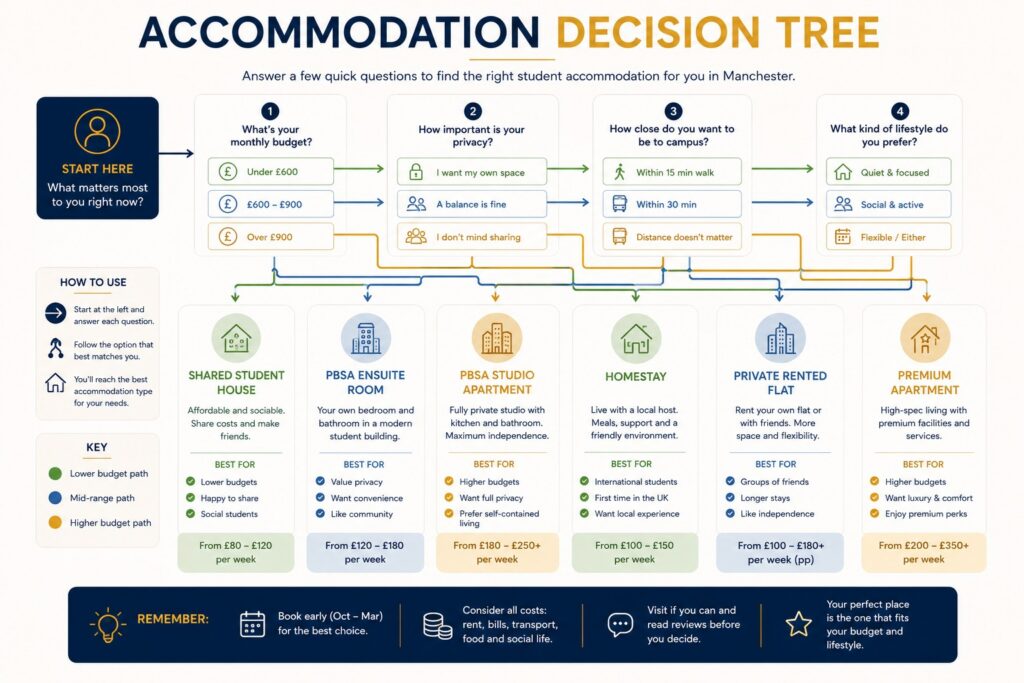
Use the decision guide below to help narrow down your options before you start viewing properties.
Step 1: What’s Your Budget?
Your budget is usually the biggest factor when choosing accommodation.
- Under £150 per week – Consider shared houses or non-ensuite rooms.
- £150 – £220 per week – You’ll have a wide choice of ensuite rooms and many PBSA options.
- £220+ per week – Premium PBSA developments and private studios become more accessible.
Remember to check whether bills are included before comparing prices.
Step 2: How Important Is Walking to University?
Living closer to campus can save both time and transport costs.
If you want to walk to lectures every day, look for accommodation around:
- Oxford Road
- Hulme
- Manchester City Centre
- Victoria Park
If you’re happy using buses or trams, areas such as Fallowfield, Rusholme, Withington and Didsbury offer more accommodation choices.
Step 3: Do You Want a Social Lifestyle or Somewhere Quiet?
Think about how you like to spend your time outside lectures.
Choose a lively area if you enjoy:
- Meeting new people
- Student nightlife
- Busy cafés and restaurants
- Living with larger groups
Consider quieter neighbourhoods if you prefer:
- Independent study
- Smaller communities
- Green spaces
- Less noise during evenings
Step 4: Would You Like Your Own Bathroom?
A private bathroom offers greater convenience and privacy but usually increases the weekly rent.
An ensuite room provides:
- Private bedroom
- Private bathroom
- Shared kitchen and living areas
A non-ensuite room offers:
- Private bedroom
- Shared bathroom
- Lower overall cost
Step 5: Do You Want a Private Studio?
Studios provide complete independence with your own:
- Bedroom
- Kitchen
- Bathroom
- Living space
They’re ideal for postgraduate students, mature students or anyone who values privacy, although they are generally the most expensive accommodation type.
If you’d rather meet new people, an ensuite room within a shared flat often provides a better balance between privacy and social living.
Step 6: Are Bills Included?
Always check what’s included in your rent before signing a tenancy agreement.
Many purpose-built student accommodations include:
- Electricity
- Water
- Heating
- High-speed Wi-Fi
- Contents insurance
Private houses may require you to organise and pay for these separately.
Step 7: Which Facilities Matter Most?
Different buildings offer different amenities, so consider which features you’ll actually use.
Some popular facilities include:
- On-site gym
- Study rooms
- Cinema room
- Laundry facilities
- Secure bike storage
- 24-hour security
- Outdoor social spaces
- Games rooms
Don’t pay extra for facilities you know you’ll rarely use.
Step 8: Do You Need Parking?
If you’re bringing a car to university, make sure your accommodation offers parking or has nearby permit options. Many city-centre buildings have limited spaces, while some universities discourage students from bringing vehicles unless absolutely necessary.
If you won’t have a car, excellent public transport links may be a more important consideration than parking availability.
Step 9: Are You Moving to the UK from Overseas?
International students often have additional considerations when choosing accommodation.
You may want to prioritise:
- All-inclusive bills
- Flexible payment options
- Secure buildings with on-site management
- Fully furnished rooms
- Accommodation close to supermarkets and public transport
- Providers experienced in supporting international students
Many PBSA developments are specifically designed to make the transition to studying in the UK as straightforward as possible.
A Simple Checklist Before You Book
Before committing to any accommodation, make sure you can answer “yes” to most of these questions:
- Is it within my weekly budget?
- Is the location convenient for my university?
- Does the room type suit my lifestyle?
- Are the facilities important to me?
- Are bills included?
- Do I understand the tenancy agreement?
- Have I checked the cancellation policy?
- Am I booking early enough to secure my preferred room?
Taking the time to answer these questions before making a decision can help you avoid unnecessary stress later and ensure you choose accommodation that supports both your studies and your overall university experience.
When Should You Book Student Accommodation?
One of the biggest mistakes students make is waiting too long before starting their accommodation search. Manchester is one of the UK’s largest student cities, with well over 100,000 students competing for accommodation each year. The most popular buildings, room types and price bands are often reserved months before the academic year begins.

While it’s still possible to find accommodation later in the year, booking early usually gives you the widest choice, the best locations and access to lower-priced rooms before availability becomes limited.
Below is a typical booking timeline to help you understand what happens throughout the year.
| Month | What Happens | What You Should Do |
| September | Students move into accommodation and providers begin planning for the following academic year. | Start researching different accommodation types and neighbourhoods. |
| October | Many PBSA providers launch rooms for the next academic year. Early availability is highest. | Begin comparing properties and deciding where you’d like to live. |
| November | Bookings increase as returning students secure their preferred rooms. | If you’ve found somewhere you like, consider booking before prices rise. |
| December | Popular buildings begin filling up, particularly ensuite rooms and studios. | Narrow down your shortlist and arrange viewings if possible. |
| January | One of the busiest booking periods after the Christmas break. | Aim to secure accommodation if you’re confident in your choice. |
| February | Availability begins reducing across the most popular developments. | Book soon if you want the widest selection of room types and locations. |
| March | Many premium rooms and popular student areas have limited availability. | Expect fewer options and higher demand. |
| April | Choice becomes more restricted, especially for groups wanting to live together. | Be flexible with location or room type if necessary. |
| May | Most well-known student developments are largely full. | Secure one of the remaining rooms before summer demand increases. |
| June | Late bookings continue, although availability is significantly reduced. | Act quickly if you haven’t yet arranged accommodation. |
| Clearing (August–September) | Additional students enter the market after receiving university places. Remaining rooms become highly competitive. | Book as soon as your university place is confirmed to maximise your options. |
Why Booking Early Makes a Difference
Students who start their search earlier typically benefit from:
- A wider choice of accommodation
- Better room selection within each building
- More flexibility over location
- Greater availability for groups wanting to live together
- Access to lower-priced room categories before they sell out
- More time to compare contracts and facilities without rushing
Leaving your search until late spring or summer doesn’t necessarily mean you won’t find somewhere to live, but you may need to compromise on location, room type or budget.
Is It Ever Too Early?
Not usually. Many students begin researching accommodation during the autumn term, even if they don’t book immediately. Starting early allows you to compare neighbourhoods, understand pricing and monitor availability before making a decision.
If you’re still deciding which university you’ll attend, it’s perfectly reasonable to research accommodation in advance so you’re ready to act once your place is confirmed.
For a more detailed explanation of why early planning can save both money and stress, read our guide to Why You Should Look For Student Accommodation Early.

Student Accommodation Costs by Room Type
Not all student accommodation offers the same balance of price, privacy and convenience. While weekly rent is often the first thing students compare, it’s equally important to consider what’s included, how much personal space you’ll have and whether the accommodation matches your lifestyle.
For example, a shared house may appear cheaper at first, but once utility bills are added, the difference between that and an all-inclusive ensuite room can be much smaller than expected. Equally, paying more for a studio may be worthwhile if privacy and independent living are your priorities.

The comparison below highlights the main accommodation types available in Manchester.
| Room Type | Average Weekly Price | Pros | Cons | Best For |
| Shared Student House | £110 – £170 | Lowest cost, larger living spaces, ideal for groups of friends | Bills may not be included, greater responsibility, shared facilities | Students on a budget and friendship groups |
| University Hall | £150 – £240 | Close to campus, all-inclusive rent, excellent for meeting people | Limited availability, less choice over room type | First-year students |
| PBSA (Purpose-Built Student Accommodation) | £170 – £320+ | Modern facilities, bills included, secure buildings, study spaces, gyms | Higher weekly rent than shared housing | Students wanting convenience and all-inclusive living |
| Ensuite Room | £150 – £260 | Private bathroom, shared kitchen encourages socialising, good balance of privacy and cost | Shared cooking facilities | Students wanting privacy without paying for a studio |
| Studio Apartment | £220 – £350+ | Complete privacy, private kitchen and bathroom, ideal for independent living | Highest accommodation cost | Postgraduates, mature students and those wanting their own space |
Shared Student Houses
Shared houses remain one of the most affordable accommodation options in Manchester. They’re particularly popular with second and third-year students who already have friendship groups and want to reduce living costs.
While weekly rent is often lower, remember to factor in electricity, gas, water, broadband and other household bills if these aren’t included within your tenancy.
University Halls
University-managed halls are designed primarily for first-year students and provide an easy transition into university life. Rent is usually all-inclusive, and you’ll live alongside hundreds of other students, making it one of the easiest ways to build friendships during your first year.
Because availability is limited, many students move into private accommodation after their first year.
Purpose-Built Student Accommodation (PBSA)
Purpose-built student accommodation has grown rapidly across Manchester and is now one of the most popular housing choices. Buildings typically include furnished rooms, high-speed Wi-Fi, study areas, gyms, communal lounges, laundry facilities and 24-hour security.
Although PBSA is generally more expensive than shared housing, many students appreciate the convenience of having bills included and access to modern facilities.
Ensuite Rooms
Ensuite rooms are often considered the “best of both worlds.” You’ll have your own private bedroom and bathroom while sharing the kitchen and communal areas with other students. This creates a good balance between privacy and social interaction, making ensuite rooms one of the most sought-after accommodation types.
Studio Apartments
Studios provide complete independence by combining your bedroom, kitchen and bathroom into one private living space. They’re particularly popular with postgraduate students, mature students and anyone who values peace and quiet.
Although studios command the highest weekly rents, they offer the greatest flexibility and privacy throughout the academic year.
Which Room Type Offers the Best Value?
For most students, an ensuite room offers the strongest balance between affordability, privacy and social living. If keeping costs as low as possible is your priority, a shared student house is usually the most economical option. If convenience, modern facilities and all-inclusive bills matter most, PBSA is often worth the additional cost. Students looking for complete independence may find that a studio apartment provides the best overall experience, provided it fits comfortably within their budget.

What’s Included in Student Accommodation?
One of the biggest advantages of modern student accommodation is that many everyday living costs and facilities are included within your rent. However, what’s provided can vary significantly between university halls, purpose-built student accommodation (PBSA) and private rented houses.
Before signing a tenancy agreement, always check exactly what’s included. A room with a slightly higher weekly rent may actually offer better value if it includes utilities, internet access and additional facilities that you would otherwise need to pay for separately.
The table below outlines what you’ll commonly find across different types of student accommodation.
| Feature | University Halls | PBSA | Shared Student House |
| Furniture | Usually | Yes | Usually |
| High-Speed Wi-Fi | Usually | Yes | Sometimes |
| Electricity & Water | Usually | Yes | Sometimes |
| Heating | Usually | Yes | Sometimes |
| Contents Insurance | Sometimes | Often | Rarely |
| Laundry Facilities | Yes | Yes | Usually |
| Gym | Rarely | Often | No |
| Cinema Room | Rarely | Sometimes | No |
| Study Rooms | Sometimes | Yes | No |
| Bike Storage | Sometimes | Usually | Sometimes |
| 24-Hour Security | Rarely | Usually | No |
Furniture
Most student accommodation comes fully furnished, allowing you to move in without purchasing the essentials.
A typical room will usually include:
- Bed and mattress
- Desk and chair
- Wardrobe
- Chest of drawers or storage units
- Shelving
- Curtains or blinds
Studios and some premium rooms may also include additional furniture such as sofas, dining tables or larger storage areas.
High-Speed Wi-Fi
Reliable internet is essential for both studying and everyday life. Most university halls and purpose-built student accommodation include high-speed Wi-Fi within the rent, while private shared houses may require tenants to arrange and pay for broadband themselves.
If fast internet is important for online lectures, gaming or streaming, it’s worth checking the connection speed before booking.
Utility Bills
Many students choose all-inclusive accommodation because it makes budgeting much simpler.
Bills that are commonly included include:
- Electricity
- Water
- Heating
- Gas (where applicable)
Private rented houses sometimes include bills, but many require tenants to organise utility accounts independently.
Laundry Facilities
Most student accommodation provides on-site laundry rooms with washing machines and tumble dryers. These are usually operated through a card or mobile payment system, with each wash and dry cycle charged separately.
Private houses typically include their own washing machine, although tumble dryers are less common.
Gym
Many newer PBSA developments include free access to an on-site gym. While these facilities vary in size, having a gym within your building can save both time and the cost of an external membership.
Gym access is much less common in university halls and almost never included in shared student houses.
Cinema Rooms
Premium student accommodation increasingly offers cinema rooms where residents can watch films, sporting events or social gatherings together. While this isn’t an essential feature, it can be a great addition if you enjoy communal living and organised events.
Study Rooms
Dedicated study spaces are becoming one of the most valued features in purpose-built student accommodation. Quiet study rooms provide an alternative to your bedroom or university library, particularly during exam periods when concentration is essential.
Bike Storage
Manchester is a cycle-friendly city, so secure bike storage can be an important consideration if you’re planning to cycle between university and your accommodation.
Many PBSA buildings offer secure indoor cycle storage, while university halls and shared houses vary considerably.
Security
Security is often one of the biggest reasons students choose purpose-built accommodation.
Many developments include:
- Secure key or fob entry
- CCTV
- 24-hour reception or on-site staff
- Controlled visitor access
- Secure parcel collection
These features provide additional peace of mind, particularly for students moving away from home for the first time.
Don’t Just Compare the Weekly Rent
When comparing accommodation, think about the overall value rather than simply choosing the lowest weekly price. A room that includes furniture, high-speed Wi-Fi, utility bills, study spaces, a gym and security may represent better value than a cheaper property where you’ll need to pay for many of these separately.
For a more detailed breakdown of what you can expect from different accommodation providers, read our guide to What’s Included in Student Accommodation UK.

Guarantors, Deposits & Contracts
Before booking your student accommodation, it’s important to understand the financial and legal commitments involved. Alongside your weekly rent, you’ll often need to provide a deposit, sign a tenancy agreement and, in many cases, nominate a guarantor.
Taking a little time to understand these requirements before you book can help avoid unexpected costs and ensure you’re comfortable with the terms of your contract.
Deposits
Most accommodation providers require a deposit before your booking is confirmed. The amount varies depending on the accommodation provider and the type of tenancy.
Your deposit is typically used to cover:
- Damage beyond normal wear and tear
- Outstanding rent
- Cleaning costs if the property is left in poor condition
- Missing furniture or fixtures
If you leave your accommodation in good condition and meet the terms of your tenancy agreement, your deposit is usually returned after your contract ends.
Always check:
- How much the deposit is
- When it needs to be paid
- Under what circumstances deductions can be made
- How and when it will be refunded
What Is a Guarantor?
A guarantor is someone who agrees to be legally responsible for your rent if you’re unable to make your payments. This is commonly a parent, guardian or close family member.
Many private landlords and accommodation providers require a UK-based guarantor before confirming your booking, particularly if you’re paying your rent in instalments.
A guarantor may be required to:
- Confirm their identity
- Provide proof of income
- Pass basic financial checks
- Sign a guarantor agreement
Not every accommodation provider requires a guarantor, but it’s important to check before applying.
For a more detailed explanation, read our guide to Guarantor Student Accommodation.
What If You’re an International Student?
International students often don’t have access to a UK-based guarantor. Fortunately, many accommodation providers offer alternative options.
These may include:
- Paying your rent in full before moving in
- Using an approved international guarantor service
- Choosing accommodation providers that don’t require a UK guarantor
- Providing additional financial documentation
Many purpose-built student accommodation providers are experienced in supporting international students and offer flexible payment arrangements to make the booking process easier.
Paying in Instalments
Rather than paying your entire rent upfront, many students choose to spread the cost across several instalments during the academic year.
Payment schedules vary, but common options include:
- Three instalments
- Four instalments
- Monthly payments
- One full payment in advance
Some providers align instalment dates with student finance payment schedules, helping students manage their cash flow more easily.
Before signing your contract, make sure you understand:
- The payment dates
- Accepted payment methods
- Any charges for late payments
- Whether instalments are available without a guarantor
Understanding Your Tenancy Agreement
Your tenancy agreement is a legally binding contract, so it’s important to read it carefully before signing.
Pay particular attention to:
- Contract length
- Rent payment schedule
- What’s included in your rent
- Rules regarding guests
- Maintenance responsibilities
- Cancellation terms
- End-of-tenancy requirements
If anything is unclear, ask the accommodation provider to explain it before committing.
Refunds and Cancellation Policies
Cancellation policies vary between providers, so never assume you’ll automatically receive a refund if your plans change.
Many providers offer refunds if:
- Your university application is unsuccessful
- You don’t receive the required grades
- Your visa application is refused (for international students)
- You cancel within a specified cooling-off period
Others may charge administration fees or retain part of your deposit.
Always read the cancellation policy carefully before paying any money, particularly if you’re booking several months before your course begins.
A Few Final Checks Before You Sign
Before confirming your accommodation, make sure you know:
- How much you’ll pay upfront
- Whether you need a guarantor
- When rent instalments are due
- What happens if your circumstances change
- The conditions for getting your deposit back
- Exactly what you’re agreeing to in the tenancy contract
Understanding these details before signing will help you book with confidence and avoid unexpected surprises later in the academic year.
Moving Into Student Accommodation
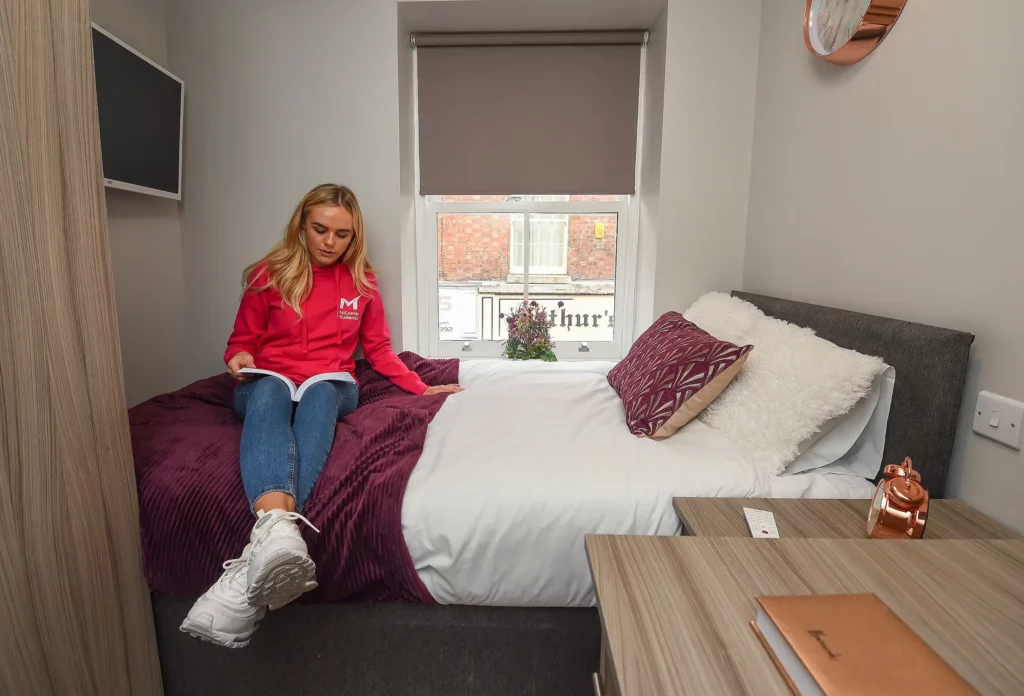
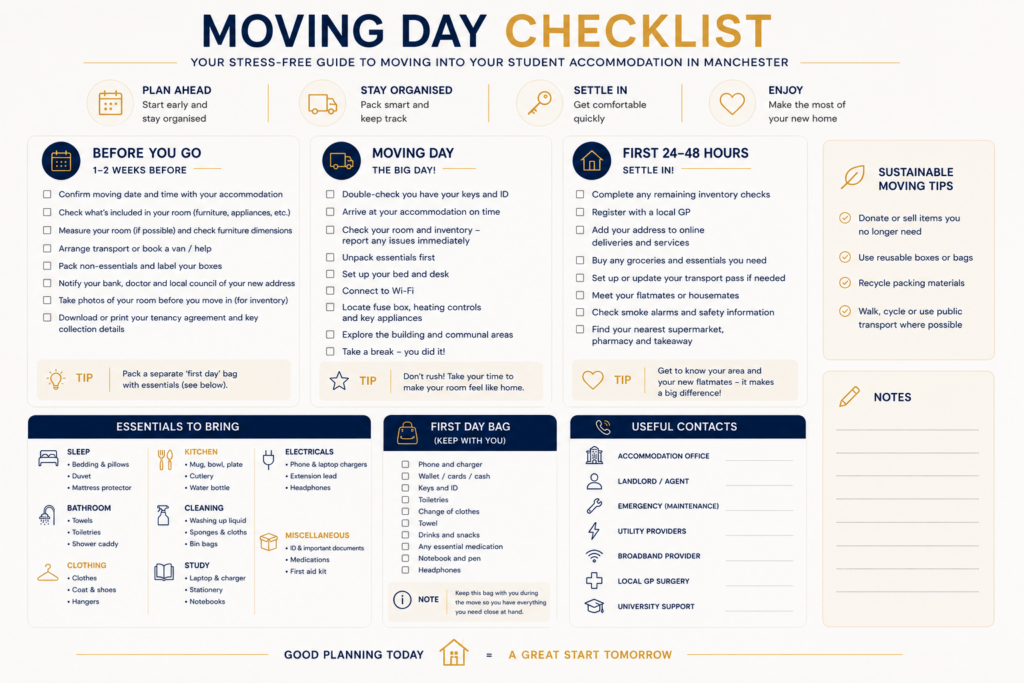
Moving into student accommodation is an exciting milestone, but it’s also a busy day with plenty to organise. Whether you’re moving into university halls, a shared house or purpose-built student accommodation, preparing in advance can make the process much less stressful.
A little planning before you arrive will help you settle in more quickly and avoid last-minute trips to the shops for forgotten essentials.
Before You Start Packing
Most student accommodation comes fully furnished, so you won’t need to bring large items such as beds, wardrobes or desks. Instead, focus on the personal items you’ll use every day.
A typical packing list includes:
- Bedding (duvet, pillows and sheets)
- Towels
- Clothing and shoes
- Toiletries
- Laptop and chargers
- Kitchen equipment (if not provided)
- Plates, bowls, mugs and cutlery
- Cleaning products
- Stationery
- Personal decorations and photos
Avoid overpacking. Your room may be smaller than you’re used to, and you’ll likely accumulate more belongings throughout the academic year.
Check the Inventory
When you first arrive, you’ll usually receive an inventory listing everything included in your room.
Take a few minutes to:
- Check all furniture is present
- Test lights and electrical sockets
- Inspect walls, carpets and furniture for any damage
- Photograph any marks or defects
- Report issues immediately to the accommodation provider
Completing the inventory properly helps ensure you’re not held responsible for damage that was already there when you moved in.
Set Up Utilities
If you’re moving into university halls or purpose-built student accommodation, utilities are often included in your rent, so there’s very little to arrange.
If you’re renting a private student house, you may need to organise:
- Electricity
- Gas
- Water
- Broadband
- TV licence (where required)
It’s worth discussing these responsibilities with your housemates before moving in so everyone understands how bills will be managed.
Connect to the Wi-Fi
Reliable internet is essential from day one, whether you’re attending online lectures, completing coursework or keeping in touch with family and friends.
If Wi-Fi is included, connect your devices as soon as you arrive and check that everything is working properly.
If broadband isn’t already installed, arrange this as early as possible, as installation appointments can sometimes take several weeks.
Make the Most of Moving Day
Moving day can feel hectic, especially if hundreds of students are arriving at the same time.
A few simple tips can make the day run more smoothly:
- Arrive during your allocated check-in time.
- Bring copies of your booking confirmation and identification.
- Label your boxes to make unpacking easier.
- Introduce yourself to your new flatmates and neighbours.
- Locate important facilities such as the laundry room, bike storage and reception.
- Find your nearest supermarket, pharmacy and public transport stops.
Taking time to explore your new neighbourhood during your first few days can help you settle in much more quickly.
Settle In and Enjoy the Experience
It’s perfectly normal to feel a mixture of excitement and nerves when moving away from home for the first time. Within a few weeks, your new accommodation will begin to feel like home as you establish routines, make friends and become familiar with the local area.
Don’t worry about having everything perfect on your first day. Focus on getting organised, meeting the people around you and enjoying the start of your university experience.
For a complete list of everything you’ll need before moving day, read our Moving Into Student Accommodation Checklist.
StudentFM Accommodation in Manchester
Finding the right student accommodation isn’t just about securing a room; it’s about finding somewhere you’ll feel comfortable living throughout the academic year. At StudentFM, we focus on providing high-quality accommodation that combines great locations, modern facilities and a straightforward booking experience, helping students settle into university life with confidence.
Whether you’re moving to Manchester for your first year, returning after summer or starting a postgraduate course, our accommodation has been carefully selected to offer the comfort, convenience and support students need.
Why Choose StudentFM?
We understand that every student has different priorities, but there are a few things that matter to almost everyone: a comfortable room, reliable facilities and a hassle-free experience from booking through to moving in.
When you book with StudentFM, you can expect:
- Modern, fully furnished student accommodation
- Excellent locations with easy access to universities and transport links
- High-speed Wi-Fi for studying and streaming
- Bills included at many properties, making budgeting easier
- Secure buildings and professionally managed accommodation
- Friendly support throughout the booking process
- A simple and transparent reservation experience
Our goal is to help students spend less time worrying about accommodation and more time enjoying university life.

Featured Manchester Accommodation
If you’re looking for accommodation in Manchester, one of our featured properties is Q3 Apartments.
Q3 Apartments offers modern student living in a convenient Manchester location, with well-designed rooms, contemporary communal spaces and excellent transport links to the city’s universities. It’s an excellent choice for students looking for high-quality accommodation with everything they need close by.
Whether you’re studying at the University of Manchester, Manchester Metropolitan University or the University of Salford, Q3 Apartments provides a comfortable base from which to enjoy everything the city has to offer.
A Simple Booking Process
Booking your accommodation shouldn’t be complicated. Once you’ve found a property that suits your needs, the process is straightforward:
- Browse available rooms.
- Choose your preferred room type.
- Complete your booking.
- Receive confirmation and move-in information.
- Get ready to start your university journey.
If you have any questions before booking, our team is always happy to help you understand your options and find accommodation that’s right for your budget and lifestyle.
Browse Student Accommodation in Manchester
Ready to find your student home?
Browse our full range of Student Accommodation in Manchester to compare available properties, explore room types and secure your accommodation before the most popular options sell out.
Frequently Asked Questions
Manchester is generally considered more affordable than London, while still offering a wide range of accommodation options. Weekly rents typically start from around £110 for shared housing and can exceed £350 for premium studios. Your overall living costs will depend on your accommodation, lifestyle and how often you socialise.
Many first-year students choose university halls or purpose-built student accommodation (PBSA), particularly in areas such as Fallowfield, Victoria Park and Oxford Road. These locations make it easy to meet other students and are well connected to Manchester’s universities.
For many students, yes. Purpose-built student accommodation offers all-inclusive bills, modern facilities, on-site management and additional amenities such as study rooms, gyms and communal lounges. While it’s often more expensive than shared housing, many students find the convenience and added security worthwhile.
It depends on your priorities. An ensuite room gives you a private bedroom and bathroom while sharing a kitchen with other students, making it a great balance between privacy and social living. A studio provides complete independence with your own kitchen and living space but usually comes at a higher weekly cost.
Most university halls and purpose-built student accommodation include utility bills, Wi-Fi and other services within the rent. Shared student houses vary, so always check your tenancy agreement before booking.
Yes. Manchester welcomes thousands of international students every year, and many accommodation providers are experienced in helping overseas applicants. If you don’t have a UK guarantor, alternative payment options or guarantor services are often available.
The earlier, the better. Many accommodation providers begin accepting bookings during October and November for the following academic year. Booking before spring usually provides the widest choice of rooms and locations.
Deposits vary depending on the accommodation provider. Some providers require only a small booking deposit, while others ask for a larger tenancy deposit before your contract begins. Always check the payment terms before confirming your booking.
Some studio apartments allow dual occupancy, while many ensuite rooms and shared flats are designed for single occupancy only. If you’re planning to live with a partner, check the property’s occupancy policy before booking.
Manchester is one of the UK’s largest student cities and is generally considered a safe place to study. As with any major city, it’s sensible to remain aware of your surroundings, particularly at night. Choosing accommodation with secure access, CCTV and on-site management can provide additional peace of mind.
Most student tenancy agreements last between 42 and 51 weeks, although shorter and longer contracts are available depending on the provider. Some postgraduate accommodation also offers flexible tenancy lengths.
If you don’t have a UK-based guarantor, you may still be able to book accommodation by paying your rent upfront, using an approved guarantor service or choosing a provider that doesn’t require one. Many purpose-built student accommodation providers offer options specifically for international students.
Often, yes. If you’re booking with friends, many providers allow group bookings so you can live together. If you’re booking individually, accommodation providers may ask about your preferences before matching you with compatible flatmates.
Almost all student accommodation in Manchester is fully furnished. A typical room includes a bed, desk, chair, wardrobe and storage, while studios also include a private kitchenette and dining area.
Most full-time students are exempt from paying council tax during their studies. If everyone living in the property is a full-time student, council tax is usually not payable.
Yes. Many providers offer in-person viewings, while others provide virtual tours, photographs and videos for students who are unable to visit Manchester before making a decision.
High-speed Wi-Fi is included in most university halls and purpose-built student accommodation. Shared houses may include broadband, but it’s important to check this before signing your tenancy agreement.
Most accommodation is furnished, so you’ll mainly need to bring bedding, towels, kitchen essentials, clothing, toiletries, study materials and personal belongings. Check with your accommodation provider to see exactly what’s already included.
Cancellation policies differ between accommodation providers. Some allow cancellations if you don’t receive your university place or your visa application is unsuccessful, while others have stricter terms. Always read the cancellation policy before paying a deposit.
There isn’t a single “best” area, it depends on your priorities. Fallowfield is ideal for first-year students, Rusholme offers excellent value, Oxford Road is perfect for walking to lectures, Didsbury suits postgraduates looking for a quieter lifestyle, while Manchester City Centre and the Northern Quarter are popular with students who want to be close to shopping, restaurants and nightlife.
Conclusion
Manchester is one of the UK’s most exciting student cities, offering a huge variety of accommodation to suit every budget, lifestyle and stage of university life. Whether you’re looking for an affordable shared house, a sociable ensuite room, a modern purpose-built student accommodation development or a private studio, there’s no shortage of options across the city.
The key to finding the right accommodation is planning ahead. By understanding the different room types, comparing Manchester’s student neighbourhoods and setting a realistic budget before you start your search, you’ll be in a much stronger position to choose accommodation that supports both your studies and your university experience.
It’s also worth remembering that the most popular properties and room types are often reserved months before the academic year begins. Starting your search early gives you the widest choice, better value for money and the opportunity to secure accommodation in your preferred location before availability becomes limited.
If you’re ready to find your student home in Manchester, explore StudentFM’s range of high-quality accommodation and compare available properties, room types and locations.
Browse our Student Accommodation in Manchester to find the right room for your university journey, or take a closer look at Q3 Apartments and secure your accommodation today.