
Finding cheap student accommodation in Newcastle-under-Lyme is possible across a range of budgets, but how much you pay will depend heavily on the type of accommodation you choose, what is included in your rent and where you live.
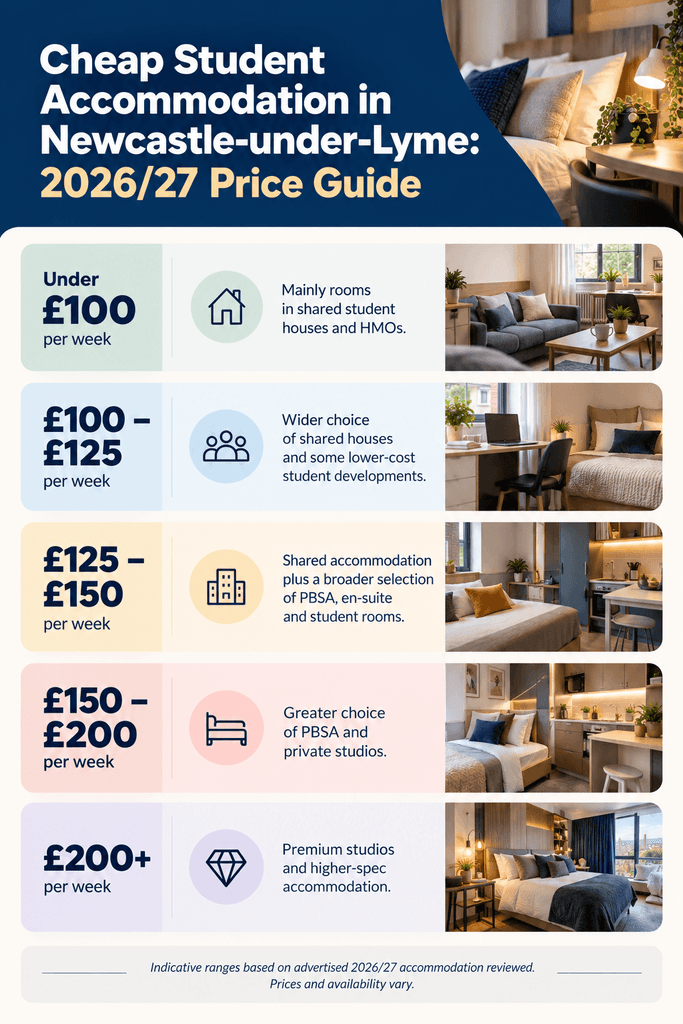
Based on current advertised listings reviewed for the 2026/27 academic year, some of the lowest-priced rooms can be found for under £100 per week, particularly within shared student houses and HMOs. Moving into the £100 – £125 per week range provides more choice, while budgets of around £125 – £150 per week can open up a wider selection of shared accommodation, en-suite rooms and purpose-built student accommodation (PBSA). Private studios generally appear further up the price range in exchange for greater privacy and self-contained facilities.

These prices should be treated as current advertised examples rather than official average rents for Newcastle-under-Lyme. Prices, room types and availability can change throughout the academic year, so it’s always worth checking current student accommodation in Newcastle-under-Lyme before making a decision.
It’s also important not to judge affordability on weekly rent alone. A £95-per-week room with bills and broadband charged separately could work out differently from a more expensive room where those costs are already included. Contract length, utilities, internet, transport and upfront costs can all affect how much you actually spend over the year.
This guide looks at what different student budgets can currently get you in Newcastle-under-Lyme, the cheapest types of accommodation, what to check before booking and how to compare the real cost of different options. For help planning your wider university spending alongside your rent, you can also read our student budgeting guide.
Cheap Student Accommodation in Newcastle-under-Lyme at a Glance
Student accommodation in Newcastle-under-Lyme is available across a wide range of budgets. Based on the 2026/27 advertised listings reviewed for this guide, rooms in shared student houses appear at the lowest end of the market, while increasing your weekly budget generally opens up more choice across en-suite rooms, purpose-built student accommodation (PBSA) and private studios.
| Weekly budget | What students may find |
| Under £100 | Mainly rooms in shared student houses and HMOs |
| £100 – £125 | Wider choice of shared houses and some lower-cost student developments |
| £125 – £150 | Shared accommodation plus a broader selection of PBSA, en-suite and student rooms |
| £150 – £200 | Greater choice of PBSA and private studios |
| £200+ | Premium studios and higher-spec accommodation |
These are indicative price bands based on current 2026/27 advertised listings reviewed for this guide, rather than official Newcastle-under-Lyme market averages. Individual prices, availability, room types and what’s included can change, so always check the latest details before booking.
Before You Compare Prices
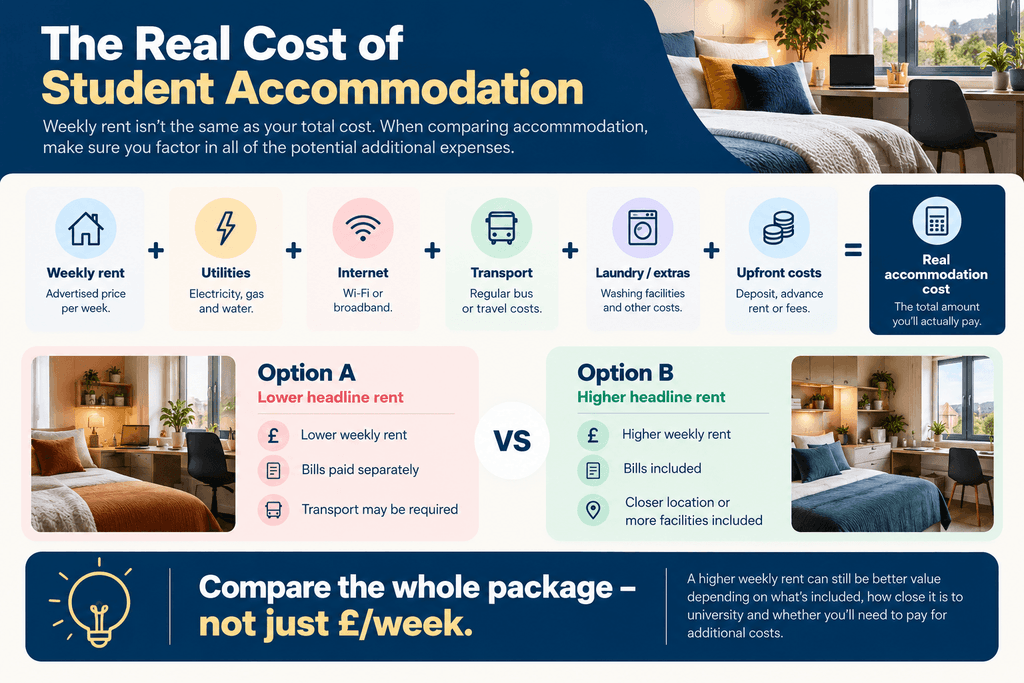
The lowest weekly rent isn’t necessarily the cheapest accommodation overall. When comparing different options, think about the complete cost:
Rent + bills + broadband + transport + contract length + upfront costs = your true accommodation cost.
For example, a cheaper room with utilities and broadband charged separately may ultimately cost more than its headline rent suggests. Likewise, two rooms advertised at the same weekly price could have very different total costs if one has a longer contract or requires additional payments.
The key is to compare like for like and work out what you’ll actually pay across your full tenancy, rather than choosing accommodation based solely on the lowest advertised weekly price.
What Counts as Cheap Student Accommodation in Newcastle-under-Lyme?
There isn’t one official price that makes student accommodation in Newcastle-under-Lyme “cheap”. What represents good value depends on the type of accommodation you’re comparing and what is included in the rent.
For example, a £100-per-week room in a shared student house and a £160-per-week self-contained studio are very different types of accommodation. The shared room may have the lower headline price, but you could be sharing a bathroom, kitchen and living areas with several other students. A studio may cost more but provide your own bathroom, kitchen and living space, with bills and internet potentially included.
When comparing affordable accommodation, consider:
- Room type: Is it a room in a shared house, an en-suite room or a private studio?
- Bathroom: Will you have your own bathroom or share with other students?
- Kitchen: Is the kitchen communal or completely private?
- Bills: Are electricity, water and heating included in the advertised rent?
- Internet: Is broadband included, or will you need to arrange and pay for it separately?
- Furnishings: Is the room fully furnished, and what furniture and appliances are provided?
- Facilities: Does the accommodation include laundry facilities, communal spaces, study areas, security or other amenities?
- Location: How close are you to university, shops and public transport, and will you need to budget for regular travel?
- Tenancy length: How many weeks are you paying for, and what is the total cost across the entire contract?
For students primarily focused on keeping weekly rent down, shared student accommodation is worth considering because many of the lowest-priced examples found during our 2026/27 research were rooms within shared properties.

However, students who want more facilities or a managed student environment may prefer purpose-built student accommodation, while those weighing up different privately managed options can read our guide to private student accommodation vs PBSA.
Ultimately, cheap should mean affordable for the type of accommodation and level of privacy you actually want, rather than simply the lowest number you can find on a property listing.
Can You Find Student Accommodation in Newcastle-under-Lyme for Under £100 a Week?
Yes, it is possible to find student accommodation in Newcastle-under-Lyme for under £100 per week, although options at this price point are more likely to be rooms within shared student houses rather than private studios or higher-specification purpose-built accommodation.
During our review of advertised accommodation for the 2026/27 academic year, we found individual rooms in larger shared houses advertised at around £69 – £70 per week, alongside other house shares and individual rooms at approximately £95 – £98 per week.
These examples show that sub-£100 accommodation does exist, but they shouldn’t be interpreted as an average rental price for Newcastle-under-Lyme. The very cheapest rooms represent the lower end of the listings we reviewed, and availability at these prices can vary considerably throughout the booking period.
What Can You Expect for Under £100 a Week?
At this budget, you’re more likely to find:
- a private bedroom within a shared student house or HMO
- shared kitchens and communal living areas
- shared bathroom facilities in some properties
- fewer on-site facilities than you might find within PBSA
- bills that may be included, excluded or subject to a fair-use allowance

Importantly, a room advertised for £90 per week isn’t automatically cheaper overall than one advertised for £100 or £110 per week.
Our research included lower-priced shared rooms where utilities and broadband were included, as well as others where bills were charged separately or subject to usage allowances. That makes checking exactly what’s included particularly important when comparing accommodation at the cheaper end of the market.
Students working with a strict £100-per-week budget should therefore compare more than the headline rent. Check the room type, bills, broadband, contract length and transport costs before deciding which property offers the best overall value.
It can also be worth starting your search early if your budget is particularly tight. Sub-£100 rooms do appear in Newcastle-under-Lyme, but there is no guarantee that the lowest-priced options will be available when you’re ready to book.
Student Accommodation in Newcastle-under-Lyme Under £150 a Week
If your budget stretches to £150 per week, the range of student accommodation available in Newcastle-under-Lyme becomes considerably broader.
While many of the sub-£100 options identified in our 2026/27 research were rooms within shared houses, the £100 – £150 per week range included a much wider mix of accommodation. Across the advertised listings we reviewed, students could find:
- rooms in shared student houses
- individual rooms within larger student properties
- en-suite accommodation
- purpose-built student accommodation (PBSA)
- some lower-priced studios and managed student developments
This makes £150 per week a useful budget point for students who want to balance affordability with greater choice, privacy or included facilities.
What Can £100 – £150 a Week Get You?
At the lower end of this range, shared accommodation remains common. However, moving towards £125 – £150 per week can open up more managed student accommodation and en-suite options, depending on availability.
Our research found several advertised PBSA options within or around this price range, alongside all-inclusive shared houses. This means students with a £150 weekly ceiling don’t necessarily have to choose a traditional house share.
However, the type of room matters. A £145 en-suite room with a shared kitchen isn’t directly comparable with a £145 self-contained studio, just as an all-inclusive £130 room isn’t necessarily equivalent to a cheaper property where utilities need to be paid separately.
For students interested in managed accommodation, our guide to purpose-built student accommodation explains what PBSA typically offers and how it differs from a traditional student house.

Is £150 a Week a Realistic Student Budget?
Based on the 2026/27 listings reviewed for this guide, £150 per week is a realistic ceiling for finding a range of student accommodation in Newcastle-under-Lyme. It provides considerably more choice than restricting a search to under £100 per week.
That doesn’t mean every room or property will be available below £150. Private studios and higher-specification rooms can exceed this level, while prices and availability can change throughout the booking cycle.
The important thing is to decide what matters most to you. If keeping rent as low as possible is the priority, a shared house may still make sense. If you’re willing to spend closer to £150 per week, you may be able to prioritise features such as an en-suite bathroom, inclusive bills, managed facilities or greater privacy without automatically moving into the premium end of the market.
As with any budget, compare the complete package rather than treating £150 per week as the only figure that matters.
What Is the Cheapest Type of Student Accommodation?
The cheapest type of student accommodation in Newcastle-under-Lyme will depend on availability and what is included in the rent. However, across the 2026/27 listings reviewed for this guide, the lowest advertised prices generally appeared within shared student houses and individual rooms in HMOs.
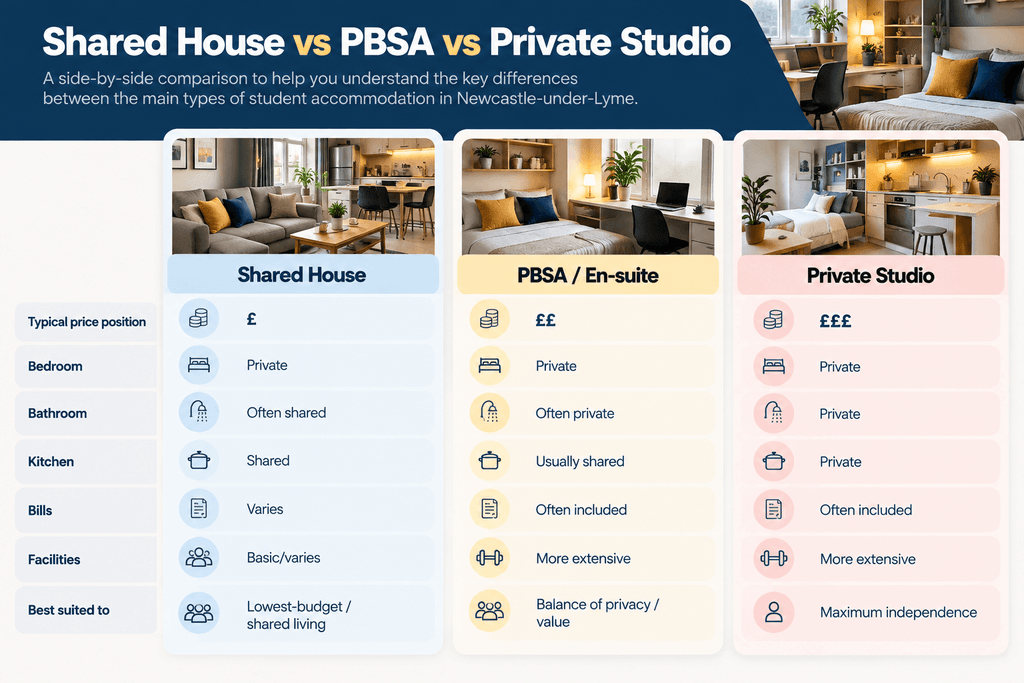
As you move from shared housing towards en-suite PBSA and then private studios, prices generally increase alongside the level of privacy and facilities provided.
Shared Student Houses
For students whose main priority is keeping their weekly rent as low as possible, a room in a shared student house is often one of the first options to consider.
Many of the lowest-priced examples identified during our research were individual bedrooms within larger shared properties, including some advertised below £100 per week.
The main advantages can include lower headline rents, sharing household costs and a sociable living environment. Sharing a property with other students can also make it possible to access a larger kitchen and communal living space without paying for an entire property yourself.
There are compromises to consider. Bathrooms, kitchens and living spaces may be shared, bills aren’t always included in the advertised rent, and your experience will naturally depend partly on who you live with.
Our guide to shared student accommodation covers what to expect if you’re considering this type of property.

PBSA and En-suite Rooms
Purpose-built student accommodation can provide a middle ground between a traditional shared house and a completely self-contained studio.
Depending on the property and room type, students may have a private bedroom and en-suite bathroom while sharing a kitchen and communal space with other residents.
PBSA can also include features such as:
- utilities bundled into the rent
- Wi-Fi
- managed accommodation
- building security
- communal social or study spaces
- on-site facilities
This can make comparing PBSA with a cheaper shared house more complicated than simply looking at the weekly price. A slightly higher rent may already cover costs that would need to be paid separately elsewhere.
You can learn more about how this type of accommodation works in our guide to purpose-built student accommodation.
Private Studios
Private studios generally appeared further up the price range than rooms in shared houses within the listings we reviewed.
The key difference is privacy. Rather than simply having your own bedroom, a studio typically provides a private bathroom, private kitchen and independent living or study space, allowing you to live without sharing your main facilities with housemates.
Depending on the accommodation, the rent may also include bills, internet and access to communal or managed facilities.
For some students, the additional privacy can justify the higher weekly cost. For others, particularly those working with a tighter budget, an en-suite room or shared house may provide a better balance between price and the facilities they actually need.
If you’re deciding between the two room types, our en-suite vs studio student accommodation guide explains the main differences in more detail.
Cheap Rent vs Good Value: Why the Lowest Weekly Price Isn’t Always Cheapest
Imagine you’re comparing two rooms in Newcastle-under-Lyme:
- Room A: £95 per week + bills
- Room B: £120 per week including bills and broadband
Room A clearly has the lower advertised weekly rent. However, that doesn’t necessarily mean it will cost less overall.
Once electricity, heating, water and broadband are added to Room A, the difference between the two options could become much smaller. Other costs, such as transport and the length of the tenancy, can change the calculation further.
This is why it’s important to look beyond the headline weekly price when searching for cheap student accommodation.
What Should You Compare?
Before deciding which property offers better value, check the following:
- Electricity: Is it included in your rent or paid separately?
- Gas and heating: How is the property heated, and will you need to budget for it separately?
- Water: Is the water bill included?
- Broadband: Is Wi-Fi provided, and is there an additional charge?
- Contents insurance: Is any cover included, or will you need to arrange your own?
- Laundry: Does the property have its own washing machine, or will you pay to use communal laundry facilities?
- Transport: Will you need to regularly pay for buses or other transport to university?
- Additional facilities: Are you paying more for facilities you’ll genuinely use, such as communal areas, study spaces or on-site services?
- Contract duration: How many weeks of rent are you committing to pay?
Our guide to what’s included in student accommodation explains the costs and facilities you may find bundled into your rent.
Compare the Total Cost, Not Just the Weekly Rent
A useful way to approach accommodation is to calculate what you’ll pay across the entire tenancy.
For example, a room with a lower weekly rent could become less attractive if you then need to pay separately for utilities, broadband and regular transport. Equally, a more expensive all-inclusive room isn’t automatically better value if you’re paying for facilities you don’t need.
Students considering accommodation where utilities are bundled into one payment can read our guide to all-inclusive student accommodation to understand what may be covered.
Ultimately, the aim isn’t simply to find the lowest advertised rent. It’s to find accommodation that fits your budget once all of the costs associated with living there are taken into account.
Are Bills Included in Cheap Student Accommodation?
Cheap student accommodation doesn’t automatically mean that bills are excluded from the weekly rent.
In fact, several of the lower-cost shared rooms we reviewed for the 2026/27 academic year included household bills, while other properties advertised a lower weekly rent but required students to pay utilities separately. Some listings also included bills subject to a fair-use allowance, meaning additional charges could apply if household usage exceeds a specified limit.
There isn’t one rule that applies to every shared house, PBSA property or private studio in Newcastle-under-Lyme, so it’s important to check exactly what is included before comparing prices.
Which Bills Should You Check?
When reviewing a student accommodation listing, look for whether the rent includes:
- Electricity
- Gas and heating
- Water
- Wi-Fi or broadband
- Contents insurance, where provided
- TV licence, where applicable
If a property is advertised as bills included or all-inclusive, don’t assume that necessarily means unlimited usage. Check whether there is a fair-use policy and, if so, what the allowance covers and what happens if you exceed it.
You should also check whether every utility is included. For example, a property could include electricity, gas and water while requiring students to arrange another service separately.
Are All-Inclusive Rooms Better Value?
They can make budgeting easier because more of your accommodation costs are combined into one regular payment. However, whether an all-inclusive room represents better value will depend on the rent, what’s included and how it compares with similar accommodation.
Our guide to all-inclusive student accommodation explains how this type of arrangement works, while our guide to what’s included in student accommodation covers the wider costs and facilities you should check before booking.
The key takeaway is simple: don’t assume a cheap room excludes bills, and don’t assume a higher-priced room includes everything. Check each property individually and compare the complete cost before deciding which option best fits your budget.
How Contract Length Changes the Real Price
Weekly rent is useful for comparing student accommodation, but it doesn’t tell you how much you’ll actually pay over the full tenancy.
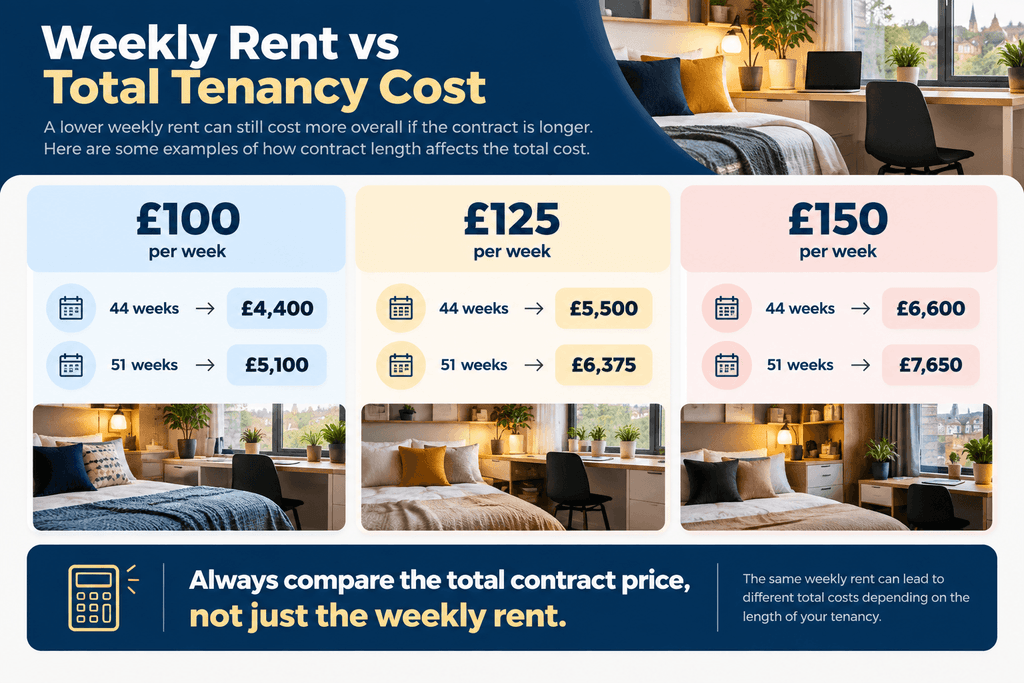
A property with a lower weekly rent but a longer contract can cost more overall than accommodation with a slightly higher weekly price and a shorter tenancy. That’s why it’s worth checking both figures before deciding which option is cheaper.
For example, £125 per week might initially look considerably cheaper than £150 per week. But the total amount you pay depends on how many weeks you’re contracted for.
Illustrative Student Accommodation Costs by Contract Length
| Weekly rent | 44 weeks | 45 weeks | 51 weeks |
| £100 | £4,400 | £4,500 | £5,100 |
| £125 | £5,500 | £5,625 | £6,375 |
| £150 | £6,600 | £6,750 | £7,650 |
| £175 | £7,700 | £7,875 | £8,925 |
These figures are mathematical examples designed to show how contract length affects total cost. They are not the contract lengths or prices offered by every student property in Newcastle-under-Lyme.
Why Does Contract Length Matter?
The difference can be significant.
At £150 per week, a 44-week tenancy would total £6,600, while paying the same weekly rent for 51 weeks would total £7,650. That’s a difference of £1,050, despite the advertised weekly price being exactly the same.
Equally, accommodation advertised at £125 per week for 51 weeks would cost £6,375, while a hypothetical 44-week contract at £150 per week would cost £6,600. The weekly price differs by £25, but the difference across the full tenancy is only £225.
This doesn’t mean a shorter contract is automatically better. A longer tenancy may suit students who want to remain in Newcastle-under-Lyme over the summer, while a shorter contract could be more appropriate if you only need accommodation during the academic year.
The important thing is to compare total tenancy cost alongside weekly rent.
Before booking, check:
- the advertised weekly rent
- the exact number of weeks in the contract
- the total rent payable across the tenancy
- whether bills are included for the full period
- the tenancy start and end dates
- whether you’ll actually need the accommodation for the entire contract
This gives you a much clearer picture of affordability than comparing weekly prices alone
Deposits, Guarantors and Upfront Costs
Finding accommodation with an affordable weekly rent is only part of the equation. You also need to consider how much money may be required when you book and how the remaining rent needs to be paid.
Payment arrangements vary between properties and accommodation providers, so always check the specific terms before committing to a tenancy.
Deposits
Some student accommodation requires a deposit to secure your room. The amount can vary, so include this in your upfront budget rather than looking solely at the first rent payment.
Before paying, check how much the deposit is, when it needs to be paid and the conditions under which it will be returned.
Advance Rent and Instalments
You should also check when your rent is due.
Depending on the accommodation and your circumstances, you may be able to pay in instalments, while other arrangements could require rent to be paid further in advance.
When comparing two similarly priced rooms, consider:
- how much is required to secure the accommodation
- when the first rent payment is due
- how many instalments are available
- the dates and amounts of subsequent payments
- the total amount payable across the tenancy
This is particularly important if you’re relying on student finance and need your accommodation payments to work alongside your maintenance payments.
Guarantor Requirements
Some accommodation providers or landlords may require a guarantor, particularly when rent is being paid in instalments.
A guarantor typically agrees to take financial responsibility if the tenant doesn’t meet their rental obligations. Requirements can vary between providers, so our guide to student accommodation guarantors explains the process in more detail.
This can be an especially important consideration for international students, who may not have access to a suitable UK-based guarantor. Depending on the accommodation provider, alternatives may be available, such as different payment arrangements or third-party guarantor services.
StudentFM also provides information about its guarantor waiver programme, which may provide an alternative in eligible circumstances. Always check the terms and availability for the specific accommodation you’re considering.
Check the Cancellation and Refund Terms
Before paying a deposit or making an advance rent payment, read the cancellation terms carefully.
You should understand what happens if your circumstances change, including whether any payments are refundable and what conditions or deadlines apply.
StudentFM’s cancellation policy provides further information for relevant bookings, but you should always check the terms attached to your specific property and tenancy before committing.
Ultimately, genuinely affordable student accommodation needs to work for your finances both when you book and throughout the tenancy. A low weekly rent is less useful if the upfront payment requirements don’t fit your budget.
Does Location Affect the Real Cost of Student Accommodation?
Yes. Where you live can affect how much student accommodation costs overall, even if the property itself has a lower weekly rent.
A cheaper room further away from university may initially look like the most affordable option, but regular transport costs can reduce some of those savings. Equally, accommodation with a slightly higher weekly rent could work well for your budget if its location allows you to walk or cycle more often.
For students studying at Keele University, it’s therefore worth considering the cost of getting between your accommodation and campus alongside the rent itself.

Think About Your Regular Journeys
Before booking, consider how you’ll travel to university and the places you’ll use most frequently.
This could include:
- Distance from Keele: How far is the accommodation from campus, and how often will you need to make the journey?
- Bus routes: Is there a convenient bus connection, and will regular fares need to become part of your weekly budget?
- Walking and cycling: Can some everyday journeys realistically be made without paying for transport?
- Supermarkets: Having affordable food shops nearby could make everyday budgeting easier.
- Town-centre amenities: Living close to shops, cafés and other services may reduce the number of additional journeys you need to make.
The cheapest location on paper therefore isn’t necessarily the cheapest location for your particular routine.
For example, saving £10 or £15 per week on rent may look attractive, but the calculation changes if living further away means spending more on transport throughout the academic year. On the other hand, students who don’t mind walking or cycling may be able to keep those additional costs much lower.
You can explore current student accommodation in Newcastle-under-Lyme to compare options within the town.
It’s also worth remembering that Newcastle-under-Lyme and Stoke-on-Trent are separate places, despite their proximity. Students considering a wider search can explore student accommodation in Stoke-on-Trent separately and compare the location, transport requirements and total costs with Newcastle-under-Lyme options.
The key is to consider rent and location together. A lower weekly price can still be good value, but only if any additional travel costs continue to make sense for your overall student budget.
Cheap Private Studios in Newcastle-under-Lyme: When Paying More Can Offer Better Value
If you’re specifically looking for a private student studio in Newcastle-under-Lyme, it’s important to compare it with other studios rather than benchmarking the price against the cheapest room in a shared house.
A bedroom in a five-bedroom student house and a self-contained studio provide very different living arrangements. The shared room will often have a lower headline rent because facilities such as the kitchen, bathroom and living areas may be shared between several students.
With a private studio, you’re generally paying more for privacy, independence and your own facilities.
What Do You Get With a Private Student Studio?
Depending on the property, a studio can provide:
- Private kitchen: Your own space for preparing and storing food rather than sharing a communal kitchen.
- Private bathroom: Your own shower, toilet and bathroom facilities.
- Personal living and study space: A self-contained room designed for sleeping, studying and relaxing.
- Inclusive bills: Utilities may be incorporated into the weekly rent, making monthly budgeting more predictable.
- Wi-Fi: Internet may also be included as part of the accommodation package.
- Managed accommodation: Rather than renting a room from an individual landlord, some studios form part of professionally managed student developments.
- Additional facilities: Depending on the property, residents may also have access to communal or on-site facilities.
This means a studio costing more each week isn’t necessarily offering the same product at a higher price. You’re paying for a different level of privacy and independence.

When Can a Studio Offer Better Value?
A private studio may make sense if having your own kitchen and bathroom is a priority, you prefer living independently, or you value having more of your accommodation costs combined into one regular payment.
That doesn’t make studios the cheapest choice for every student. If your priority is simply minimising weekly rent, shared accommodation will generally provide more options at the lower end of the price range.
However, if you already know you want a self-contained space, comparing a £160 studio with a £90 room in a shared house isn’t particularly useful. Instead, compare studios based on their weekly rent, total tenancy cost, bills, internet, facilities, location and room specification.
One option for students looking for private studio accommodation is The Metropolis, StudentFM’s purpose-built student accommodation in Newcastle-under-Lyme. The next section looks more closely at what it offers and how its studio options fit into the wider 2026/27 accommodation market.
The Metropolis: All-Inclusive Student Studios in Newcastle-under-Lyme
For students specifically comparing private studios, The Metropolis provides an all-inclusive student accommodation option in Newcastle-under-Lyme.
The Metropolis isn’t being presented as the absolute cheapest student accommodation in the town. As we’ve seen throughout this guide, students primarily focused on finding the lowest possible weekly rent are more likely to find cheaper options within shared houses and HMOs.
Instead, The Metropolis is useful to compare if you’re looking for a self-contained private studio and want more of your accommodation costs included within one weekly price.

What’s Included at The Metropolis?
The development offers a selection of private studio categories, allowing students to choose between different room specifications and price points depending on their budget and availability.
Key features include:
- private self-contained studios
- private kitchen facilities
- private bathroom facilities
- bills included in the rent
- high-speed internet
- different studio categories
- professionally managed student accommodation
- Newcastle-under-Lyme location
When comparing The Metropolis with other accommodation, the important figure isn’t simply the advertised weekly rent. Look at the complete package and consider what you would otherwise need to pay for separately.
For example, a cheaper private rental may still require separate payments for electricity, heating, water and broadband. An all-inclusive studio combines more of those costs into the accommodation price, making it easier to understand what you’ll be paying throughout your tenancy.
Compare Like for Like
If you’re considering The Metropolis, compare it with other private studios offering a similar level of privacy and facilities, rather than with the cheapest bedroom available in a shared house.
Check the current studio price, what’s included, contract length and total tenancy cost before making your decision. Prices and room availability can change, so the latest information should always be checked directly on The Metropolis property page.
You can also view available StudentFM properties if you’d like to compare The Metropolis with other StudentFM accommodation options.
How to Find Cheaper Student Accommodation in Newcastle-under-Lyme
Finding cheaper student accommodation isn’t just about sorting property listings from the lowest price to the highest. A little flexibility around room type, location, contract length and what’s included can make a significant difference to your overall accommodation costs.
Here are seven things to consider when searching for affordable student accommodation in Newcastle-under-Lyme.
1. Start Looking Early
Starting your search early gives you more time to compare properties across different price points rather than choosing from whatever happens to remain available later in the booking cycle.
This can be particularly useful if you’re looking for accommodation within a strict budget, such as under £100 or £150 per week.
Our guide to why you should look for student accommodation early explains the benefits of beginning your search sooner.
2. Decide Whether You Need a Studio or Are Happy Sharing
One of the biggest factors affecting your budget is the type of accommodation you choose.
If your priority is keeping rent as low as possible, being open to a room in a shared student house can give you access to more lower-priced options. If having your own kitchen and bathroom is important, you’ll need to compare your budget against private studios rather than shared rooms.
Deciding which features are essential before you start searching makes it easier to compare suitable properties.

3. Compare Bills-Inclusive and Bills-Exclusive Rent
Don’t immediately dismiss a property because its weekly rent is slightly higher.
A £120-per-week room including bills and broadband could compare differently with a £100-per-week room once utilities and internet are added separately.
Check exactly what’s included and calculate the likely total cost before deciding which option is genuinely cheaper.
4. Compare the Full Tenancy Cost
Always look beyond the weekly price.
Multiply the weekly rent by the number of weeks in the tenancy and compare the resulting totals. A cheaper weekly rate over a significantly longer contract could cost more overall than a higher rate over a shorter tenancy.
You should also consider whether you actually need accommodation for the entire contract period.
5. Check Transport Before Choosing a Cheaper Location
Moving further away can sometimes give you access to lower-priced accommodation, but factor in the cost and convenience of getting to university.
If saving £10 per week on rent means regularly paying for additional transport, some of that saving disappears.
Consider bus connections, walking and cycling distances alongside the rent before deciding whether a cheaper location works for your budget.
6. Understand Deposits and Payment Schedules
Check how much money you’ll need when booking rather than concentrating solely on the weekly rent.
Look at the deposit, advance rent requirements, available instalment schedules and any guarantor requirements. An affordable property still needs to work with your finances at the point you secure it and throughout the tenancy.
Our guide to choosing your student accommodation wisely covers some of the wider factors worth considering before committing to a property.
7. Don’t Choose Accommodation Purely Because of Cashback or Discounts
Cashback offers and temporary discounts can look attractive, and they’re frequently highlighted when student accommodation is advertised online.
However, a promotion shouldn’t replace a proper comparison of the underlying accommodation cost.
Look at the standard rent, total tenancy cost, contract length, bills, room type and location first. You can then consider any genuine promotion as an additional benefit rather than allowing it to determine which property you choose.
Ultimately, the cheapest suitable accommodation will depend on your priorities. Decide what you need, set a realistic budget and compare the complete cost of each option.
You can search available StudentFM properties when you’re ready to start comparing accommodation.
How to Compare Cheap Student Accommodation Before Booking
Once you’ve found accommodation that appears to fit your budget, take a few minutes to compare the details before booking.
Two properties with similar weekly rents can have very different total costs, facilities and payment requirements, so use the following checklist to make sure you’re comparing like for like.
Student Accommodation Comparison Checklist
- Weekly rent – How much is the advertised rent per week?
- Total tenancy cost – How much will you pay across the entire contract?
- Contract length – How many weeks does the tenancy run for, and what are the start and end dates?
- Bills included or excluded – Are electricity, heating and water included in the rent?
- Fair-use limits – If bills are included, is there a usage allowance or fair-use policy?
- Deposit and upfront payments – How much will you need to pay when securing the accommodation?
- Guarantor requirements – Will you need a guarantor, and are there alternatives if you don’t have one?
- Distance to university – How far is the property from your campus and the places you’ll visit regularly?
- Transport costs – Will you need to budget for regular bus or other transport fares?
- Room, bathroom and kitchen type – Are these facilities private, en-suite or shared with other students?
- Wi-Fi – Is broadband included in the rent, and is there an additional charge?
- Laundry – Are washing facilities provided, and will you need to pay each time you use them?
- Security – What security measures are provided at the property?
- Cancellation conditions – What happens if your circumstances change after you’ve booked?
Don’t Compare on Price Alone
Once you’ve worked through the checklist, you’ll have a much better idea of which property actually offers the right balance between price, location, privacy and facilities.
Security should form part of that decision too. Our guide to how to know if your student accommodation is safe and secure covers some of the features worth checking before booking.
If you have questions about booking, payments or living in StudentFM accommodation, you can also visit the StudentFM FAQs.
The goal isn’t necessarily to choose the property with the lowest weekly rent. It’s to understand exactly what you’re getting for your money and what you’ll actually pay from the beginning to the end of your tenancy.

When Should You Book Cheap Student Accommodation for 2026/27?
If you’re working with a strict accommodation budget, it can be useful to start comparing options early.
Lower-cost student rooms are inventory-dependent, which means the choice available at any given price point will change as rooms are booked. Waiting doesn’t necessarily mean that prices will always increase, but it can mean having fewer properties or room types available within your preferred budget.
This is particularly relevant if you’re looking for accommodation under £100 or £150 per week, where you may have specific requirements around bills, location or room type as well as price.
Starting earlier gives you more time to compare the weekly rent, total tenancy cost, what’s included and the type of accommodation available without having to make a decision based solely on what’s left.
For more advice on timing your search, read our guide to why you should look for student accommodation early.
FAQs
There is no official price that defines cheap student accommodation in Newcastle-under-Lyme. Based on the 2026/27 advertised listings reviewed for this guide, we found examples of rooms in shared properties for under £100 per week, with considerably more choice as budgets increased towards £100 – £150 per week. Prices and availability can change, so these should be treated as current examples rather than market averages.
Yes. Our research found student rooms advertised for under £100 per week, predominantly within shared houses and HMOs. However, availability at this price can vary, and students should check whether bills, broadband and other costs are included before comparing options.
Yes. The 2026/27 listings reviewed showed considerably more choice within a £150-per-week budget, including shared student accommodation, individual rooms, en-suite options and some PBSA and student developments. The exact options available will depend on when you search and which room types remain available.
Based on the listings reviewed for this guide, rooms within shared student houses generally appeared at the lowest advertised prices. However, a lower weekly rent doesn’t necessarily mean a lower total cost, particularly if utilities, broadband or transport need to be paid separately.
Sometimes. Several lower-priced rooms reviewed for this guide included household bills, while others excluded utilities or applied fair-use allowances. Always check the individual property listing to see whether electricity, heating, water and Wi-Fi are included in the advertised rent.
Neither option is universally cheaper. Shared student houses often appeared at the lower end of the advertised prices we reviewed, but PBSA may include bills, Wi-Fi, security and additional facilities within the rent. Compare the total tenancy cost and what’s included rather than choosing based on accommodation type alone.
Private studios generally appeared at a higher price point than rooms in shared houses within the 2026/27 listings reviewed. This reflects the different accommodation provided, with studios typically offering a private kitchen, private bathroom and self-contained living space. Students looking specifically for studios should compare them with other studios rather than the cheapest shared rooms.
Consider accommodation in Newcastle-under-Lyme and compare shared houses, PBSA, en-suite rooms and private studios according to your budget. You should also factor in the distance to Keele University and any regular transport costs, as cheaper rent further away won’t necessarily result in the lowest overall cost.
It’s worth starting your research early enough to compare a broad range of properties and room types. Lower-cost accommodation is dependent on availability, so students with strict budgets may benefit from comparing options before the choice becomes more limited. This doesn’t mean prices will necessarily increase later, but the accommodation available within your preferred budget can change as rooms are booked.
Conclusion: Finding Affordable Student Accommodation in Newcastle-under-Lyme
Finding affordable student accommodation in Newcastle-under-Lyme ultimately comes down to more than choosing the property with the lowest advertised weekly rent.
Students focused on keeping their headline rent as low as possible are likely to find the cheapest options among rooms in shared student houses and HMOs. If you have more flexibility in your budget, you can access a wider choice of PBSA, en-suite accommodation and private studios, where bills, broadband and additional facilities may already be included in the price.
The best-value accommodation will therefore depend on the combination that works for you:
Budget + privacy + bills + location + contract length + facilities.
Before booking, compare the complete cost across your tenancy, check exactly what’s included and consider whether you’re paying for the facilities and level of privacy you actually want.
You can explore current student accommodation in Newcastle-under-Lyme or view The Metropolis to compare available StudentFM accommodation.