
The cost of living in Newcastle-under-Lyme can be relatively manageable for students, particularly when compared with some of the UK’s larger university cities. However, how much you actually need each week or month will depend heavily on the type of accommodation you choose, whether your bills are included, how much you spend on food, how often you travel and your overall lifestyle.
Newcastle-under-Lyme is a popular base for students studying at Keele University and the University of Staffordshire, with accommodation, shops, restaurants and everyday amenities all within easy reach. Choosing the right student accommodation in Newcastle-under-Lyme can also make a significant difference to your overall budget, especially if utilities and internet are already included in your rent.

In this 2026/27 guide, we’ll break down the main costs students should plan for, including accommodation, household bills, food, transport, socialising, fitness and everyday expenses. We’ll also look at realistic weekly and monthly student budgets to help you work out how much money you may need while living and studying in Newcastle-under-Lyme.
Cost of Living in Newcastle-under-Lyme at a Glance
For the 2026/27 academic year, a student living in Newcastle-under-Lyme should typically budget around £800 – £1,250 per month for their main living expenses. The exact amount will depend heavily on accommodation choice and lifestyle, particularly how often you travel, eat out, and socialise.
| Expense | Weekly estimate | Monthly estimate |
| Accommodation | £100 – £200 | £433 – £867 |
| Groceries | £25 – £45 | £108 – £195 |
| Transport | £5 – £20 | £22 – £87 |
| Eating out & socialising | £20 – £50 | £87 – £217 |
| Phone & subscriptions | — | £15 – £35 |
| Laundry & personal expenses | — | £20 – £50 |
| Estimated total | £150 – £315 | £685 – £1,450 |
These figures are intended as a practical guide rather than a fixed budget. Current 2026 student listings in Newcastle-under-Lyme show shared accommodation at around £100 – £135 per week, while private studios and purpose-built accommodation can cost around £150 – £200+ per week, depending on the property and room type.
Transport can remain relatively inexpensive if you live centrally and walk or cycle regularly. For students travelling to Keele University, the current Keele Key costs £19 per week, while the wider North Staffordshire Student Smart ticket is available for £14 per week.
Accommodation will usually take up the largest part of your budget, so it is important not to compare properties based on the advertised weekly rent alone. A slightly higher rent may include electricity, heating, water and Wi-Fi, while a cheaper private rental could require these to be paid separately. Looking at your total monthly living cost gives you a much better idea of what you can realistically afford.
If you’re still comparing your options, take a look at StudentFM’s student accommodation in Newcastle-under-Lyme to see current room choices and prices.

How Much Does Student Accommodation Cost in Newcastle-under-Lyme?
Accommodation will usually be the largest part of a student’s living costs in Newcastle-under-Lyme. Prices vary considerably depending on whether you choose a room in a shared house, purpose-built student accommodation or a private studio, as well as the property’s location, facilities and tenancy length.
It is also important to look beyond the advertised weekly rent. A cheaper room may require you to pay household bills separately, while another property may include utilities, Wi-Fi and other services within the rent.
Shared Student Houses
Shared student houses and HMOs can offer some of the lowest headline rents in Newcastle-under-Lyme, particularly for groups of students who are happy to share kitchens, bathrooms and communal areas.
However, the advertised rent doesn’t always represent the full cost of living in the property. Before signing a tenancy, check:
- whether electricity, gas/heating and water are included
- whether broadband or Wi-Fi is included
- how much deposit is required
- the length of the tenancy
- how far the property is from your university
- how much you may need to spend on buses or other transport.
This is particularly important for students studying at Keele University, as choosing cheaper accommodation further from campus could increase your regular transport costs.
Shared housing can still represent excellent value, but compare the total cost of the tenancy rather than choosing solely on the lowest weekly rent.

Purpose-Built Student Accommodation (PBSA)
Purpose-built student accommodation (PBSA) is accommodation specifically designed around student living. Rather than simply renting a bedroom in a conventional house, PBSA developments can combine accommodation with utilities, facilities and services within one weekly price.
Depending on the property, this can include:
- electricity and heating
- water
- high-speed Wi-Fi
- communal spaces
- on-site maintenance
- security
- contents insurance.
This can make budgeting considerably easier because many of your essential housing costs are combined into one payment.
For this reason, a PBSA room with a slightly higher advertised weekly price could potentially cost less overall than a private rental once additional household bills are considered.
There are advantages to both options, so it’s worth comparing private student accommodation vs PBSA before deciding which type of accommodation best suits your budget and preferred way of living.
Private Student Studios
Private studios are a popular choice for students who want greater independence and privacy. Rather than sharing kitchens and bathrooms with housemates, studios typically provide your own bedroom, bathroom and kitchen facilities within one self-contained space.
They generally sit towards the higher end of the student accommodation market, but the price can also include utilities and facilities that would otherwise need to be paid for separately.
At The Metropolis in Newcastle-under-Lyme, StudentFM’s current 2026/27 studio options include:
| Studio type | 2026/27 price |
| Classic Studio | From £157 pppw |
| Premium Studio | £171 pppw |
| Premium Plus Studio | £194 pppw |
| Ultimate Studio | £204 pppw |
For example, students choosing the Classic Studio at The Metropolis can have their own private kitchen and en-suite bathroom, with bills and high-speed internet included.
Prices can vary according to the room type, size, tenancy length and current availability, so always check the latest room information before calculating your final accommodation budget.
The key when comparing shared houses, PBSA and studios is therefore not simply “Which has the cheapest weekly rent?” Instead, compare what you receive for that price, what additional costs you’ll need to pay and what the accommodation will cost across the full length of your tenancy.

What Does Your Student Rent Actually Include?
When comparing student accommodation in Newcastle-under-Lyme, the cheapest advertised weekly rent isn’t necessarily the cheapest option overall. What is included within that rent can make a significant difference to how much you actually spend each month.
Before comparing properties, check whether your rent includes:
- electricity
- gas or heating
- water
- broadband or Wi-Fi
- contents insurance
- maintenance
- access to communal facilities.
For example, a room with a lower weekly rent may initially appear better value, but if electricity, heating, water and internet all need to be paid separately, the total cost could be considerably higher than the headline figure suggests.
This is one of the advantages of all-inclusive student accommodation, where many of these regular household costs are incorporated into the rent. It can also make budgeting easier because you have fewer separate bills to plan for throughout the academic year.
At The Metropolis, for example, utilities and high-speed internet are included in the rent. This means students can factor these essential costs into their accommodation budget from the outset rather than estimating separate monthly utility bills.
There can still be additional expenses depending on the property and your lifestyle, such as laundry, TV licensing, subscriptions or optional services, so always check exactly what your tenancy includes before booking.
For a more detailed breakdown of the costs and services you should look for, read our guide to what’s included in student accommodation.
How Much Should Students Budget for Food?
Food is likely to be one of your largest regular expenses after accommodation. How much you spend will depend on where you shop, how often you cook, and how regularly you eat out or order takeaways.
The 2026 National Student Money Survey found that students across the UK spend an average of £155 per month on groceries, equivalent to roughly £36 per week. This provides a useful benchmark, although your own spending could be considerably lower or higher.
Weekly Grocery Shopping
A realistic starting point for a student food budget in 2026 is:
| Shopping style | Suggested weekly budget |
| Budget-conscious | £25 – £30 |
| Typical student shop | £35 – £40 |
| Higher-spend shop | £45 – £55+ |
A budget-conscious shop generally means planning meals in advance, cooking most meals from scratch and choosing supermarket own-brand products. Around £35 – £40 per week is a sensible middle ground given the current UK student average of approximately £36.
Students living in Newcastle-under-Lyme have several supermarket options. For example, Morrisons has a supermarket on Goose Street in the town, making it possible to do a larger weekly shop without travelling far outside Newcastle-under-Lyme.

Eating Out and Takeaways
Eating out doesn’t have to destroy your student budget, but several meals, coffees and takeaways each week can quickly add up.
As a practical 2026 guide, students could expect to spend roughly:
- Coffee: around £2.50 – £3.50
- Inexpensive lunch or meal deal: around £5 – £10
- Takeaway: around £8 – £15+ per person
- Restaurant/pub meal: around £10 – £20+ per person
These ranges are consistent with current local examples. Family Bakery Cafe in Newcastle-under-Lyme lists coffees from around £2.60 – £3.45, while The Milehouse currently advertises a £10 lunch menu.
The national student survey provides another useful benchmark: students currently report spending an average of £45 per month on takeaways and eating out, separate from their grocery spending.
You don’t necessarily need to stop eating out altogether. Giving yourself a specific monthly food-and-takeaway allowance can make it easier to enjoy meals with friends without losing track of your wider budget.
How to Spend Less on Food
One of the easiest ways to reduce food costs is to plan what you’re going to eat before you go shopping. Creating a weekly meal plan helps you buy what you actually need and can reduce both impulse purchases and food waste.
Other simple ways to save include:
- cook larger portions and freeze leftovers for another day
- choose supermarket own-brand products for everyday essentials
- take a shopping list and stick to it
- share larger packs and ingredients with housemates
- make use of genuine student discounts and supermarket loyalty offers
- prepare lunches rather than buying food between lectures every day
- keep takeaways as an occasional expense rather than a regular habit.
If you’re new to cooking for yourself, our guide to healthy meal planning and easy recipes for busy students has practical ideas for keeping meals affordable and manageable.
You can also read our beginner’s guide on how to meal plan for more ways to organise your weekly food shop and make your budget go further.
Student Transport Costs in Newcastle-under-Lyme
Newcastle-under-Lyme is a market town in Staffordshire and should not be confused with Newcastle upon Tyne in the North East. It sits close to both Keele University and Stoke-on-Trent, making buses particularly important for students travelling between their accommodation, university and the wider local area.
Keele University is approximately two miles from Newcastle-under-Lyme, with the university describing the town as around a 10-minute bus journey from campus. The main number 25 bus connects Keele University with Newcastle-under-Lyme, Royal Stoke University Hospital, Stoke-on-Trent railway station and Hanley.
Students attending the University of Staffordshire may also need to factor regular travel towards Stoke-on-Trent into their budget, depending on where their course is based.
Walking and Cycling
If you live close to Newcastle-under-Lyme town centre, many everyday journeys can be completed on foot. Shops, supermarkets, cafés, restaurants and other local amenities are concentrated around the town, which can help keep day-to-day transport costs low.
Cycling can also reduce regular travel costs. Keele supports students travelling to campus by bike and provides facilities including cycle storage, while the university also publishes information for students cycling to and from campus.
However, students shouldn’t automatically assume they’ll be able to walk everywhere. Keele University is outside Newcastle-under-Lyme town centre, so regular travel to campus may still require a bus or bike.

Bus Travel
The number 25 bus is one of the most useful services for students living in Newcastle-under-Lyme. It connects Keele University with Newcastle-under-Lyme, Stoke-on-Trent and Stoke-on-Trent railway station.
For 2026/27, Keele students and staff with a valid Keele Card can use the Keele Key, which is valid across a wider network of participating local bus services. Current prices are:
| Keele Key ticket | 2026/27 price |
| Day ticket | £5.50 |
| Weekly ticket | £19 |
| Annual ticket – 10 months | £400 |
The annual ticket covers the period from 1 September to 30 June, which could make it more economical for students who expect to use buses regularly throughout the academic year.
Keele has also funded additional weekday morning buses from Newcastle-under-Lyme bus station to campus for the autumn 2026 term, reflecting the importance of this route for commuting students.
If you’re choosing accommodation away from campus, factor these transport costs into your overall housing budget. Saving £10 per week on rent may not represent the same saving overall if you then need to pay for regular bus travel.
Train Travel
Newcastle-under-Lyme does not have its own railway station, so students travelling further afield will commonly use Stoke-on-Trent railway station. The number 25 bus provides a direct connection between Keele University and the station, travelling via Newcastle-under-Lyme.
Students who regularly travel home by train may also benefit from a 16 – 25 Railcard. In 2026, it costs £35 for one year or £80 for three years and provides one-third off most eligible rail fares. Full-time mature students aged 26 or over can also qualify subject to the Railcard’s eligibility requirements.
There are some restrictions to be aware of. For journeys made between 4:30am and 10am Monday to Friday, the 16 – 25 Railcard generally has a £12 minimum fare, although this does not apply to Advance fares and there are exceptions at certain times of year.
Overall, students living centrally in Newcastle-under-Lyme may be able to keep everyday transport spending relatively low by walking or cycling, while those travelling regularly to Keele University or Stoke-on-Trent should include bus travel as a recurring part of their monthly budget.
How Much Does a Student Night Out Cost in Newcastle-under-Lyme?
Socialising is a normal part of student life, so it makes sense to include it in your budget rather than treating every night out, takeaway or cinema trip as an unexpected expense.
Newcastle-under-Lyme has pubs, bars, restaurants, takeaways and a cinema around the town centre, and current 2026 prices suggest that a student could spend anywhere from £10 – £15 on a low-cost evening to £30 – £50+ on a bigger night out, depending on drinks, food and transport.
As a rough guide, these are sensible amounts to budget:
| Expense | Typical 2026 cost |
| Pint / alcoholic drink | £3 – £6+ |
| Pub meal | £10 – £15 |
| Takeaway | £6 – £15 |
| Cinema ticket | £7 – £10 |
| Lower-cost night out | £10 – £20 |
| Bigger night out | £30 – £50+ |
| Taxi | Varies by distance, time and operator |
These are ranges rather than fixed prices, but current local menus give a useful indication of what students might encounter. At Yates Newcastle-under-Lyme, for example, pub favourites such as lasagne and an all-day breakfast are currently £10.50, while fish and chips costs £11.
Takeaway prices vary substantially too. Sherif Kebab House in Newcastle-under-Lyme currently has meal deals from around £7 – £11, while a set meal for one at Malik’s is £14.
A cinema trip can also be relatively affordable. Current ticket offers for Vue Newcastle-under-Lyme start at around £7 including the booking fee, with upgraded seating costing more.

The biggest variation is likely to come from how much you drink and whether you need a taxi afterwards. A few drinks, food and a journey home can quickly turn an inexpensive evening into a £30 – £50+ expense. Taxi costs also depend on the distance travelled, time of day and operator, so they are better treated as a variable expense rather than assuming one standard fare.
You don’t need to spend that much every time you socialise. Pub offers, student events and sharing a takeaway can reduce the cost considerably. Current local promotions include discounted food-and-drink deals during the week, although these offers change regularly.
There are plenty of ways to socialise without spending much at all. Cooking with housemates, film or games nights, university society events, walking or running with friends and spending time in local parks can all provide lower-cost alternatives.
A useful approach is to give yourself a separate weekly or monthly social budget. That way, nights out and meals with friends are already accounted for without eating into the money you’ve set aside for accommodation, food and transport.
Gym, Sport and Fitness Costs
Staying active doesn’t necessarily need to add a large amount to your student budget. Newcastle-under-Lyme and the surrounding university area offer a mixture of commercial gyms, university sports facilities and pay-as-you-go activities, while running, walking and cycling can cost virtually nothing once you have the necessary equipment.
For students who want a commercial gym in the town itself, JD Gyms Newcastle-under-Lyme currently charges £29.99 per month, with classes included and 24/7 access. A day pass is £10.99, making it possible to try the facilities without committing to a membership.
University facilities can be considerably cheaper. At the University of Staffordshire, current student prices include £10 per month for off-peak access, £15 per month for unlimited access, £40 per semester or £100 for an academic-year membership from September to May. Students can also use the gym on a pay-as-you-go basis for £4 per session. Students living on campus can access the university gym free of charge.

Keele University also has its own Sports Centre, with a fitness centre, functional fitness space and fitness classes. Membership options vary throughout the year, so Keele students should check the university’s latest prices when planning their 2026/27 budget.
For students who don’t want a regular membership, Jubilee2 in Newcastle-under-Lyme provides another pay-as-you-go option. Current casual prices are £6.90 per visit for the gym, with the same standard price applying to swimming and group exercise classes. Eligible Lyme Card concession users currently pay £4.90.
This means a realistic fitness budget could range from £0 per month for students who primarily run, walk, cycle or exercise at home, through to around £10 – £30+ per month for regular gym users. Pay-as-you-go activities can be particularly useful if you only exercise indoors occasionally and don’t want another monthly subscription.
Running, walking and cycling are also good free alternatives, while home workouts require little or no equipment. If you’d rather exercise without paying for a gym membership, our guide to 10 ways busy students can stay active and fit at home has more ideas.
As with other student expenses, choose a membership based on how often you’ll realistically use it. A £30 monthly gym membership used several times each week may represent good value, whereas occasional gym users could spend less by choosing university facilities or paying per session.
Other Monthly Costs Students Often Forget
Rent, food and transport will probably make up the majority of your student budget, but smaller recurring expenses can add a surprising amount over the course of a month. Building these costs into your budget from the beginning can help prevent you from running short towards the end of term.
Phone Contract
Your mobile phone could cost anywhere from around £5 – £30+ per month, depending on whether you use a SIM-only deal or are paying for a handset as part of your contract.
If you already own your phone, switching to a SIM-only plan can be one of the easiest ways to reduce this expense. Before choosing a contract, consider how much mobile data you actually use, particularly if your accommodation and university provide Wi-Fi.
Streaming and Subscriptions
Streaming services, music subscriptions, cloud storage, gaming memberships and other digital services can easily become recurring monthly expenses.
You don’t need to budget for services you don’t use, but it is worth checking your bank account for subscriptions you may have forgotten about. Even several relatively inexpensive memberships can add up over an academic year.
Student plans are available for some services, including Spotify Premium Student, so check whether a student discount is available before paying the standard price.

Laundry
Laundry is particularly important to consider if you’re living in purpose-built student accommodation, where washing machines and dryers may be located in a communal laundry room and charged separately.
The exact price varies between developments, so check whether laundry is included or charged per wash and dry cycle before moving in. Even a relatively small charge can become a regular monthly expense if you’re doing several loads each week.
Students living in a shared house may have access to their own washing machine, although the electricity and water used could form part of your household bills if these aren’t included in the rent.
Toiletries and Household Products
Toilet roll, shampoo, toothpaste, shower products, washing-up liquid, laundry detergent and cleaning supplies are easy to overlook when creating a student budget.
Individually these purchases may not seem significant, but they become regular expenses throughout the year. Sharing household products such as cleaning supplies with housemates can help reduce unnecessary duplication.
Course Materials and Printing
The amount you spend on your course will depend considerably on what you’re studying. Some students may have very few additional expenses, while others could need textbooks, specialist equipment, art materials, software or regular printing.
Before starting your course, check what your university provides and whether essential books are available through the library before buying them yourself. Second-hand textbooks and digital editions can also be cheaper alternatives where appropriate.
Clothing
Clothing isn’t necessarily a monthly expense, but it still needs to be considered across the year. You may need everyday clothes, winter clothing, sportswear or specific clothing and equipment for your course or placement.
Rather than allocating a large amount every month, you could keep a smaller amount aside for occasional purchases when they’re actually needed.
Haircuts and Personal Care
Haircuts, cosmetics and other personal-care expenses vary significantly from one student to another. They can therefore be difficult to represent with a single realistic monthly figure.
The important thing is to include whatever you normally spend rather than leaving these expenses out because they aren’t essential weekly purchases.
Contents Insurance
Contents insurance can provide cover for personal belongings such as laptops, phones and other possessions, but don’t automatically buy a separate policy without checking your accommodation first.
Some purpose-built student accommodation includes contents insurance as part of the rent, while other properties don’t. Check your tenancy information to understand what protection you already have and whether additional cover is necessary.
Emergency and Unexpected Spending
Finally, try not to budget every pound of your student finance or income towards planned expenses.
Unexpected costs can appear throughout the year, whether that’s replacing a broken phone charger, travelling home unexpectedly, buying something required for your course or dealing with another unplanned expense.
Even a relatively small emergency buffer can make these situations easier to manage. If possible, leave some headroom in your monthly budget rather than calculating your spending so tightly that one unexpected cost puts the rest of the month under pressure.
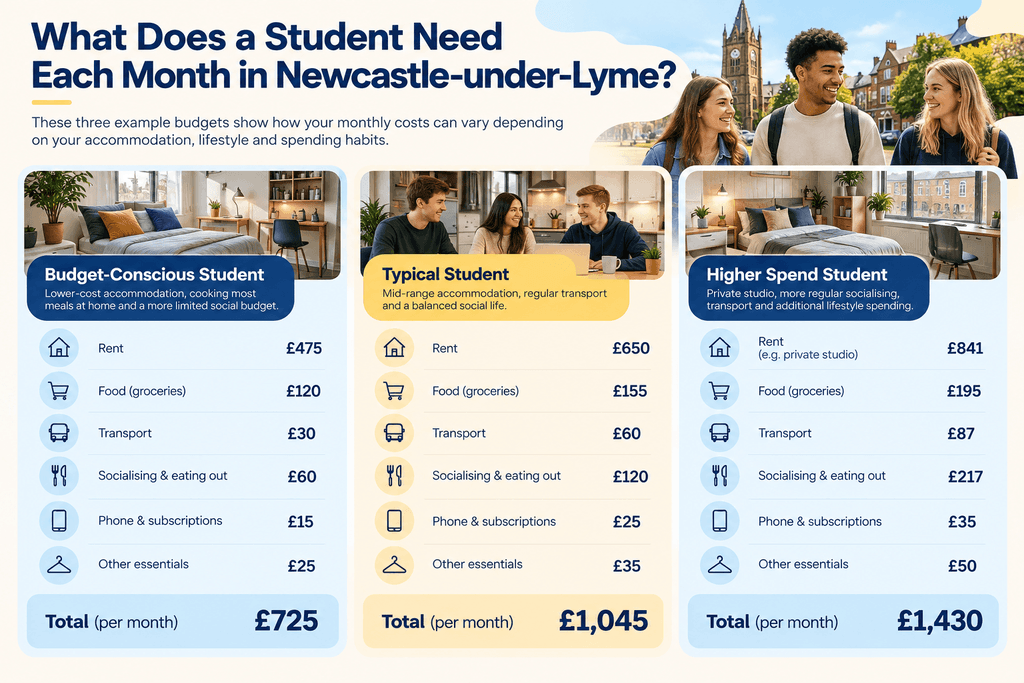
Three Realistic Newcastle-under-Lyme Student Budgets
There isn’t one monthly cost of living figure that will accurately represent every student in Newcastle-under-Lyme. Your accommodation, travel habits, food spending and social life can change your overall budget by hundreds of pounds each month.
A more useful approach is to look at several realistic examples. The budgets below use the 2026/27 costs discussed throughout this guide and are intended as illustrations rather than fixed spending targets.
Budget-Conscious Student
This example represents a student choosing a lower-cost room in a shared house, cooking most meals at home, walking whenever practical and keeping subscriptions and nights out relatively limited.
| Monthly expense | Example budget |
| Accommodation | £475 |
| Groceries | £120 |
| Transport | £30 |
| Eating out & socialising | £60 |
| Phone & subscriptions | £15 |
| Laundry, toiletries & personal costs | £25 |
| Estimated monthly total | £725 |
At approximately £725 per month, accommodation still accounts for the majority of the budget. Keeping grocery costs around £25 – £30 per week, walking for shorter journeys and limiting takeaways and paid subscriptions can make a significant difference.

The important consideration with cheaper shared accommodation is whether household bills are included. If electricity, heating, water and broadband need to be paid separately, these would need to be added to the example above.
Typical Student Budget
A student choosing mid-range accommodation, spending around the current typical amount on groceries, using buses regularly and having a few meals, takeaways or nights out each month could have a budget closer to the following:
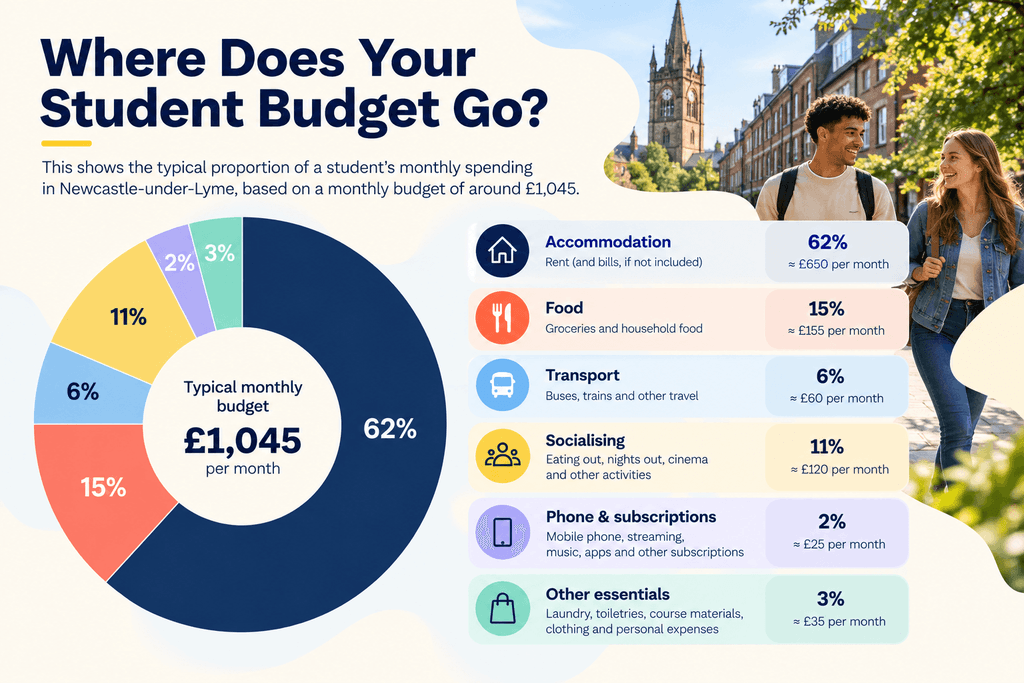
| Monthly expense | Example budget |
| Accommodation | £650 |
| Groceries | £155 |
| Transport | £60 |
| Eating out & socialising | £120 |
| Phone & subscriptions | £25 |
| Laundry, toiletries & personal costs | £35 |
| Estimated monthly total | £1,045 |
That produces an estimated budget of around £1,045 per month.
This example provides more room for regular transport and social activities without assuming particularly high spending. However, actual costs could still move significantly depending on the accommodation chosen and how frequently you travel to university.
Private Studio / Higher-Spend Budget
Students who prefer the independence of a private studio and spend more regularly on eating out, socialising, transport, fitness and subscriptions will naturally need a larger monthly budget.
For this example, we’ve used the current £194 per week Premium Plus Studio at The Metropolis as the accommodation benchmark. That is approximately £841 per month when converting the weekly rate into a monthly equivalent, with utilities and high-speed internet included.
How to Save Money as a Student in Newcastle-under-Lyme
Reducing your cost of living doesn’t necessarily mean cutting out everything you enjoy. Some of the biggest savings come from making better decisions about accommodation, food, transport and recurring expenses before they become part of your monthly routine.
For a more detailed approach to managing your money at university, start with our student budgeting guide, which covers the main costs students should plan for and how to build a realistic budget.
Compare Total Accommodation Costs
Don’t choose accommodation based on weekly rent alone. Compare what you’ll actually spend once electricity, heating, water, Wi-Fi and transport are included.
A cheaper room that requires separate utility payments and regular bus travel could ultimately cost more than accommodation with a higher headline rent where bills are included.
Look for Bills-Inclusive Accommodation
Bills-inclusive accommodation can make your monthly spending much easier to predict. Rather than budgeting separately for energy, water and broadband, many of these costs are incorporated into your rent.
Always check exactly what’s included before booking, as this varies between properties.

Start Looking for Accommodation Early
Leaving your accommodation search until the last minute can reduce the number of rooms, locations and price points available to you.
Starting earlier gives you more time to compare properties rather than feeling pressured into taking whatever remains. Read more about why you should look for student accommodation early.
Plan Your Meals
Deciding what you’re going to eat before visiting the supermarket can reduce impulse purchases, unnecessary takeaways and food waste.
Try planning several meals around the same ingredients, cooking larger portions and freezing leftovers. Supermarket own-brand products can also reduce the cost of everyday essentials without requiring major changes to what you eat.
Make Use of Student Discounts
Check for student pricing before paying the standard rate. Discounts are available across everything from food and clothing to entertainment, software and subscriptions.
University student services and established student discount platforms can be useful places to check, but don’t buy something purely because it has a student discount attached to it.
Consider a Railcard
If you regularly travel home or elsewhere by train, a 16 – 25 Railcard could reduce eligible rail fares by one-third.
The saving will depend on how frequently you travel, so compare the cost of the Railcard with the journeys you’re realistically likely to make during the year.
Walk or Cycle Where Practical
Students living centrally in Newcastle-under-Lyme may be able to walk to shops, cafés and other everyday amenities rather than paying for short bus or taxi journeys.
Cycling can also be useful for some journeys. Even replacing a few paid trips each week can make a noticeable difference across an academic year.
Use University Facilities
Before paying for a commercial gym, study space, software or other services, check what’s already available through your university.
University facilities can sometimes be free or offered at reduced student rates, so it’s worth understanding what’s included as part of your student experience before purchasing separate memberships.
Give Yourself a Weekly Spending Limit
Breaking your disposable income into weekly amounts can make it easier to see when you’re overspending.
Once rent and other essential bills have been accounted for, decide how much you can realistically spend each week on groceries, socialising, takeaways and other non-essential purchases. This can be easier to manage than trying to make one monthly amount last until your next payment.
Build an Emergency Buffer
Try to keep a small amount separate for unexpected costs rather than allocating every pound of your budget in advance.
Unexpected travel, replacing something that’s broken or buying additional course materials can otherwise disrupt the rest of your monthly spending.
Review Your Subscriptions Regularly
Streaming platforms, music services, cloud storage, gaming memberships and app subscriptions can gradually become a significant monthly expense.
Check your recurring payments every few months and cancel anything you’re no longer using. A £5 or £10 subscription may not seem particularly expensive on its own, but several unnecessary subscriptions can add up to hundreds of pounds over a year.
Ultimately, saving money as a student is less about finding one major cut and more about controlling the expenses that repeat every week and month. Accommodation, food, transport and subscriptions are particularly worth reviewing because even relatively small savings can become significant across the full academic year.
Is Newcastle-under-Lyme Affordable Compared With Other Student Cities?
Newcastle-under-Lyme can be a relatively affordable place to live as a student, particularly when accommodation costs are compared with some larger university cities. However, the amount you actually spend will depend much more on your accommodation type and lifestyle than the city alone.
One useful comparison is current private room rents. SpareRoom’s Q2 2026 data puts the average monthly room rent for the Keele University/Newcastle-under-Lyme area at £535, compared with £533 in Sheffield, £561 in Leicester and £572 in Leeds. This places Newcastle-under-Lyme towards the lower end of this particular comparison, although these figures only measure room rents rather than a student’s complete cost of living.
| Student city | Indicative monthly room rent* |
| Sheffield | £533 |
| Newcastle-under-Lyme / Keele | £535 |
| Leicester | £561 |
| Leeds | £572 |
*Q2 2026 SpareRoom room-rental data. This should be treated as a comparison benchmark rather than the price every student will pay.
Manchester can require a larger overall budget. StudentFM’s current Manchester cost of living guide estimates around £1,100 – £1,350 per month for a typical student, while the University of Manchester’s own 2026/27 estimates put private house-share accommodation with average bills at approximately £645 – £710 per month.
For more detailed comparisons, you can explore StudentFM’s guides to the cost of living in Sheffield, Leeds, Leicester and Preston.
Ultimately, Newcastle-under-Lyme shouldn’t simply be described as the “cheapest” student city. Current evidence suggests accommodation can be competitively priced, but your actual monthly costs will still depend on whether you choose a shared house or private studio, what’s included in your rent, how often you travel and your personal spending habits.
Finding Student Accommodation in Newcastle-under-Lyme
Where you choose to live can have a significant impact on your overall student budget. The weekly rent is important, but your accommodation choice can also affect utility costs, transport spending, everyday convenience and how much you have left for food, socialising and other expenses.
For example, accommodation with a lower headline rent may become more expensive once electricity, heating, water and broadband are added. Similarly, living further away from university could mean budgeting for regular bus travel, while a more central location may allow you to walk to shops and other everyday amenities.
Before booking, compare the total cost of living in each property, including what’s included in the rent, the length of the tenancy and how you’ll travel to university.
You can explore StudentFM’s current student accommodation in Newcastle-under-Lyme to compare available options.
Students looking for more independence can also consider The Metropolis, which offers private studios with utilities and high-speed internet included in the rent. With different studio types available, students can compare room sizes and prices according to their preferred budget and living arrangements.
Alternatively, you can search all available StudentFM properties and rooms to compare accommodation across Newcastle-under-Lyme and other StudentFM locations.
Whichever option you choose, consider the complete monthly cost rather than rent in isolation. Finding accommodation that works for both your lifestyle and your budget can make managing the rest of your student living costs considerably easier.
FAQs About the Cost of Living in Newcastle-under-Lyme
Newcastle-under-Lyme can be relatively affordable for students compared with some larger UK university cities, but your actual costs will depend heavily on accommodation and lifestyle. Rent will usually be your biggest expense, followed by food, transport and socialising.
Choosing accommodation with bills included and living somewhere that reduces your reliance on buses or taxis can make a significant difference to your overall monthly spending.
Based on the 2026/27 costs covered in this guide, a realistic student budget could range from around £725 per month for a budget-conscious lifestyle to approximately £1,430 per month for a student choosing a private studio and spending more on transport, fitness and socialising.
A typical example in this guide comes to approximately £1,045 per month. These figures cover accommodation, groceries, transport, socialising, phone/subscriptions and basic personal expenses, but don’t include tuition fees or major one-off purchases.
It’s sensible to keep some additional money available for course materials, travel home, clothing and unexpected expenses.
Student accommodation prices vary considerably depending on whether you choose a shared house, PBSA or a private studio.
Current 2026 listings researched for this guide show rooms in shared accommodation from around £80 – £135+ per week, while purpose-built accommodation and private studios generally cost more depending on the facilities and what’s included. These are examples from current listings rather than an official Newcastle-under-Lyme average.
StudentFM’s The Metropolis currently has 2026/27 studios from £157 per person per week, with other room types rising to £200+ per week. All bills and high-speed Wi-Fi are included.
It depends on the property and tenancy. Some shared houses require students to pay electricity, heating, water and broadband separately, while many purpose-built student properties offer bills-inclusive rent.
At The Metropolis, for example, utilities and high-speed Wi-Fi are included.
Always check the tenancy before booking rather than assuming bills are included. Our guide to what’s included in student accommodation explains what to look for.
A sensible 2026 grocery budget is around £25 – £45 per week for many students. Around £25 – £30 could work for someone who meal plans and cooks most meals from scratch, while £35 – £40 provides a more typical allowance. Students buying more premium products or convenience foods may spend £45 – £55 or more.
Takeaways, coffees and meals out should ideally be budgeted separately.
The number 25 bus connects Newcastle-under-Lyme town centre with Keele University and continues towards Royal Stoke University Hospital and Stoke-on-Trent railway station.
For Keele Card holders, the current Keele Key costs £5.50 for a day ticket, £19 for a weekly ticket or £400 for a 10-month annual ticket covering 1 September to 30 June.
Your actual cost of travelling to university will therefore depend on how frequently you use the bus and which ticket works best for your travel pattern.
Accommodation in Newcastle-under-Lyme can be cheaper than comparable options in Manchester, but it isn’t accurate to say every student will automatically spend less.
StudentFM’s Manchester cost of living guide provides a more detailed breakdown of Manchester expenses. When comparing the two, consider rent, bills, transport and lifestyle together rather than accommodation prices alone.
Yes. Students can live in Newcastle-under-Lyme without owning a car, particularly if they choose accommodation close to the town centre and public transport.
Many everyday amenities can be reached on foot, while cycling provides another low-cost option. The number 25 bus connects Newcastle-under-Lyme with Keele University, Royal Stoke University Hospital and Stoke-on-Trent railway station, providing access to onward rail travel.
Newcastle-under-Lyme can be a practical base for Keele University students who want access to town-centre shops, supermarkets, cafés, pubs and other amenities while remaining connected to campus by bus.
Accommodation choice is important. Living centrally can make everyday errands easier to complete on foot, while regular bus services provide transport to Keele University. StudentFM’s current student accommodation in Newcastle-under-Lyme is centrally located and offers access to transport links serving Keele and the surrounding area.
Conclusion
There isn’t one universal cost of living for students in Newcastle-under-Lyme. Your accommodation choice, what’s included in your rent, how often you travel and your everyday spending habits can all make a significant difference to your monthly budget.
The most important thing is to look at the complete cost of student living. Work out your rent + bills + transport + everyday spending together, rather than choosing accommodation based solely on the advertised weekly rent.
Looking for somewhere to live for 2026/27? Explore StudentFM’s student accommodation in Newcastle-under-Lyme and compare the available room options at The Metropolis.