
Newcastle is one of the UK’s most popular and comparatively affordable university cities, home to Newcastle University and Northumbria University. With a vibrant student community, affordable entertainment, excellent public transport and a wide range of accommodation options, the city offers an attractive balance between quality of life and everyday living costs.
For most students, accommodation represents their largest monthly expense. However, understanding the true cost of living in Newcastle means budgeting beyond rent. Groceries, household bills, transport, socialising, study materials and personal expenses can all have a significant impact on your overall university budget.

Whether you’re looking to keep your expenses as low as possible or prefer the comfort and convenience of a private studio with greater flexibility for social activities, your monthly expenditure will depend on your accommodation choices, lifestyle and individual circumstances.
If you’re planning to study in Newcastle during the 2027/28 academic year, this guide combines recent student expenditure research with realistic budgeting examples to help you prepare financially. These estimates are intended for forward planning rather than representing confirmed 2027/28 prices.
If you’re still exploring where to live, our student accommodation in Newcastle: 2027/28 guide covers accommodation types, popular student areas and booking advice.
How Much Does It Cost to Live in Newcastle as a Student in 2027/28?
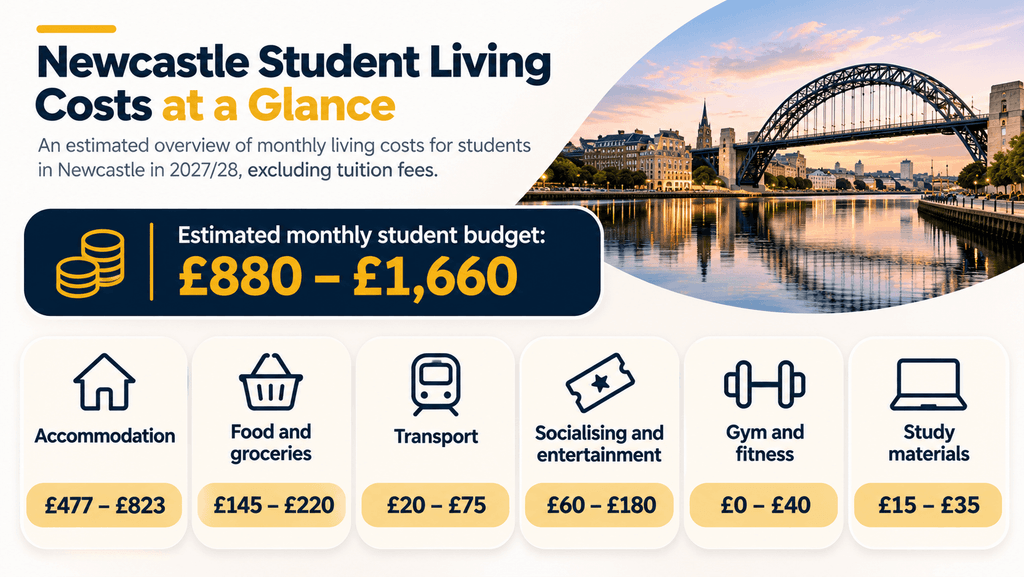
Students planning to live in Newcastle during the 2027/28 academic year should budget approximately £880 – £1,660 per month, excluding tuition fees. A budget-conscious student living in shared accommodation and cooking most meals at home may spend towards the lower end of this range, while someone living in a private studio and enjoying a more active social lifestyle may spend considerably more.
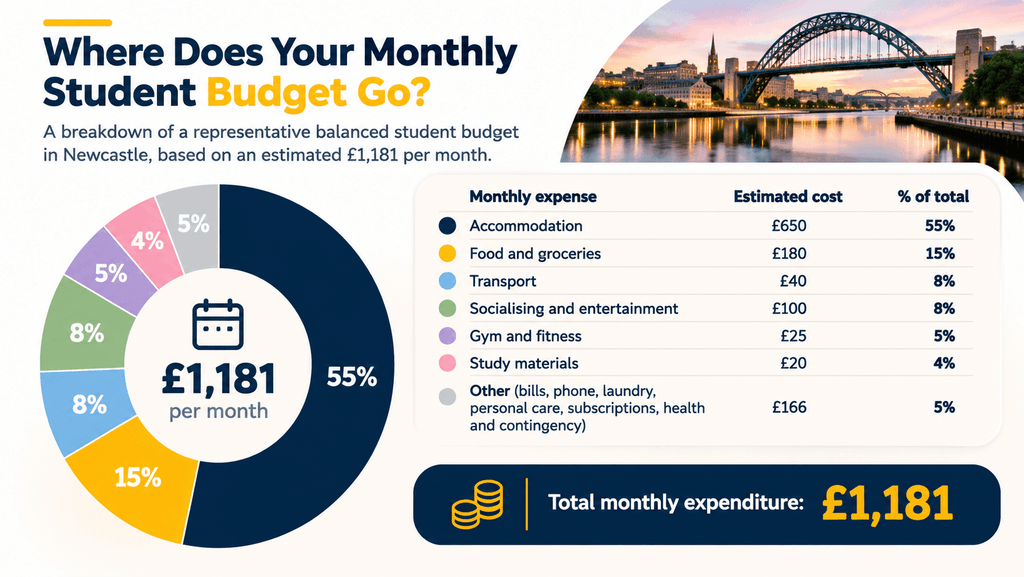
For students looking for a balance between comfortable accommodation, everyday essentials and an active university lifestyle, approximately £1,180 per month provides a useful starting point.
Research published by Newcastle University in October 2026 indicates that living costs in Newcastle are approximately 24% lower than in London when excluding rent. Northumbria University also highlights the city’s relative affordability, making Newcastle an attractive destination for both UK and international students.
Newcastle Student Living Costs at a Glance
The following table provides an estimated breakdown of monthly student living expenses in Newcastle for three different lifestyles.
| Monthly expense | Estimated monthly cost |
| Accommodation | £477 – £823 |
| Household bills | £0 – £75 |
| Food and groceries | £145 – £220 |
| Public transport | £20 – £75 |
| Socialising and entertainment | £60 – £180 |
| Gym and fitness | £0 – £40 |
| Mobile phone | £10 – £25 |
| Laundry | £10 – £20 |
| Personal care and clothing | £30 – £90 |
| Study materials | £15 – £35 |
| Subscriptions | £0 – £20 |
| Health and wellbeing | £10 – £30 |
| Emergency and contingency allowance | £30 – £100 |
| Estimated total monthly expenditure | £880 – £1,660 |
Household bills may already be included in your accommodation rent, particularly when living in purpose-built student accommodation (PBSA). Always check what is included before calculating your monthly budget.
These illustrative budgets are informed by recent university expenditure guidance and the National Student Money Survey 2026, alongside StudentFM’s own budgeting scenarios. The overall range reflects different combinations of accommodation and lifestyle choices rather than simply adding the lowest or highest figure in every category. Actual prices for the 2027/28 academic year may vary.
What Affects the Cost of Living in Newcastle?
Although Newcastle has a reputation for student affordability, the amount you spend each month will depend on several important factors.
Accommodation type
Shared student houses, university halls, en-suite rooms and private studios all come with different rental costs. Sharing accommodation can help reduce expenses, while a private studio offers greater independence, privacy and convenience.
Included household bills
Accommodation that includes electricity, heating, water and Wi-Fi can make monthly budgeting more predictable. A property with a lower advertised weekly rent may not necessarily be cheaper once additional household bills are considered.
Proximity to university
Living within walking distance of Newcastle University or Northumbria University’s City Campus could significantly reduce your transport expenditure. Accommodation further from campus may offer lower rental prices, but regular bus or Metro journeys can increase your overall monthly costs.
Lifestyle and spending habits
Cooking at home, shopping at affordable supermarkets, using student discounts and taking advantage of free university activities can help keep everyday expenses manageable. Regular takeaways, restaurant meals, shopping and nights out can increase monthly expenditure considerably.
Accommodation contract length
Student accommodation contracts can vary in length. A property with a lower weekly rent but a longer tenancy may ultimately cost more than accommodation with a slightly higher weekly rate and a shorter contract. Comparing the total contractual cost is particularly important if you plan to return home during the summer holidays.
Ultimately, finding affordable student accommodation in Newcastle is about balancing rent, location, included facilities and everyday living expenses rather than simply choosing the cheapest available room.
Monthly Student Living Expenses in Newcastle
Understanding where your money goes each month is one of the most effective ways to prepare for university life. While accommodation will typically account for the largest proportion of your student budget, everyday expenses can quickly add up.
Here’s a closer look at the main living expenses students should consider when budgeting for university in Newcastle.
Accommodation and Rent
Accommodation is likely to be your biggest financial commitment while studying in Newcastle. The amount you pay will depend on your preferred accommodation type, location, facilities and contract length.

The main accommodation options include:
- Shared student houses: Often a more affordable option, with rent and household expenses shared between housemates.
- University halls: A popular choice for first-year students, typically offering furnished rooms, communal facilities and included utilities.
- Private en-suite rooms: Providing a private bedroom and bathroom alongside shared kitchen and living facilities.
- Private studios: Offering a self-contained living space with a private bathroom and kitchen, providing greater independence and privacy.
When comparing accommodation, consider the total cost of living at each property rather than simply comparing advertised weekly rental prices.
Our guide to cheap student accommodation in Newcastle explores rental prices, affordable neighbourhoods and accommodation options in greater detail.
Electricity, Heating, Water and Internet
Household bills can represent a significant additional expense, particularly for students living in privately rented shared houses.
Depending on your accommodation agreement, you may need to budget separately for electricity, gas, heating, water, broadband and contents insurance.
For students whose rent excludes utilities, allowing approximately £60 – £90 per month for household bills provides a useful starting point, although actual costs will depend on energy consumption, property efficiency, household size and supplier tariffs.
Bills-inclusive student accommodation can make financial planning more straightforward by combining rent and essential utilities into one predictable payment. This can be particularly helpful during Newcastle’s colder winter months, when heating consumption may increase.
If utilities are already included in your rent, you should not add them again when calculating your monthly living expenses. Always check whether any fair usage policies or additional charges apply.
For more information, read our guide to what’s included in student accommodation.
Food and Groceries
Food is typically one of the largest everyday expenses after accommodation. However, it is also an area where students can exercise greater control over their spending.
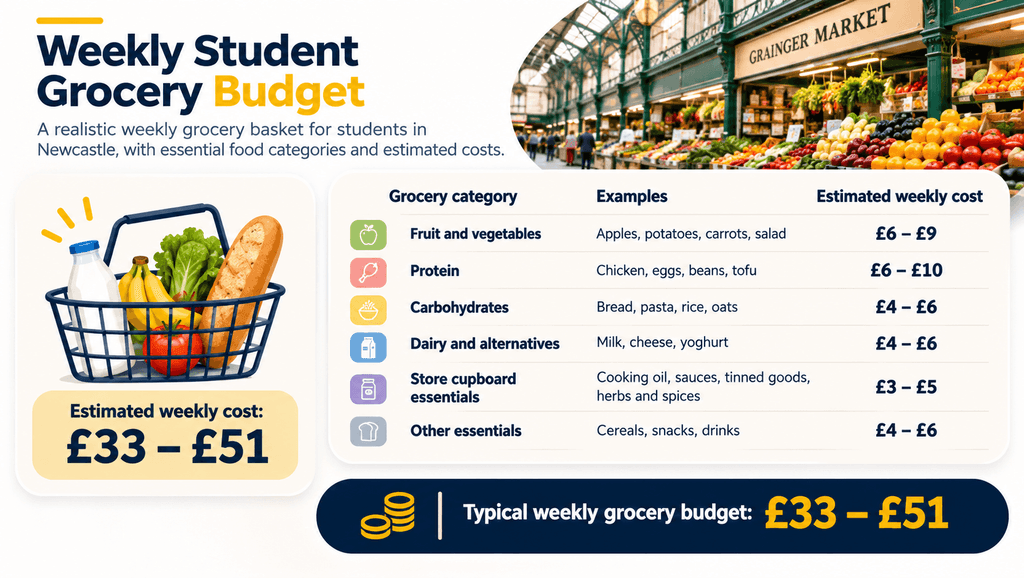
Recent student expenditure guidance from Newcastle University provides a grocery benchmark of approximately £144 per month, equivalent to around £33 per week.
For the 2027/28 academic year, a monthly grocery allowance of £145 – £220 provides a practical starting point for students with different shopping and eating habits.
Students can reduce their food expenditure by shopping at affordable supermarkets, purchasing own-brand products, planning meals in advance and batch cooking. Newcastle’s Grainger Market also offers an alternative to traditional supermarkets for fresh produce and everyday ingredients.
Remember that groceries and eating out are separate expenses. Regular takeaways, coffee purchases and restaurant meals should be accounted for within your socialising and entertainment budget rather than your supermarket shopping allowance.
Transport and Commuting
Newcastle is a relatively compact university city, with many student accommodation options within walking distance of Newcastle University and Northumbria University’s City Campus.
Students living centrally may find that walking or cycling is sufficient for most everyday journeys. Those living further from campus can access the city’s bus network and Tyne and Wear Metro, which connects Newcastle with surrounding residential areas and destinations across the region.
A monthly transport allowance of approximately £20 – £75 is a reasonable planning estimate, depending on how frequently you use public transport and whether you qualify for discounted travel.
When choosing accommodation, consider whether the savings associated with living further from university outweigh the additional cost and time involved in commuting.
Living closer to campus, supermarkets and other essential amenities can help reduce transport expenditure throughout the academic year.
Socialising, Entertainment and Fitness
Newcastle is well known for its lively student atmosphere, with a wide range of restaurants, cafés, cinemas, music venues, nightlife and cultural attractions.
Your social budget will largely depend on how you choose to spend your free time. Students who regularly eat out, attend events or enjoy nights out will naturally spend more than those who prioritise free or low-cost activities.
A monthly allowance of £60 – £180 for socialising and entertainment provides flexibility across different student lifestyles.
Fitness expenses should also be considered. Students purchasing a separate gym membership could allow an additional £25 – £40 per month, while those using free outdoor spaces or gym facilities included within their accommodation may avoid this expense altogether.
There are also plenty of ways to enjoy Newcastle without spending much money, including exploring Jesmond Dene, walking along the Quayside, visiting free museums and galleries, and participating in university societies and Students’ Union activities.
Mobile Phones, Laundry and Personal Expenses
Smaller everyday purchases are easy to overlook when preparing a university budget. Individually, these expenses may seem insignificant, but together they can account for a considerable proportion of monthly spending.
Common expenses include:
- Mobile phone contracts: Approximately £10 – £25 per month.
- Laundry: Approximately £10 – £20 per month.
- Toiletries and personal care: Approximately £15 – £40 per month.
- Clothing and shopping: Approximately £15 – £50 per month.
- Digital subscriptions: Approximately £0 – £20 per month.
- Health and wellbeing: Approximately £10 – £30 per month.
Students can reduce these expenses by choosing affordable SIM-only contracts, sharing eligible household subscriptions, taking advantage of student discounts and purchasing everyday essentials in advance.
It’s also sensible to set aside an additional £30 – £100 per month, where affordable, as a contingency allowance for unexpected expenses, replacements or emergencies.
Study Materials and University Expenses
Although many university learning resources are available digitally or through university libraries, students should still budget for course-related expenses.
These may include textbooks, stationery, printing, software subscriptions, specialist equipment and materials required for practical coursework.
For most students, setting aside approximately £15 – £35 per month provides a useful starting point. However, students studying subjects such as architecture, engineering, art and design may require a larger allowance for specialist materials and equipment.
Before purchasing textbooks or software, check whether your university provides free access, library copies, equipment loans or discounted student licences.
It’s important to note that tuition fees are separate from the living cost calculations in this guide. Students should account for their tuition fees and any substantial course-specific expenses separately when preparing their overall university budget.
Three Realistic Student Budgets for Newcastle
Every student’s financial circumstances are different. While some students prioritise keeping their living expenses as low as possible, others may prefer more comfortable accommodation, greater independence and additional flexibility for social activities.
To help you prepare for the 2027/28 academic year, we’ve created three illustrative monthly student budgets based on different accommodation choices, spending habits and lifestyles.
These examples draw on recent expenditure guidance from Newcastle University and the National Student Money Survey 2026, alongside StudentFM’s own estimated expenditure allowances.
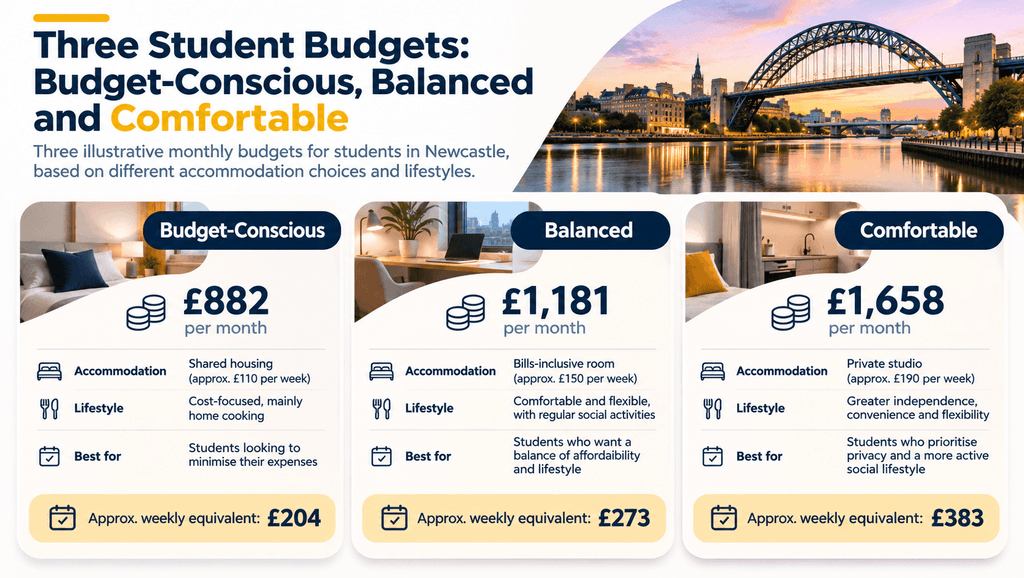
Budget-Conscious Student
Estimated monthly budget: £882
This budget is suitable for students looking to minimise their living expenses while still allowing for essential purchases, occasional social activities and unexpected costs.
A budget-conscious student might choose lower-cost shared accommodation, prepare most meals at home and walk or cycle to university wherever practical.
Typical spending habits include:
- Living in shared accommodation costing approximately £110 per week.
- Allowing £75 per month for household bills.
- Spending approximately £33 – £35 per week on groceries.
- Walking or cycling for most everyday journeys.
- Taking advantage of free university activities and student discounts.
- Choosing affordable SIM-only mobile contracts.
- Limiting takeaways, restaurant meals and unnecessary purchases.
- Setting aside £30 per month for unexpected expenses.
This lifestyle may require more careful financial planning, but it demonstrates how students could manage their monthly expenditure without completely sacrificing their university social experience.
Balanced Student Budget
Estimated monthly budget: £1,181
A balanced student budget is suitable for students who want to manage their finances responsibly while enjoying a comfortable and active university lifestyle.
This example assumes bills-inclusive accommodation costing approximately £150 per week, alongside a more flexible grocery allowance, regular social activities and occasional meals out.
Typical spending habits include:
- Living in comfortable, bills-inclusive student accommodation.
- Spending approximately £42 per week on groceries.
- Using public transport when needed.
- Enjoying occasional restaurant meals, takeaways and nights out.
- Maintaining a standard gym membership where facilities are not included.
- Allowing for clothing, subscriptions and personal purchases.
- Setting aside £50 per month for unexpected expenses.
For students who want to balance affordability with comfort, convenience and an active social life, this budget provides a useful starting point when planning their university finances.
Comfortable Student Budget
Estimated monthly budget: £1,658
A comfortable student budget is suitable for students who prioritise privacy, convenience and greater flexibility in how they spend their time.
This example assumes bills-inclusive private studio accommodation costing approximately £190 per week, with additional allowances for groceries, transport, entertainment and personal expenses.
Typical spending habits include:
- Living in a self-contained private studio with a private bathroom and kitchen.
- Spending approximately £51 per week on groceries.
- Using public transport more frequently.
- Enjoying regular meals out, entertainment and social activities.
- Spending more on fitness, hobbies and personal purchases.
- Allowing greater flexibility for clothing and subscriptions.
- Setting aside £100 per month as a financial buffer.
Although this lifestyle involves higher monthly expenditure, students may value the additional independence, privacy and convenience it provides throughout the academic year.
Newcastle Student Budget Comparison
The following table compares the estimated monthly expenditure across all three student lifestyles.
| Monthly expense | Budget-conscious | Balanced | Comfortable |
| Accommodation | £477 | £650 | £823 |
| Household bills | £75 | Included | Included |
| Groceries | £145 | £180 | £220 |
| Transport | £20 | £40 | £75 |
| Socialising and eating out | £60 | £100 | £180 |
| Gym and fitness | £0 | £25 | £40 |
| Mobile phone | £10 | £16 | £25 |
| Laundry | £10 | £15 | £20 |
| Toiletries and personal care | £15 | £25 | £40 |
| Clothing and shopping | £15 | £30 | £50 |
| Study materials | £15 | £20 | £35 |
| Digital subscriptions | £0 | £10 | £20 |
| Health and wellbeing | £10 | £20 | £30 |
| Contingency | £30 | £50 | £100 |
| Total monthly budget | £882 | £1,181 | £1,658 |
| Approximate weekly equivalent | £204 | £273 | £383 |
Understanding These Student Budget Estimates
These budgets are illustrative planning scenarios rather than confirmed accommodation prices or measured average living costs for Newcastle in 2027/28.
Weekly accommodation costs have been converted into monthly equivalents by multiplying the weekly rent by 52 and dividing by 12. Actual rental payments and instalment schedules will depend on your accommodation agreement and tenancy length.
The budget-conscious example includes a separate household bills allowance, while the balanced and comfortable examples assume essential utilities are included within the rent.
All three budgets assume that students qualify for council tax exemption and exclude tuition fees, accommodation deposits, initial moving costs and substantial travel during university holidays.
How Much Money Do You Need After Paying Rent and Bills?
If you’ve already secured your student accommodation, understanding how much money you need for your remaining everyday expenses can make financial planning considerably easier.
| Student lifestyle | Monthly spending after rent and bills | Weekly equivalent |
| Budget-conscious | £330 | £76 |
| Balanced | £531 | £123 |
| Comfortable | £835 | £193 |
For a budget-conscious student, approximately £76 per week after rent and household bills could cover groceries, occasional transport, essential personal expenses and limited social activities.
Students looking for greater flexibility may prefer to allow approximately £123 – £193 per week, depending on their lifestyle and spending habits.
The most effective student budget is one that reflects your own financial circumstances, accommodation commitments and priorities, rather than simply following an average expenditure figure.
Is £1,000 a Month Enough to Live in Newcastle as a Student?
Yes, £1,000 per month could be enough to live in Newcastle as a student, provided you secure affordable accommodation, manage your everyday expenses carefully and maintain a relatively budget-conscious lifestyle.
Accommodation will be the biggest factor in determining whether this budget is achievable. Students paying around £600 per month for bills-inclusive accommodation would have £400 remaining for groceries, transport, socialising and other everyday expenses.
However, students choosing more expensive private studios, commuting regularly or frequently eating out may find that £1,000 per month is insufficient.
What a £1,000 Monthly Student Budget Could Look Like
The following example demonstrates how a student could allocate a £1,000 monthly budget while studying in Newcastle.
| Monthly expense | Estimated cost |
| Bills-inclusive accommodation | £600 |
| Groceries | £145 |
| Transport | £20 |
| Socialising and eating out | £75 |
| Mobile phone | £15 |
| Laundry | £15 |
| Personal care and clothing | £35 |
| Study materials | £15 |
| Health and wellbeing | £15 |
| Digital subscriptions | £10 |
| Contingency | £55 |
| Total monthly expenditure | £1,000 |
This example assumes that you can secure accommodation costing approximately £138 per week, with electricity, heating, water and Wi-Fi included.
To make this budget achievable, students would generally need to:
- Prepare most meals at home and shop at affordable supermarkets.
- Walk or cycle to university wherever practical.
- Limit regular takeaways and restaurant meals.
- Take advantage of student discounts and free social activities.
- Avoid unnecessary subscriptions and impulse purchases.
- Monitor everyday spending throughout the month.
One advantage of this example is that it includes a £55 monthly contingency allowance, providing some flexibility for unexpected expenses rather than allocating every pound to regular spending.
However, this budget excludes tuition fees, initial moving expenses, accommodation deposits and substantial travel during university holidays. It also assumes that suitable bills-inclusive accommodation is available within the proposed rental allowance.
How Much Money Do Students Need After Paying Rent?
Once you’ve secured your student accommodation, calculating how much money you have available after rent and household bills is one of the simplest ways to establish a realistic everyday spending budget.
Start by subtracting your monthly accommodation costs and any separately charged household bills from your available monthly income or funding.
Monthly available funds − accommodation costs − household bills = remaining monthly spending allowance.
For example, if you have £1,000 available each month and pay £600 for bills-inclusive accommodation, you will have £400 remaining, equivalent to approximately £92 per week.
The following examples demonstrate how different accommodation costs affect your remaining spending allowance.
| Monthly budget | Accommodation and bills | Remaining monthly allowance | Weekly equivalent |
| £1,000 | £500 | £500 | £115 |
| £1,000 | £600 | £400 | £92 |
| £1,000 | £700 | £300 | £69 |
| £1,000 | £800 | £200 | £46 |
As these examples demonstrate, even a £100 difference in monthly accommodation costs can have a significant impact on your everyday spending power.
Based on our three illustrative student budgets, allowing approximately £330 – £530 per month after rent and household bills provides a useful starting point for students looking to balance affordability with everyday essentials and social activities. Students who prefer greater lifestyle flexibility may need considerably more.
When planning your finances, make sure your remaining allowance covers essential expenses before allocating money towards entertainment, shopping and other discretionary purchases.
For more practical advice on managing your finances throughout the academic year, read our student budgeting guide: managing the cost of university.

How Much Does Food Cost for Students in Newcastle?
Food is one of the most important everyday expenses to consider when preparing your student budget. Fortunately, Newcastle offers a wide range of supermarkets, independent food retailers and local markets, giving students plenty of opportunities to keep grocery costs manageable.
The amount you spend will depend on where you shop, your dietary requirements, how frequently you cook at home and how often you eat out.
Average Weekly Student Grocery Budget
Students in Newcastle could plan to spend approximately £33 – £51 per week on groceries, depending on their shopping habits and lifestyle.
Recent expenditure guidance from Newcastle University estimates monthly grocery spending at £144, equivalent to approximately £33 per week. The National Student Money Survey 2026 reports a UK student grocery expenditure benchmark of £155 per month.
Based on these benchmarks, the following allowances provide a useful starting point for planning your food budget for 2027/28.
| Student lifestyle | Weekly grocery budget | Monthly grocery budget |
| Budget-conscious | £33 – £35 | £145 |
| Balanced | Approximately £42 | £180 |
| Comfortable | Approximately £51 | £220 |
These estimates cover supermarket shopping and ingredients for meals prepared at home. Takeaways, restaurant meals, coffees and food purchased on campus should be budgeted for separately.
Students with specialist dietary requirements or higher nutritional needs may need to allocate more towards their weekly food shop.
Typical Grocery Prices in Newcastle
Understanding the cost of everyday supermarket essentials can help you plan your weekly shopping more effectively.
The following table provides indicative prices for common grocery items to help students estimate their food expenditure.
| Grocery item | Quantity | Indicative price |
| Milk | 1 litre | £1.20 |
| Bread | 800g loaf | £1.50 |
| Eggs | 12 | £2.70 |
| Rice | 1kg | £1.70 |
| Pasta | 500g | £0.90 |
| Chicken breast | 1kg | £7.00 |
| Apples | 1kg | £2.50 |
| Potatoes | 1kg | £1.20 |
| Total | £18.70 |
These items represent a selection of everyday essentials rather than a complete weekly food shop. Students will also need to consider vegetables, additional protein sources, breakfast ingredients, cooking essentials and other dietary requirements.
Prices vary between supermarkets, brands, product sizes and promotional offers. These indicative figures are intended for budgeting purposes rather than representing confirmed supermarket prices for 2027/28.
Where Can Students Buy Cheap Groceries in Newcastle?
Newcastle offers several options for students looking to reduce their weekly grocery expenditure without compromising on the quality or variety of their meals.
Grainger Market
Located in Newcastle city centre, Grainger Market is a historic indoor market offering fresh fruit, vegetables, meat, fish and other food products from independent traders.
Shopping at local markets can be particularly useful for students who want to purchase smaller quantities of fresh ingredients and reduce food waste.
Aldi and Lidl
Discount supermarkets such as Aldi and Lidl are popular options for students looking to purchase affordable everyday essentials, own-brand products and ingredients for home cooking.
Planning a larger weekly shop can help reduce the need for frequent, potentially more expensive convenience store purchases.
Larger supermarkets
Larger branches of Tesco, Asda, Morrisons and Sainsbury’s often provide a wider selection of own-brand products, larger pack sizes and promotional offers than smaller city-centre convenience stores.
Comparing the price per kilogram or litre is particularly useful when deciding whether larger packs offer better value.
Reduced-to-clear products
Many supermarkets discount products approaching their use-by or best-before dates. These can offer useful savings, particularly when purchasing food that you intend to cook immediately or can safely freeze.
Online supermarket delivery
Supermarket delivery can be economical when placing larger orders or sharing a delivery with housemates. However, always consider minimum order requirements, delivery charges and whether you could complete the same shop more cheaply in person.
Food waste and surplus food apps
Apps such as Too Good To Go allow users to purchase surplus food from participating cafés, bakeries, restaurants and supermarkets at discounted prices.
Olio also enables people to share surplus food and other items within their local community.
Both can help students reduce food waste and supplement their regular grocery shopping, although availability varies by location.
Cooking at Home vs Eating Out
Preparing meals at home is one of the most effective ways to reduce student living expenses throughout the academic year.
Small, regular purchases such as sandwiches, coffees and lunches on campus can quickly become a significant monthly expense.
For example, consider the potential savings from preparing your own lunch rather than purchasing one five days a week.
| Lunch expenditure | Buying lunch | Preparing lunch at home |
| Estimated cost per meal | £6 | £2 |
| Weekly cost (5 lunches) | £30 | £10 |
| Average monthly cost | £130 | £43.33 |
| Cost over 40 weeks | £1,200 | £400 |
Potential saving: £800 over 40 weeks.
This illustrative example demonstrates how relatively small changes to everyday spending habits can make a considerable difference over an academic year.
The NatWest Student Handover Report 2026 also highlights meal preparation and batch cooking among the money-saving habits adopted by university students.
Cooking larger portions, freezing individual meals, preparing lunches in advance and planning your weekly shopping around a meal plan can all help reduce food expenditure.
You don’t need to avoid eating out altogether. Setting aside a separate allowance for restaurant meals, takeaways and social occasions allows you to enjoy Newcastle’s food scene while keeping your essential grocery budget under control.
How Much Does Student Transport Cost in Newcastle?
Students in Newcastle could budget approximately £20 – £75 per month for transport, depending on where they live, how frequently they travel and whether they qualify for discounted fares.
One of the advantages of studying in Newcastle is its relatively compact city centre. Many students living close to Newcastle University or Northumbria University’s City Campus can walk to lectures, supermarkets, restaurants and entertainment venues without relying on public transport every day.
For longer journeys, Newcastle benefits from an extensive bus network and the Tyne and Wear Metro.
Newcastle Metro Prices and Student Discounts
The Tyne and Wear Metro connects Newcastle city centre with surrounding residential areas, Sunderland, Newcastle International Airport and coastal destinations such as Tynemouth and Whitley Bay.
Popular Metro stations for students include Haymarket, Monument, Central Station, Jesmond and West Jesmond.
Students looking to reduce their travel expenditure can explore several ticketing options through Nexus:
- Student Metro Season Tickets: Designed for eligible students who regularly travel on the Metro, with options covering all three Metro zones.
- Pop Pay As You Go: A reusable smartcard that allows passengers to pay for individual journeys without purchasing a separate paper ticket each time.
- Pop Blue: A discounted travel option for passengers aged 21 and under.
- Network One Travel Tickets: Combined travel options for passengers who regularly use multiple forms of public transport across Tyne and Wear.
A season ticket may offer better value for students commuting regularly, while pay-as-you-go travel may be more economical for those making occasional journeys.
Before purchasing a travel pass, check the latest Metro ticket prices and travel discounts, as fares, eligibility requirements and ticket conditions may change before the 2027/28 academic year.
Student Bus Travel
Newcastle has an extensive bus network connecting the city centre with popular student neighbourhoods, university campuses and surrounding areas.
The main local bus operators include Stagecoach, Go North East and Arriva.
Students can explore several ways to reduce bus travel costs, including operator-specific student passes, weekly or monthly travel tickets and discounted fares for eligible young passengers.
Students aged 21 and under should also investigate the region’s young-person travel schemes, which can offer discounted single journeys and multi-operator day tickets, subject to current eligibility requirements.
If you regularly travel using different bus operators or combine bus journeys with Metro travel, a multi-operator ticket may offer better value than purchasing separate tickets.
Always compare the cost of a travel pass against your expected number of journeys. Students who only use public transport occasionally may find that individual tickets are more economical.
Walking and Cycling to University
Walking is one of the simplest ways to reduce student living expenses in Newcastle.
Newcastle University and Northumbria University’s City Campus are both located close to the city centre, making walking a practical option for many students living in central neighbourhoods.
Students attending Northumbria University’s Coach Lane Campus should consider their commuting requirements separately, as it is located further from the city centre.
Cycling can also provide an affordable alternative to regular bus or Metro journeys, particularly for students living in neighbourhoods such as Jesmond, Sandyford and Heaton.
Students looking for an affordable bicycle can explore Recyke y’bike, a North East charity that refurbishes donated bicycles and makes them available for reuse.
Newcastle University has also promoted Dr Bike sessions through its cycling support initiatives, helping students access bicycle safety checks and minor repairs. Students should check the university’s latest event information for availability.
When budgeting for cycling, remember to consider the initial cost of a bicycle, a secure lock, lights, safety equipment and occasional maintenance.
Can Living Closer to University Save Money?
Choosing accommodation within walking distance of university could reduce your overall living expenses, even if the advertised weekly rent is slightly higher.
For example, consider two illustrative accommodation options with equivalent facilities and included household bills.
| Monthly expense | Accommodation further from campus | Accommodation near campus |
| Weekly rent | £140 | £150 |
| Monthly rental equivalent | £607 | £650 |
| Monthly transport allowance | £60 | £10 |
| Combined monthly cost | £667 | £660 |
In this example, the accommodation closer to university costs approximately £7 less per month overall, despite having a higher advertised weekly rent.
Living closer to campus may also offer additional benefits, including shorter commuting times, greater convenience and easier access to university facilities, supermarkets and social activities.
However, the most economical option will depend on your individual timetable, accommodation preferences and travel requirements.
Our guide to the best student areas in Newcastle explores popular neighbourhoods, university accessibility, transport connections and the advantages of living in different parts of the city.

How Much Does Socialising Cost in Newcastle?
Students in Newcastle could budget approximately £60 – £180 per month for socialising and entertainment, depending on how frequently they eat out, attend events and participate in leisure activities.
Newcastle is well known for its lively student atmosphere, independent restaurants, music venues, nightlife and cultural attractions. However, enjoying university life doesn’t necessarily mean spending large amounts of money.
Recent expenditure guidance from Newcastle University estimates that students spend approximately £99 per month on socialising, providing a useful benchmark when planning your entertainment budget.
Eating Out and Student Nightlife
From independent cafés and affordable restaurants to live music venues and student nights, Newcastle offers entertainment options to suit a wide range of budgets.
The following indicative prices provide a starting point when planning your social expenditure.
| Activity | Estimated cost |
| Coffee | £3 – £4 |
| Inexpensive restaurant meal | £12 – £15 |
| Takeaway | £8 – £15 |
| Cinema ticket | £8 – £12 |
| Student union meal | £4 – £8 |
| Live music event | £20 – £40 |
These are illustrative planning estimates. Actual prices will vary depending on the venue, event, time of day and available student discounts.
Students can reduce their entertainment expenditure by looking for student restaurant offers, discounted cinema tickets, university-organised events and seasonal promotions such as Newcastle Restaurant Week.
Hosting meals, film nights or games evenings with friends can also provide an affordable alternative to regularly going out.
Gyms, Sports and Student Societies
Staying active and joining student societies can be an important part of the university experience, offering opportunities to meet new people, develop interests and maintain your physical and mental wellbeing.
Both Newcastle University and Northumbria University offer sports facilities, fitness programmes and opportunities to participate in recreational and competitive activities.
Students purchasing a separate gym membership could allow approximately £25 – £40 per month, depending on their chosen facilities and membership package.
However, some purpose-built student accommodation includes on-site fitness facilities within the rental price. Choosing accommodation with an included gym could help reduce additional monthly expenditure, particularly if you would otherwise purchase a separate membership.
University societies are another excellent way to socialise without relying on expensive nights out. From photography and gaming to volunteering, music and outdoor activities, there are opportunities to explore new interests and meet like-minded students.
Some societies charge membership fees or additional activity costs, so it’s worth checking these before joining.
Free and Cheap Things to Do in Newcastle
One of the advantages of studying in Newcastle is the variety of cultural attractions, outdoor spaces and activities that can be enjoyed on a limited budget.
Jesmond Dene
Jesmond Dene is a picturesque wooded valley offering walking trails, green spaces and opportunities to enjoy nature away from the busy city centre. It’s an ideal location for a weekend walk, picnic or inexpensive afternoon with friends.
Newcastle Quayside
The Quayside offers riverside walks, impressive architecture and views of Newcastle’s iconic bridges. Students can explore the waterfront, cross the Gateshead Millennium Bridge or visit the Quayside Market without needing to spend money on admission.
Great North Museum: Hancock
Located close to Newcastle University’s main campus, the Great North Museum: Hancock offers exhibitions covering natural history, archaeology, ancient civilisations and science. General admission is normally free, although some activities or special events may carry additional charges.
Baltic Centre for Contemporary Art
Located on the Gateshead side of the River Tyne, Baltic Centre for Contemporary Art offers contemporary art exhibitions, cultural experiences and impressive views across the Quayside. General admission is normally free.
Heaton Park and Exhibition Park
Newcastle’s public parks provide accessible spaces for walking, running, picnics, outdoor exercise and spending time with friends. They offer a particularly affordable alternative to paid leisure activities.
University and Students’ Union events
Both universities organise a variety of social events, workshops, volunteering opportunities and recreational activities throughout the academic year.
Students can explore upcoming activities through Newcastle University Students’ Union and Northumbria Students’ Union, including free and low-cost events.
Admission arrangements, opening hours and event charges can change, so always check the relevant venue’s website before visiting.
Ultimately, affordable student living in Newcastle doesn’t mean missing out on the university experience. Combining occasional paid entertainment with free cultural attractions, outdoor activities and university events can help you enjoy everything the city has to offer while keeping your monthly expenditure manageable.

Is Newcastle Cheaper Than London for Students?
Yes, Newcastle is generally a more affordable city for students than London, particularly when it comes to accommodation, eating out and entertainment.
According to Newcastle University, research compiled in October 2026 indicates that living costs in Newcastle are approximately 24% lower than in London when excluding rent.
Accommodation is likely to account for a significant proportion of the overall difference in student living expenses. However, students may also benefit from lower entertainment costs, more affordable fitness facilities and reduced commuting expenses, particularly when living within walking distance of university.
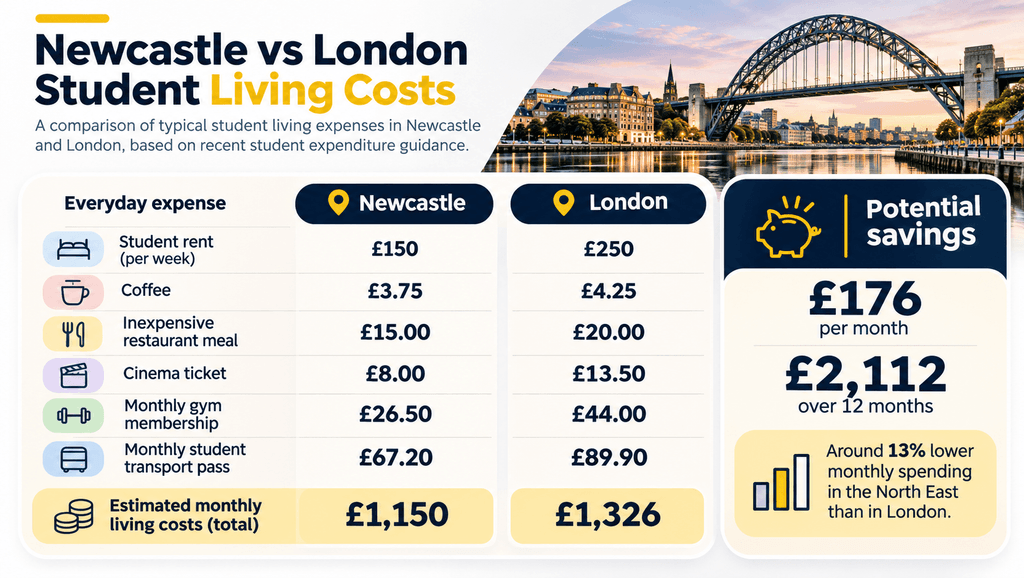
Newcastle vs London Student Living Costs
The following comparison illustrates how selected everyday expenses could differ between Newcastle and London.
| Everyday expense | Newcastle | London |
| Coffee | £3.75 | £4.25 |
| Inexpensive restaurant meal | £15.00 | £20.00 |
| Cinema ticket | £8.00 | £13.50 |
| Monthly gym membership | £26.50 | £44.00 |
| Monthly student transport pass | £67.20 | £89.90 |
These indicative figures are drawn from previously published Newcastle International Study Centre cost-of-living guidance. They should be treated as planning benchmarks rather than confirmed 2027/28 prices. Transport passes may also differ in geographical coverage, eligibility and permitted journeys.
Although individual purchases may only differ by a few pounds, these differences can accumulate considerably over an academic year.
The main differences between studying in Newcastle and London include:
- Accommodation: Rental prices are generally lower in Newcastle, potentially making private en-suite rooms and studios more accessible to students with smaller budgets.
- Transport: Newcastle’s relatively compact central university locations may allow students to walk or cycle more frequently, reducing reliance on public transport.
- Eating out: Restaurant meals, cafés and takeaways can be more affordable in Newcastle.
- Fitness: Gym memberships and recreational activities may cost less, depending on the facilities and membership selected.
- Entertainment: Cinema tickets, nightlife and other leisure activities can be less expensive.
- Groceries: The difference may be less significant when purchasing nationally priced products from major supermarket chains.
Ultimately, the financial benefits of studying in Newcastle will depend on your accommodation choices, commuting requirements and individual spending habits.
How Much Could Students Save by Studying in Newcastle?
The National Student Money Survey 2026 provides another useful comparison, examining reported monthly student expenditure across different UK regions.
| Student location | Average monthly expenditure | 12-month equivalent |
| North East England | £1,150 | £13,800 |
| UK average | £1,146 | £13,752 |
| London | £1,326 | £15,912 |
| Difference between the North East and London | £176 | £2,112 |
According to these figures, students in the North East report spending approximately 13% less per month than students in London.
If this monthly expenditure difference remained consistent, it would represent approximately:
- £176 per month.
- £1,584 over nine months.
- £2,112 over twelve months.
It’s important to recognise that the North East figures represent the wider region rather than Newcastle specifically. The survey also reflects students with different accommodation arrangements, lifestyles and financial circumstances.
These figures therefore illustrate differences in reported regional student expenditure rather than guaranteed individual savings.
For students considering where to study in 2027/28, Newcastle’s combination of comparatively affordable accommodation, accessible university campuses and extensive cultural and social opportunities makes it an attractive alternative to more expensive university cities such as London.
How Does Newcastle Compare With Other UK Student Cities?
Newcastle offers a relatively affordable student experience compared with many major UK university destinations, particularly London. However, living costs across northern England and the Midlands can be relatively similar, depending on accommodation choices and individual spending habits.
The National Student Money Survey 2026 provides a useful regional comparison of average monthly student expenditure.
| University destination | Region | Average monthly student expenditure |
| Newcastle | North East | £1,150 |
| Manchester | North West | £1,052 |
| Leeds | Yorkshire and the Humber | £1,106 |
| Sheffield | Yorkshire and the Humber | £1,106 |
| Leicester | East Midlands | £1,026 |
| Nottingham | East Midlands | £1,026 |
| London | London | £1,326 |
| UK average | National | £1,146 |
These figures represent regional student expenditure rather than individual city averages. Actual living costs within each city will vary depending on accommodation, transport requirements and lifestyle.
Newcastle’s appeal lies in its combination of comparatively affordable accommodation, centrally located university campuses, extensive public transport connections and a vibrant student social scene.
If you’re comparing university destinations for 2027/28, our dedicated student living cost guides provide further information:
- Cost of living in Manchester for students
- Cost of living in Leeds for students
- Cost of living in Sheffield for students
- Cost of living in Leicester for students
When comparing university cities, consider your total living expenses rather than accommodation prices alone. A slightly higher weekly rent in a convenient, bills-inclusive property could ultimately offer better value than cheaper accommodation with additional household bills and commuting costs.
How Much Does It Cost to Live in Newcastle for a Full Academic Year?
Based on our illustrative student budgets, the annual cost of living in Newcastle could range from approximately £10,600 to £19,900 over 12 months, excluding tuition fees.
However, the actual amount you need for an academic year will depend on your accommodation contract length, how many weeks you spend in Newcastle and your living arrangements during university holidays.
Understanding these differences is particularly important when planning your student maintenance loan, savings and other sources of financial support.
Weekly, Monthly and Annual Student Budgets
The following table demonstrates how our three student lifestyle budgets translate into weekly, monthly and annual expenditure.
| Student lifestyle | Weekly equivalent | Monthly budget | 12-month budget |
| Budget-conscious | £204 | £882 | £10,584 |
| Balanced | £273 | £1,181 | £14,172 |
| Comfortable | £383 | £1,658 | £19,896 |
These figures assume consistent expenditure throughout the year. However, not every student will spend 12 months living in Newcastle.
Accommodation contracts commonly vary in length, with some covering the main academic year and others extending throughout the summer holidays.
For example, the total accommodation cost can vary considerably depending on the length of your tenancy agreement.
| Weekly accommodation cost | 44-week contract | 51-week contract |
| £110 | £4,840 | £5,610 |
| £150 | £6,600 | £7,650 |
| £190 | £8,360 | £9,690 |
At £150 per week, the difference between a 44-week and a 51-week accommodation contract is £1,050.
When calculating your academic-year budget, consider:
- Your total contractual accommodation cost.
- Any household bills not included in your rent.
- The number of weeks you expect to spend in Newcastle.
- Everyday living expenses during term time.
- Travel and living expenses during university holidays.
- Initial moving costs and emergency savings.
For example, a student following our balanced budget could spend £6,600 on bills-inclusive accommodation over a 44-week contract and £4,779 on nine months of everyday living expenses.
This would produce an illustrative academic-year budget of £11,379, before accounting for additional holiday expenditure, moving costs and tuition fees.
Always compare the total contractual cost of accommodation rather than simply multiplying the advertised weekly rent by the number of weeks you expect to attend lectures.
Budgeting During University Holidays
Student expenditure doesn’t necessarily stop when university closes for Christmas, Easter or the summer holidays.
Even if you return home during these periods, you may still be responsible for accommodation payments and other ongoing financial commitments.
Expenses to consider include:
- Christmas and Easter travel: Train tickets, coach fares or flights when visiting family and friends.
- Ongoing accommodation payments: Rent remains payable according to your tenancy agreement, even when you are away.
- Summer accommodation: Additional housing costs if your existing contract ends before your next tenancy begins.
- Household bills: Standing charges, broadband and other contractual payments may continue during periods of absence.
- Regular commitments: Mobile phone contracts, subscriptions, insurance and gym memberships.
- Storage and moving costs: Particularly when changing accommodation between academic years.
Students who remain in Newcastle during the summer for employment, placements or postgraduate study should also budget for groceries, transport and everyday living expenses during this period.
Planning for these costs in advance can help prevent financial difficulties towards the end of the academic year.
Hidden Costs Students Should Budget For
When preparing for university, it’s easy to focus on rent, groceries and transport while overlooking smaller or less predictable expenses.
Some of these costs occur when you first move into your accommodation, while others may arise unexpectedly throughout the year.
| Initial university expense | Estimated cost |
| Bedding and towels | £40 – £100 |
| Kitchen equipment and utensils | £40 – £100 |
| Cleaning products and household essentials | £20 – £40 |
| Initial grocery shop | £40 – £70 |
| Stationery and basic study equipment | £20 – £50 |
| Moving expenses and local travel | £30 – £100 |
| Estimated total | £190 – £460 |
These are illustrative allowances. Your actual expenditure will depend on what your accommodation provides and which items you already own.
Other potentially overlooked expenses include:
- Contents insurance, where not included in your accommodation.
- Replacement laptops, mobile phones and other electronics.
- Specialist course equipment, textbooks and field trips.
- Unexpected travel or family commitments.
- Dental care, prescriptions and other healthcare expenses.
- Accommodation deposits and advance rental payments.
- Emergency expenses.
Setting aside approximately £200 – £500 for initial university setup costs, alongside a regular monthly contingency allowance, can help you prepare for these additional expenses.
Avoid counting your initial grocery shop twice if it is already included in your monthly food budget.
It’s also important to distinguish between expenditure and upfront financial commitments. A refundable accommodation deposit, for example, is not necessarily a permanent expense, but you will still need sufficient funds available to pay it.
Some accommodation providers may also require a guarantor, particularly when students choose to pay their rent in instalments.
Our guide to student accommodation guarantor requirements explains how guarantors work and what students should consider before signing a tenancy agreement.
Do Students Pay Council Tax in Newcastle?
Households occupied entirely by qualifying full-time students are generally exempt from Council Tax in England, including Newcastle.
This means that students living together in an eligible all-student household would not normally need to include Council Tax within their monthly living expenses.
However, different arrangements may apply when students live with people who are not full-time students.
For example:
- A household occupied entirely by qualifying full-time students is generally exempt.
- A household containing one countable non-student adult may qualify for a 25% Council Tax discount.
- A household containing two or more countable non-student adults will generally not qualify for a discount solely because students also live there.
- Part-time students may not qualify for the same exemptions as full-time students.
Students may need to provide evidence of their full-time student status to the local authority.
For further information, consult the official Council Tax guidance for full-time students or contact Newcastle City Council to confirm the arrangements applicable to your household.
Our student living cost estimates throughout this guide assume that the student qualifies for Council Tax exemption or is not personally liable for Council Tax.

How Can Students Afford to Live in Newcastle?
Although Newcastle offers a relatively affordable student experience, managing accommodation costs and everyday living expenses requires careful financial planning.
Many students fund their university experience through a combination of maintenance loans, part-time employment, personal savings, family support, scholarships and bursaries.
Understanding the financial support available before starting university can help you establish a realistic budget for the academic year.
Student Maintenance Loans
For eligible UK students, maintenance loans can provide financial support towards accommodation, groceries, transport and other everyday living expenses while studying at university.
The amount you may receive depends on several factors, including:
- Your household income.
- Where you normally live in the UK.
- Whether you live at home or away from home while studying.
- Your course and study arrangements.
- Your individual eligibility for student finance.
Student finance arrangements differ across England, Scotland, Wales and Northern Ireland.
Maintenance loans may not cover the full cost of living independently, so students should compare their expected financial support against their estimated annual expenditure before committing to accommodation.
Students planning to begin university in 2027/28 should check the latest government guidance once funding rates for their academic year are confirmed.
For students applying through Student Finance England, the government student finance calculator can help estimate the financial support they may be eligible to receive.
Part-Time Jobs for Students
Part-time employment can help students supplement their maintenance loans, develop professional skills and gain valuable work experience while studying in Newcastle.
Newcastle’s large student population, hospitality sector, retail centres and university campuses provide a variety of potential employment opportunities.
Popular part-time jobs for students include:
- University campus roles and student ambassador positions.
- Cafés, restaurants, bars and hospitality venues.
- Retail positions in Eldon Square and across the city centre.
- Customer service and administrative roles.
- Tutoring and academic support.
- Event staffing and seasonal employment.
Even a relatively small number of working hours each week could make a meaningful contribution towards everyday living expenses.
For example, a student working 10 hours per week at an illustrative hourly rate of £13 could earn approximately £130 per week, equivalent to around £563 per month before any applicable deductions.
This is an illustrative earnings example rather than a confirmed wage rate or guaranteed income for 2027/28.
Students can explore employment opportunities through the Newcastle University Careers Service and Northumbria University Careers and Employment.
However, maintaining a healthy balance between employment, lectures, independent study and personal wellbeing is important. Students should avoid relying on more working hours than they can realistically manage alongside their academic commitments.
International students should also check any employment restrictions associated with their visa before accepting work.
Scholarships, Bursaries and Financial Support
Both Newcastle University and Northumbria University offer financial support opportunities that may help eligible students manage the cost of university.
Depending on individual circumstances, available support may include scholarships, income-assessed bursaries, hardship funding, disability-related support and financial advice.
Newcastle University
Newcastle University provides information about scholarships, bursaries, student funding and financial support services. Students experiencing financial difficulties can also seek guidance from the university’s student support teams.
Northumbria University
Northumbria University offers information about scholarships, bursaries, student funding and money advice, alongside support for eligible students experiencing financial hardship.
Eligibility requirements, application deadlines and funding amounts vary between schemes. Some awards are based on academic achievement, while others consider household income, personal circumstances or specific course requirements.
Students should investigate available funding opportunities before starting university and continue checking throughout their studies, as additional support may become available during the academic year.
Managing Your Money Throughout the Academic Year
Receiving a maintenance loan in instalments can make budgeting more challenging, particularly for students managing their finances independently for the first time.
Rather than treating each instalment as immediately available spending money, students should calculate how long it needs to last and reserve sufficient funds for essential expenditure.
A practical approach is to:
- Calculate your total available funding for the academic year.
- Set aside money for accommodation and contractual household bills.
- Allocate a monthly allowance for groceries, transport and other essentials.
- Establish a separate budget for socialising, entertainment and discretionary purchases.
- Maintain a contingency fund for unexpected expenses wherever possible.
- Review your spending regularly and adjust your budget when necessary.
For example, if you have £4,000 available to cover a four-month period, this is equivalent to a monthly budget of £1,000. Separating accommodation payments from everyday spending can help prevent you from using too much of your funding early in the term.
Practical money-saving habits, including meal planning, batch cooking, comparing prices and monitoring smaller everyday purchases, can also help students make their available funding go further.
The NatWest Student Handover Report 2026 explores students’ experiences of managing money at university and the financial habits they develop during their studies.
Developing these habits early can help students feel more confident about managing their finances throughout university, while reducing the risk of unexpected financial difficulties later in the academic year.
For further practical advice, read our student budgeting guide: managing the cost of university.
Cost of Living in Newcastle for International Students
Newcastle is an attractive destination for international students looking to combine a high-quality UK university education with relatively affordable living costs.
International students could use our estimated monthly living cost range of £880 – £1,660, excluding tuition fees, as a starting point when planning their finances for 2027/28.
However, students relocating from overseas should also budget for additional immigration, travel and accommodation expenses that domestic students may not encounter.
Additional Expenses for International Students
Alongside regular expenditure on accommodation, groceries, transport and entertainment, international students should consider the following costs before moving to Newcastle.
| Additional expense | What to budget for |
| Student visa application | UK visa application fees |
| Immigration Health Surcharge (IHS) | Healthcare surcharge based on the duration of your visa |
| International flights | Initial travel to the UK and subsequent visits home |
| Airport transfers | Transport from your arrival airport to your accommodation |
| Accommodation payments | Deposits, advance rent or initial rental instalments |
| University setup costs | Bedding, kitchen equipment, clothing and other essentials |
| International money transfers | Transfer fees, currency conversion charges and exchange rate fluctuations |
| Tuition fees | University and course-specific international tuition fees |
The published UK Student visa application fee is £558, according to government guidance accessed in November 2026. Students will generally also need to pay the Immigration Health Surcharge as part of their visa application.
The total healthcare surcharge depends on the duration of your visa and can represent a substantial upfront expense, particularly for students enrolling on multi-year degree programmes.
Students should check the latest Student visa application fees and Immigration Health Surcharge guidance before applying.
It is also worth checking whether your accommodation provider accepts international guarantors, offers rental instalments or requires advance payment of rent.
Student Visa Financial Requirements
International students applying for a UK Student visa may need to demonstrate that they have sufficient funds to cover tuition fees and support themselves while studying in the UK.
The financial requirements published by UK Visas and Immigration (UKVI), accessed in November 2026, are as follows.
| Study location | Monthly financial requirement | Maximum nine-month requirement |
| Newcastle and other locations outside London | £1,171 | £10,539 |
| London | £1,529 | £13,761 |
| Difference | £358 | £3,222 |
As Newcastle is located outside London, the applicable maintenance requirement is £1,171 per month for a maximum of nine months under the published guidance.
Students will generally also need sufficient funds to cover outstanding tuition fees for their first academic year, as detailed on their Confirmation of Acceptance for Studies (CAS).
Where bank funds are used as financial evidence, they must normally be held for a continuous period of at least 28 days, ending no more than 31 days before the visa application date.
Certain applicants may qualify for exemptions or different financial evidence arrangements.
The UK Student visa financial requirement is not the same as the actual cost of living in Newcastle.
It is an immigration requirement rather than a personalised estimate of student expenditure. Depending on your accommodation, lifestyle and individual circumstances, your actual monthly spending could be higher or lower.
Similarly, the nine-month financial evidence requirement does not mean that you only need to budget for nine months of living expenses, particularly if your accommodation contract extends throughout the summer.
Students applying for the 2027/28 academic year should consult the latest UK government Student visa financial requirements, as these figures and eligibility rules may change before their application.
Can International Students Work While Studying in Newcastle?
International students may be permitted to undertake part-time employment while studying in Newcastle, depending on their course, education provider and individual visa conditions.
Eligible students studying full-time degree-level courses may typically be permitted to work up to 20 hours per week during term time, with additional flexibility during official university holidays.
However, this allowance does not apply to every international student. Some courses and visa conditions permit fewer working hours or prohibit employment altogether. Restrictions also apply to certain types of work, including self-employment.
Potential employment opportunities in Newcastle include university campus roles, retail, hospitality, customer service and student ambassador positions.
Before accepting employment, international students should:
- Check the employment conditions attached to their visa.
- Confirm their official university term and vacation dates.
- Understand any restrictions on permitted employment.
- Ensure working hours do not interfere with academic commitments.
Part-time employment can help supplement your available funds, but it should not be treated as guaranteed income when planning your university budget or preparing your visa application.
For more information about relocating to the UK, choosing accommodation and preparing for university life, read our student accommodation advice for international students.

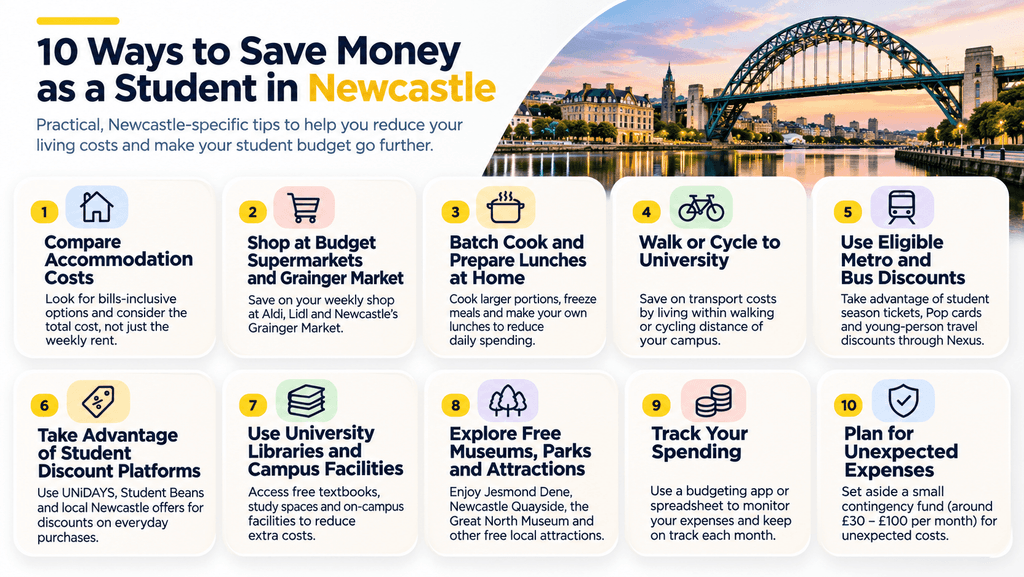
10 Ways to Save Money as a Student in Newcastle
Living on a student budget doesn’t mean missing out on everything Newcastle has to offer. Making informed accommodation choices, developing sensible spending habits and taking advantage of local student discounts can help your money go considerably further.
Here are 10 practical ways to reduce your student living expenses in Newcastle.
1. Compare Accommodation Costs With Bills Included
When comparing student accommodation, look beyond the advertised weekly rent. Electricity, heating, water, Wi-Fi and additional facilities can significantly affect your overall monthly expenditure.
Choosing bills-inclusive accommodation can make budgeting more predictable and reduce the risk of unexpected household expenses.
Read our guide to cheap student accommodation in Newcastle to understand how different accommodation options compare.
2. Shop at Budget Supermarkets and Grainger Market
Shopping at Aldi, Lidl and Newcastle’s Grainger Market can help keep your weekly grocery expenditure manageable.
Plan your meals before shopping, compare supermarket own-brand products, look for reduced-to-clear items and avoid relying on smaller convenience stores for your everyday essentials.
3. Batch Cook and Prepare Lunches at Home
Preparing several meals at once can reduce food waste, save time and help you avoid expensive last-minute takeaways.
Cooking larger portions and freezing individual meals is particularly useful during busy university periods. Preparing your own lunches instead of spending £6 per day on campus could also save approximately £800 over 40 weeks, assuming each homemade lunch costs £2.
4. Walk or Cycle to University Where Practical
Newcastle’s relatively compact city centre makes walking a practical option for many students attending Newcastle University and Northumbria University’s City Campus.
Choosing accommodation within walking or cycling distance of your university could reduce your monthly transport expenditure while saving time on your daily commute.
Students looking for an affordable second-hand bicycle can also explore Recyke y’bike.
5. Use Eligible Student Metro and Bus Discounts
If you regularly use public transport, investigate student season tickets, Pop cards and eligible young-person travel discounts through Nexus.
Compare individual journey prices with weekly, monthly and longer-term travel passes to determine which option offers the best value for your timetable and commuting requirements.
6. Take Advantage of Student Discount Platforms
Platforms such as UNiDAYS and Student Beans provide access to student discounts across clothing, technology, restaurants, entertainment and other everyday purchases.
Many Newcastle businesses also offer their own student promotions.
Remember that a discount only represents a genuine saving if you were already planning to make the purchase.
7. Use University Libraries and Campus Facilities
Before purchasing textbooks, software or specialist study resources, check what is available through your university library.
Newcastle University and Northumbria University provide academic resources, study spaces and digital learning facilities that can help reduce additional expenditure.
Students can also make use of available campus facilities, such as water refill stations and microwaves, to reduce the cost of food and drinks throughout the day.
8. Explore Free Museums, Parks and Cultural Attractions
Enjoying Newcastle doesn’t need to involve spending money every weekend.
Walking through Jesmond Dene, exploring Newcastle Quayside, visiting Exhibition Park or discovering exhibitions at the Great North Museum and Baltic Centre for Contemporary Art can provide affordable ways to spend time with friends.
University societies and Students’ Union events can also offer free or low-cost social opportunities throughout the academic year.
9. Track Everyday Spending Using a Budgeting App
Small purchases can quickly accumulate, particularly when paying for coffees, snacks, takeaways and entertainment.
Using a budgeting app, banking app or simple spreadsheet can help you understand where your money goes each month.
Set separate spending allowances for groceries, transport and socialising, and review your expenditure weekly rather than waiting until the end of the month.
10. Plan for Unexpected Expenses Before They Arise
Unexpected travel, replacement electronics, healthcare expenses and additional university costs can place pressure on even a carefully planned student budget.
Where possible, aim to set aside approximately £30 – £100 per month as a contingency fund, depending on your available income and financial circumstances.
Even building a small emergency fund gradually can provide greater financial flexibility throughout the academic year.
The most effective student budgeting habits are often the simplest: understanding your essential expenses, planning purchases in advance and making small, consistent savings.
By combining these habits with Newcastle’s affordable shopping options, accessible university campuses and free cultural attractions, students can enjoy a rewarding university experience without unnecessarily stretching their finances.
Bills-Inclusive Student Accommodation in Newcastle – Burgess House
Choosing the right student accommodation is one of the most important decisions when planning your university budget.
While finding an affordable weekly rent is important, understanding exactly what is included can make a significant difference to your overall living expenses, financial predictability and university experience.
At StudentFM, Burgess House offers independent studio living in Newcastle city centre, combining private living spaces with bills-inclusive accommodation and on-site facilities.
Make Your Student Budget More Predictable
Managing your finances at university can be considerably easier when you know how much your accommodation will cost each month.
With utility bills and Wi-Fi included in your rent, bills-inclusive student accommodation can help you avoid the uncertainty of fluctuating household expenses and the inconvenience of arranging separate utility accounts.
Having your own private kitchenette also gives you greater control over your food expenditure, making it easier to prepare meals, batch cook and reduce your reliance on takeaways.
On-site facilities can provide additional value. Access to an included gym, for example, could remove the need to budget for a separate fitness membership, while communal social spaces provide opportunities to relax and spend time with other students.
When comparing accommodation options, consider the overall value of your rent, including household bills, facilities, location and potential transport savings.
Independent Student Living at Burgess House
Located on St James’ Boulevard in Newcastle city centre, Burgess House offers self-contained private studios designed for students who value independence, privacy and convenience.
Accommodation features include:
- Self-contained, fully furnished private studios.
- Private kitchenette and en-suite bathroom.
- Dedicated study area and comfortable living space.
- Utility bills and Wi-Fi included in the rent.
- On-site gym.
- Cinema room.
- Communal lounge and social spaces.
The central location provides convenient access to Newcastle’s university campuses, supermarkets, shops, restaurants and public transport connections, helping students make the most of city-centre living.
Whether you’re moving away from home for the first time, relocating from overseas or returning for another academic year, Burgess House offers the opportunity to enjoy independent student living while keeping your accommodation expenses more predictable.
Planning your move to Newcastle for 2027/28? Explore our studio options, check the latest availability and discover what’s included in your rent.
View Burgess House student accommodation
Explore student accommodation in Newcastle

Looking for Bills-Inclusive Student Accommodation in Newcastle?
Explore private student studios at Burgess House, offering independent living, included utility bills and communal facilities close to Newcastle city centre.
Cost of Living in Newcastle for Students – FAQs
Students in Newcastle could expect to budget approximately £880 – £1,660 per month, excluding tuition fees. A balanced student budget of around £1,180 per month could cover accommodation, household bills, groceries, transport, socialising and other everyday expenses. Actual living costs will depend on your accommodation choices and lifestyle.
Yes, £1,000 per month could be enough for students who secure affordable accommodation and manage their everyday spending carefully. For example, paying £600 per month for bills-inclusive accommodation would leave £400 for groceries, transport, socialising and other essential expenses.
Newcastle is generally considered a relatively affordable UK student city, particularly compared with London. Its range of accommodation options, compact city centre, public transport connections, affordable supermarkets and free cultural attractions can help students manage their living expenses.
Based on our illustrative budgets for 2027/28, students could need approximately £204 – £383 per week, including accommodation and everyday living expenses. A balanced student lifestyle could require around £273 per week, depending on rental costs and personal spending habits.
Students could budget approximately £33 – £51 per week for groceries, equivalent to around £145 – £220 per month. Shopping at budget supermarkets, preparing meals at home and reducing food waste can help keep grocery expenditure manageable. Eating out and takeaways should be budgeted for separately.
A budget-conscious or balanced student could allocate approximately £330 – £530 per month after paying rent and household bills. This is equivalent to around £76 – £122 per week and could cover groceries, transport, socialising, personal expenses and a small contingency allowance.
Newcastle is generally more affordable than London, particularly when it comes to accommodation. Students may also benefit from lower costs for eating out, entertainment and fitness facilities. However, the amount an individual student could save depends on their accommodation, commuting requirements and lifestyle.
Households occupied entirely by qualifying full-time students are generally exempt from Council Tax. Different rules may apply when students live with non-students or study part-time. Students should confirm their eligibility with Newcastle City Council and provide evidence of their student status where required.
Yes. Newcastle’s compact city centre, extensive bus network and Tyne and Wear Metro make living without a car practical for many students. Those living close to Newcastle University or Northumbria University’s City Campus may also be able to walk or cycle to lectures, shops and entertainment venues.
International students could use the same estimated monthly living cost range of £880 – £1,660, excluding tuition fees, as a starting point. However, they should also budget for visa application fees, the Immigration Health Surcharge, international flights and initial relocation expenses. UK Student visa financial evidence requirements should be considered separately from actual living costs.
Bills-inclusive accommodation can make student budgeting more predictable by combining rent with household expenses such as electricity, heating, water and Wi-Fi. Accommodation with additional facilities, such as private kitchenettes and on-site gyms, may also help reduce other living expenses. Always compare the total cost and check exactly what is included before booking.
Based on our illustrative budgets, students could spend approximately £10,600 – £19,900 over 12 months, excluding tuition fees. A student following a balanced budget with a 44-week accommodation contract and nine months of everyday living expenses could spend approximately £11,379, before additional holiday expenditure and initial moving costs. Actual costs will depend on tenancy length and living arrangements.